Why Petaluma Homeowners Need Reliable Energy Storage Now
Home energy storage batteries in Petaluma, CA are essential for protecting your home during frequent PG&E outages and maximizing your solar investment under California’s NEM 3.0 policy. With Petaluma averaging 260 sunny days per year, battery storage systems help you capture excess solar energy during the day and use it when you need it most—during evening peak hours or unexpected Public Safety Power Shutoffs.
Quick Guide: Battery Storage Options We Install for Petaluma Homes
- Whole-home or partial-home backup configurations tailored to your electrical service
- Modular battery capacity that can expand as your needs change
- Smart load management to prioritize essential circuits during an outage
- Solar + battery integration for reliable self-consumption under NEM 3.0
If you live in Petaluma, you’re probably familiar with the frustration of PG&E’s Public Safety Power Shutoffs during wildfire season and the impact of time-of-use rates that spike when you need power most. Home energy storage batteries offer a practical solution: they store excess solar energy generated during Petaluma’s 260 sunny days each year, provide automatic backup power during grid failures, and help you shift usage away from peak demand hours.
Whether you already have solar panels or you’re considering a complete energy system upgrade, adding battery storage transforms your home from grid-dependent to energy-resilient. Learn more about energy storage batteries or explore our complete solar energy systems to get started.
I’m Karlo Jarina, and I lead the marketing efforts at Sustainable Living Builders, where I work daily with homeowners exploring home energy storage batteries in Petaluma, CA and throughout Sonoma County. My role gives me direct insight into how these systems protect homes during outages and support California’s renewable energy goals.
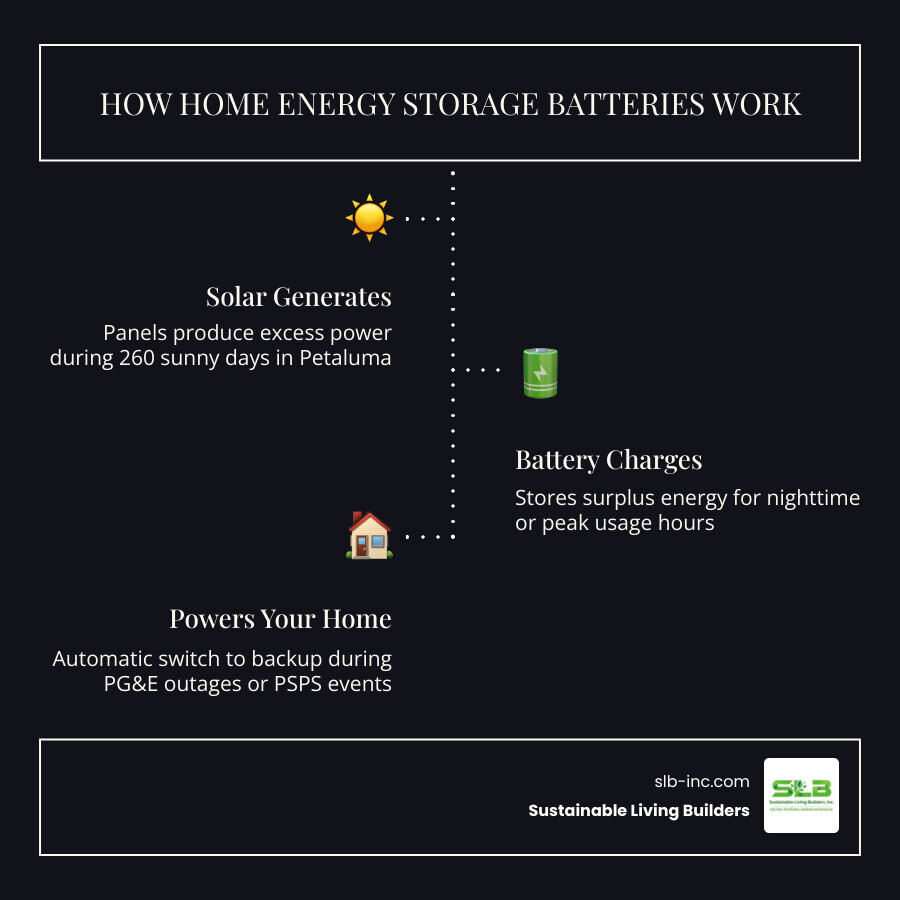
Why Home Energy Storage Batteries in Petaluma, CA are Essential
Living in Sonoma County means enjoying incredible landscapes, but it also means dealing with a power grid that is increasingly under stress. Grid reliability has become a major concern for us here in Petaluma. Between aging infrastructure and the rising threat of wildfires, the grid isn’t as dependable as it once was. This is where energy-storage-batteries come into play, acting as a personal “fuel tank” for your home’s electricity.
The shift to California’s NEM 3.0 (Net Billing Tariff) has also fundamentally changed the math for solar owners. In the past, you could send excess energy back to the grid for a decent credit. Now, those export credits have dropped significantly. To make solar-energy-systems truly effective today, you need to store that energy yourself rather than sending it back to the utility at a low return. By using stored energy during “Peak” Time-of-Use (TOU) hours—typically between 4 PM and 9 PM—you avoid the highest rate periods of the day.
Maximizing Solar Efficiency with Home Energy Storage Batteries in Petaluma, CA
Petaluma is blessed with an average of 260 sunny days per year. That is a lot of “free” fuel hitting your roof. Without a battery, any energy your solar-panels produce while you’re at work often goes to waste or is sent back to the utility at a low return.
When we install a battery system, we help you increase-home-energy-efficiency by ensuring that none of that sunshine is wasted. Your battery charges up during the morning and afternoon. When the sun goes down, your home seamlessly switches to battery power. This “self-consumption” model is the gold standard for modern energy independence. You aren’t just a solar producer; you’re your own mini-utility.
Protecting Your Home During PSPS Events
Public Safety Power Shutoffs (PSPS) have become a seasonal reality in Sonoma County. When the wind picks up and fire risk rises, PG&E may cut power to thousands of homes to prevent equipment-sparked fires. For many Petaluma residents, this isn’t just an inconvenience—it’s a safety issue.
If your home relies on a well pump for water or a septic system, a power outage means no running water and no flushing toilets. For those with critical medical devices like CPAP machines or oxygen concentrators, a battery is a literal lifesaver. Furthermore, keeping your refrigeration running prevents significant food spoilage. A properly configured battery system detects a grid failure instantly and “islands” your home, keeping your lights on while the rest of the neighborhood goes dark.
Battery Technology Options for Sonoma County Homeowners
Not all batteries are created equal. When selecting home energy storage batteries in Petaluma, CA, our team focuses on proven, homeowner-friendly battery technologies that perform well in our local climate and pair reliably with modern solar systems.
To get the most from your battery backup during an outage, many homeowners also choose to upgrade to a span-panel. This smart electrical panel helps you prioritize which appliances and circuits receive power, improving comfort and extending backup runtime.
The Benefits of LFP Home Energy Storage Batteries in Petaluma, CA
You might hear the term “LFP” a lot in the solar world. It stands for Lithium Iron Phosphate. This chemistry is widely used in today’s residential batteries because it is highly stable and well-suited for home installations.
LFP batteries are also designed for long service life and are typically backed by strong manufacturer warranties. Because they have no moving parts, they are generally low-maintenance compared to many traditional backup options.
Scalability and Modular Design
One of the biggest mistakes we see is homeowners installing a system that doesn’t match how they actually use energy. Modern systems are designed to be expandable.
This modularity is why we emphasize a house-electrical-panel-complete-guide. Your electrical panel is the heart of the system. Ensuring it is ready for future additions means your energy system can grow as your family or your energy needs (like a new EV) grow.
Choosing the Right Configuration for Your Energy Needs
How you set up your battery is just as important as which brand you choose. As experienced santa-rosa-solar-installers, we help you decide between three primary configurations:
- Whole-Home Backup: This setup aims to keep everything running—from your lights to your HVAC. It usually requires multiple battery units to handle the “surge” of starting large appliances.
- Critical Load Backup: We isolate your most important circuits (fridge, internet, a few lights, medical equipment) into a separate sub-panel. This ensures your battery lasts as long as possible during an extended outage.
- Load Shifting / Self-Consumption: If you rarely lose power but want to maximize your energy independence, this configuration focuses on storing solar energy during the day and discharging it during peak TOU hours to minimize your reliance on the grid.
Key Factors to Consider
- Capacity (kWh): Think of this as the size of the gas tank. It tells you how much total energy is stored.
- Power Rating (kW): This is the size of the pipe. It tells you how many appliances you can run at the exact same time.
- Depth of Discharge (DoD): This is the percentage of the battery that can be used safely. Most modern LFP batteries allow for 100% DoD.
- Round-Trip Efficiency: This measures how much energy is lost during the charging and discharging process. Higher is better (usually 90%+).
Incentives and Installation Requirements in Petaluma
Battery storage is a major home upgrade, and there are several home-energy-incentives that may be available to Petaluma homeowners depending on eligibility.
The Federal Investment Tax Credit (ITC) may apply to battery storage when installed according to program guidelines. California’s Self-Generation Incentive Program (SGIP) may also provide rebates for qualifying residents, with additional benefits potentially available for customers in designated areas or with qualifying medical needs.
When planning your project, it’s also important to consider roofing-in-petaluma-california. If your roof needs replacement in the near term, it can be beneficial to coordinate the roof work and the solar/battery installation so your system is installed on a long-lasting surface and avoids unnecessary disruption later.
Navigating NEM 3.0 and Utility Rates
Under NEM 3.0, the best-performing home solar setups often include battery storage to increase self-consumption—using more of your own solar energy on-site rather than exporting it.
Our team helps Petaluma homeowners design a system that stores daytime solar production and uses it during the evening, when household demand typically rises. This approach can improve energy resilience and reduce reliance on the grid during peak periods.
Frequently Asked Questions about Petaluma Battery Storage
Do solar batteries work during a PG&E PSPS event?
Yes! However, it requires a specific setup. Your system must have an “automatic transfer switch” or an “islanding” feature. Standard grid-tied solar systems actually shut off during a blackout to prevent back-feeding electricity into the grid and injuring utility workers. With a battery backup, your system disconnects from the grid and creates its own “microgrid,” allowing your solar panels to continue charging the battery even while the neighborhood is dark.
Can I add a battery to my existing solar panel system?
In most cases, yes. This is called “AC-coupling.” We can install a battery that works alongside your existing solar inverter. While it’s slightly more complex than installing everything at once, it is a very common way for Petaluma homeowners to upgrade their older systems for the new energy reality.
How long do home energy storage batteries typically last?
Most modern home batteries are rated for 10,000 cycles or 10 years, whichever comes first. In practical terms, this means the battery should retain about 70-80% of its original capacity after a decade of daily use. Because they have no moving parts, they are virtually maintenance-free—no oil changes or fuel stabilization required, unlike noisy gas generators.
Conclusion
At Sustainable Living Builders, we believe energy independence is becoming a necessity for modern California homes. By combining energy-efficient roofing, smart home tech, and home energy storage batteries in Petaluma, CA, we help you build a home that is as resilient as it is efficient.
Securing your home’s energy future means you’ll be better prepared for PSPS events and other outages—and you’ll have a system designed to make the most of your solar production day and night. We are here to guide you through every step, from the first site assessment to permitting and incentive paperwork.
Ready to secure your home’s energy future? Learn more about roofing in Petaluma, California and how we can integrate a complete energy storage solution for your family.