Why Skylight Options for California Homes Are Worth Getting Right
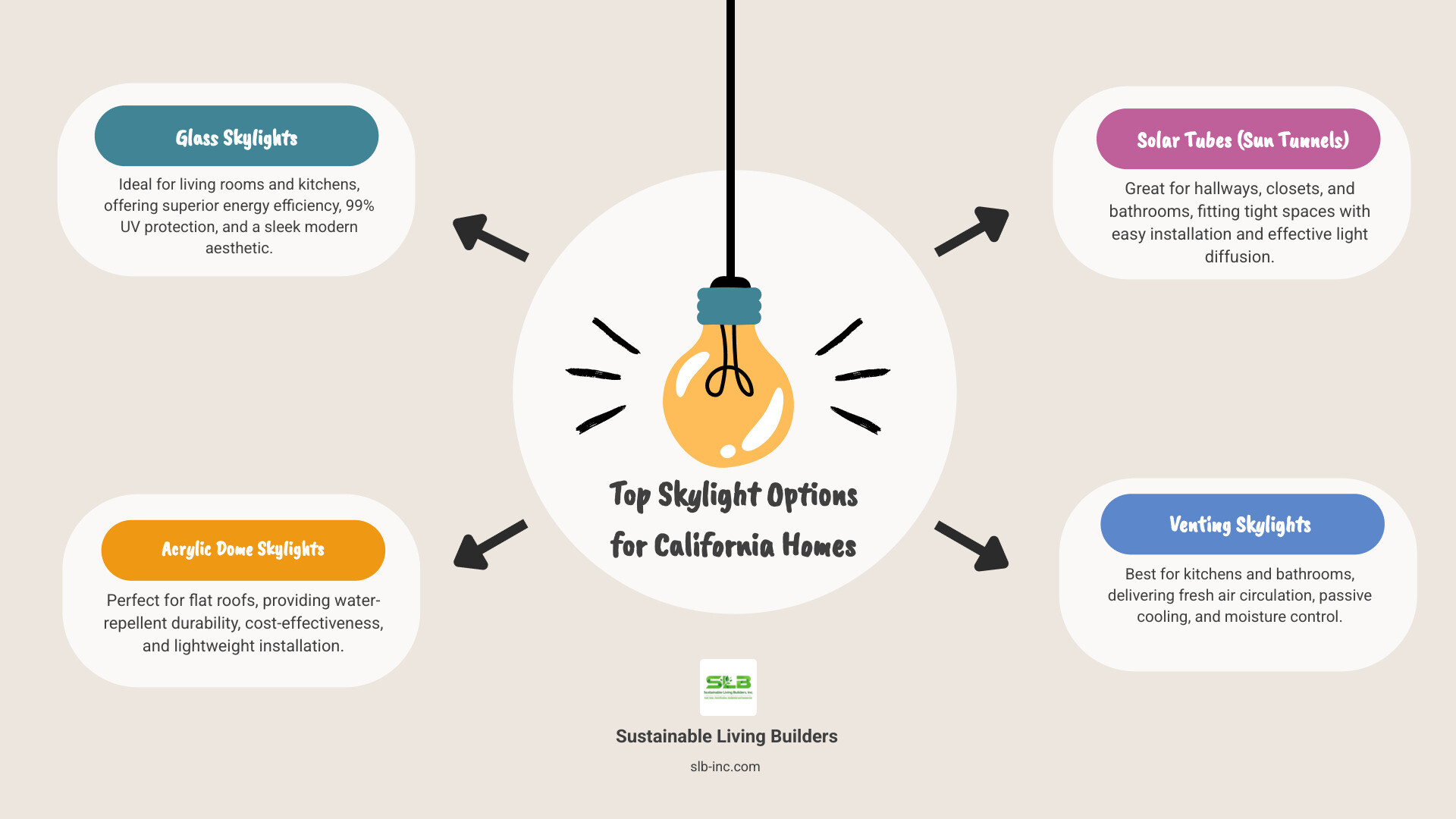
The best skylight options for California homes include:
| Skylight Type | Best For | Key Benefit |
|---|---|---|
| Glass skylights | Living rooms, kitchens | Energy efficiency, UV protection, sleek look |
| Acrylic dome skylights | Flat roofs, commercial spaces | Water-repellant, cost-effective |
| Solar tubes (sun tunnels) | Hallways, closets, bathrooms | Fits tight spaces, quick install |
| Fixed skylights | Low-traffic rooms, hallways | Simple, no moving parts |
| Venting skylights | Kitchens, bathrooms | Fresh air, passive cooling |
| Custom architectural skylights | Modern or luxury homes | Design impact, property value |
California gets more sunshine than almost anywhere else in the country. That’s a huge opportunity — but it also means choosing the wrong skylight can turn a bright idea into a hot, faded, or leaky problem.
The good news is that today’s skylights are engineered specifically for climates like California’s. Whether you’re dealing with the intense inland heat of the Inland Empire, the marine layer of the Bay Area, or the dry warmth of Southern California, there’s a skylight built for your conditions. The right choice brings in natural light, cuts your energy bills, and even helps your home stay cooler without cranking the AC.
Beyond comfort, California has its own set of rules. Title 24 energy standards, seismic safety requirements, and wildfire zone considerations all shape what you can — and should — install. Getting this right from the start saves you from costly fixes down the road.
I’m Karlo Jarina, and through my work in marketing for Sustainable Living Builders, I’ve spent considerable time researching skylight options for California homes to help homeowners make smarter, more sustainable choices. In the sections ahead, I’ll walk you through everything you need to know to find the right fit for your home.
I’m looking for the best skylight options for California homes. What should I consider?
When we start talking about the best skylight options for California homes, we aren’t just looking at a hole in the roof. We are looking at advanced daylighting systems designed to handle our unique West Coast geography. From the fog-drenched mornings in Sebastopol to the blazing afternoons in Napa, your choice of material and style dictates your home’s comfort level.

Glass Skylights
Glass is the gold standard for clarity and durability. In California, we highly recommend 5/8″ thick dual-laminated glass. Why? Because California earthquake codes require it. Laminated glass has a thin interlayer that holds the shards together if the pane ever breaks, keeping your family safe. Furthermore, modern glass units feature LoE3 coatings that block up to 99% of UV light. This is crucial for protecting your hardwood floors and furniture from the relentless California sun.
Acrylic Domes
If you have a flat roof—common in many mid-century modern homes in Sonoma and Marin—acrylic domes are a fantastic choice. Their curved “bubble” shape allows rainwater to flow off naturally, preventing the water ponding that can lead to leaks. For the best insulation, we always suggest double-domes, which create an insulating air gap between the layers.
Solar Tubes (Sun Tunnels)
Sometimes you want light in a space where a traditional skylight won’t fit, like a hallway or a small laundry room. This is where Skylights Sun Tunnels shine. These use a highly reflective rigid tube to channel sunlight from your roof down into your ceiling. They are incredibly efficient and can often be installed in just a few hours. There are many Reasons To Get Skylights And Sun Tunnels For Your Home, ranging from mood improvement to massive energy savings.
Which venting skylight options for California homes provide the best airflow?
In the heat of a California summer, heat rises and gets trapped against your ceiling. This is known as the “stack effect.” Venting skylights act like a chimney, allowing that hot air to escape while drawing cooler air in through your lower windows.
For those looking for the ultimate in convenience, solar-powered venting skylights are a game-changer. These units use a small solar panel to charge an internal battery, meaning they require no complex electrical wiring during installation. Many come equipped with rain sensors that automatically close the unit at the first sign of a drizzle—a must-have for those unpredictable North Bay winters.
If you are upgrading a humid area, a Bathroom Skylight With Exhaust Fan or a Kitchen Roof Window can significantly improve indoor air quality by removing steam and cooking odors far more effectively than a standard wall fan.
Are there custom architectural skylight options for California homes that fit modern designs?
California architecture is diverse, and sometimes a standard rectangle just won’t cut it. Custom architectural skylights can turn a functional necessity into a stunning focal point.
- Pyramid and Octagon: These add height and drama to entryways or master suites.
- Hip-Ridge: Perfect for following the peak of a gabled roof, flooding the entire length of a room with light.
- Lean-To: These span between two walls, often used in home extensions or sunrooms.
These custom designs usually feature robust aluminum frames and can be fitted with the same high-performance Roof Window glass used in standard models, ensuring that style doesn’t come at the expense of energy efficiency.
Essential Features for the California Climate and Building Codes
Living in the Golden State means adhering to some of the strictest building codes in the country, specifically Title 24. These standards are designed to reduce energy consumption, and your skylight plays a big role.
Energy Efficiency Features
To meet these standards and keep your home comfortable, we look for three key features:
- LoE3 Coatings: This triple-layer silver coating reflects infrared heat back outside while letting visible light through. It can block 99.9% of UV rays on large custom units.
- Argon Gas Fills: Replacing the air between glass panes with argon gas provides superior insulation, keeping the heat out in the summer and the warmth in during those chilly Santa Rosa nights.
- Solar Heat Gain Coefficient (SHGC): For our inland regions, we look for an SHGC between 0.22 and 0.35 to manage solar heat effectively.
| Feature | Benefit | Importance for CA |
|---|---|---|
| LoE3 Coating | Blocks 99% UV Light | High – Protects interiors from sun damage |
| Laminated Glass | Safety / Impact Resistance | Mandatory – Required by earthquake codes |
| Argon Gas | Thermal Insulation | High – Reduces AC and heating costs |
| Rain Sensor | Automatic Closing | Medium – Great for coastal weather changes |
Beyond the glass, there are 4 Benefits Of Installing Skylights In Your Home that go beyond just saving money, including increased home value and better mental well-being thanks to natural circadian rhythms.
Installation Styles and Roof Compatibility for West Coast Houses
How a skylight is attached to your roof is just as important as the skylight itself. In California, we typically see two main mounting styles.
Deck-Mounted vs. Curb-Mounted
A Deck Mounted Skylight is nailed directly to the roof deck. It has a lower profile, making it less visible from the street, which many homeowners in Marin and Sonoma prefer for aesthetic reasons. It’s highly energy-efficient because it’s “hugged” by the roof’s insulation.
Curb-mounted skylights, on the other hand, sit on a wooden frame (the curb) that is built around the roof opening. These are the preferred choice for flat roofs or for replacing older units. They are incredibly versatile and make future replacements much easier because you don’t have to disturb the surrounding roofing material.
Tile and Flat Roof Integration
Many homes in our service area feature beautiful Spanish tile roofs. These require specialized flashing kits to ensure a weathertight seal. For flat roofs, which are prone to water pooling, we ensure the skylight is either a dome style or mounted on a sloped curb to encourage drainage.
Smart Technology and Sustainable Trends for 2026
As we move through 2026, skylights are becoming part of the “smart home” ecosystem. We are seeing a huge trend toward automation that helps maintain a sustainable lifestyle.
One of the most exciting developments is smart pre-cooling. Your skylights can be programmed to open in the early morning to let in the cool California air and close automatically as the temperature rises. Combined with solar-powered shades, you can control exactly how much light and heat enters your home without ever touching a ladder.
Even better, many of these solar-powered options—including the venting systems and the shades—are eligible for a 30% federal tax rebate. This makes choosing a sustainable, high-tech option much more accessible. When you combine this with industry-leading warranties—such as 20 years on glass and 10 years on installation—you’re making a long-term investment in your home’s future. For smaller spaces, a Bathroom Sun Tunnel can provide that same eco-friendly light without the need for any electrical power at all.
Frequently Asked Questions about California Skylights
How do I choose the right skylight size for my room?
A good rule of thumb is the “5% to 15% rule.” If your room already has several windows, the skylight should be about 5% of the floor’s square footage. If the room has no windows, aim for 15%. For example, a 100-square-foot bathroom with no windows would benefit perfectly from a 15-square-foot skylight (or a large sun tunnel). Also, consider your ceiling height; rooms with ceilings over 18 feet may require larger units to ensure the light reaches the living space effectively.
What qualities should I look for in a skylight product or manufacturer for California homes?
You want a manufacturer that understands the West Coast. Look for brands that offer dual-laminated glass as a standard to meet seismic codes. Ensure they have high energy-efficiency ratings (Energy Star certified) and provide robust warranties. Local availability is also key; standard glass units usually have a 4-5 week lead time, while custom architectural pieces might take 6-8 weeks.
How do I prevent leaks and maintain my skylight in varied weather?
Maintenance is simple but vital. We recommend an annual inspection to remove debris—like leaves or pine needles—that can trap water against the flashing. Check the sealant integrity and look for any signs of condensation between the panes, which could indicate a seal failure. If you’re in an area like Sebastopol with lots of trees, keeping your roof clear is the best way to prevent leaks. If you ever notice a drip, it’s best to Find Local Companies That Can Install A New Roof Window In Sebastopol to handle the repair before it damages your drywall.
Conclusion
Choosing the right skylight options for California homes is about more than just aesthetics; it’s about creating a sustainable, comfortable, and safe environment for your family. At Sustainable Living Builders, we believe in a holistic approach to home improvement. Whether you are looking for the sleek lines of a deck-mounted glass unit or the innovative efficiency of Skylights Sun Tunnels, our goal is to help you reduce your carbon footprint while soaking up that beautiful California sun.
Our team, including our expert advisor Sunny, is dedicated to helping homeowners in Santa Rosa, Sebastopol, and throughout Sonoma, Marin, and Napa Counties find the perfect fit. By focusing on energy-efficient roofing and smart home integration, we ensure your home is ready for whatever the 2026 climate brings. Ready to brighten your life? Let’s find the perfect light for your home.