Why the Fire Resistance Metal vs Shingle Comparison Matters for Santa Rosa Homeowners
When it comes to protecting your home from wildfire, the fire resistance metal vs shingle comparison is one of the most important decisions you’ll make as a homeowner in a fire-prone region like Santa Rosa.
Here’s a quick breakdown of how the two materials stack up on fire safety:
| Factor | Metal Roofing | Asphalt Shingles |
|---|---|---|
| Fire Rating | Class A (inherently non-combustible) | Class A, B, or C (varies by product and underlayment) |
| Ignition Risk | Does not ignite or burn | Can ignite; risk increases as shingles age and dry out |
| Ember Resistance | High — embers cannot penetrate or ignite metal | Moderate — embers can lodge in gaps or ignite aging shingles |
| Performance Over Time | Maintains fire resistance for 40–70 years | Fire resistance can decline as shingles dry and degrade |
| Weight (Firefighter Safety) | Under 100 lbs per square — safer roof entry | Can exceed 1,000 lbs per square for shingle and tile roofs |
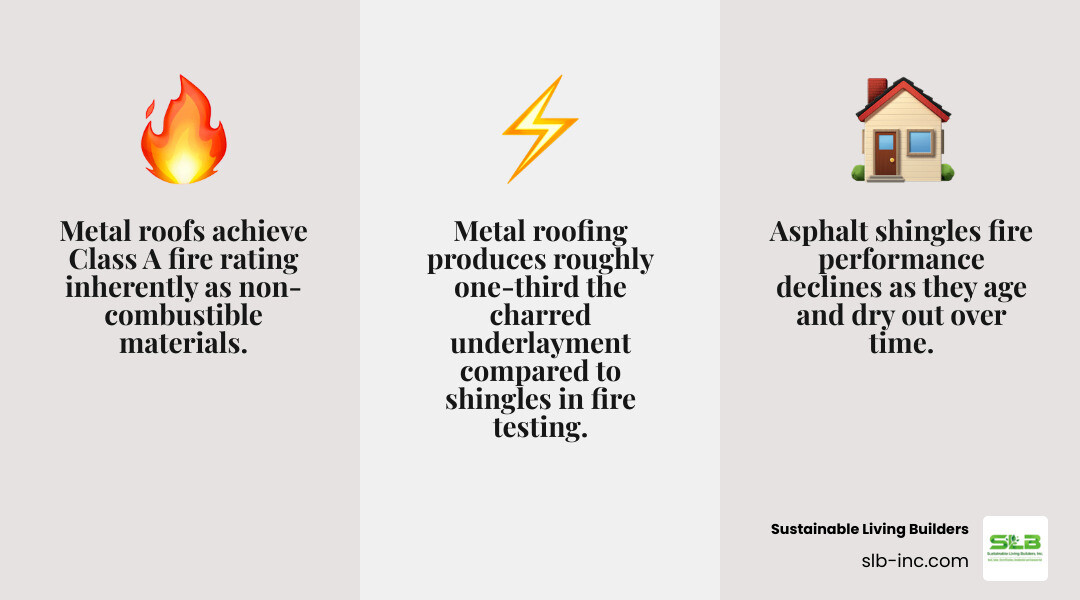
The stakes are real. According to Verisk, over 4.5 million U.S. homes sit in high or extreme wildfire risk zones. Academic fire testing at high-elevation conditions found that metal roofing produced roughly one-third the amount of charred underlayment compared to asphalt shingles — a meaningful difference when embers are landing on your roof during a wildfire event.
Beyond raw fire performance, this comparison also touches on energy efficiency, lifespan, insurance premiums, and long-term sustainability — all priorities for homeowners who want smarter, greener choices for their homes.
This guide walks you through exactly how to evaluate both materials so you can make a confident, informed decision.
How to Evaluate Fire Ratings in a Fire Resistance Metal vs Shingle Comparison
The first step in any fire resistance metal vs shingle comparison is understanding what the fire rating actually means.
Roofing products are commonly tested and classified as:
| Fire Rating | What It Means | Typical Use |
|---|---|---|
| Class A | Highest fire resistance | Best choice for wildfire-prone areas |
| Class B | Moderate fire resistance | Better than basic protection, but not top tier |
| Class C | Basic fire resistance | Lowest rated option commonly allowed |
| Unrated | No verified fire performance | Poor fit for high-risk areas |
For homes in Santa Rosa, Sonoma County, Marin County, and Napa County, Class A roofing is the benchmark homeowners should pay attention to first. In wildfire-prone areas, the roof is often exposed not just to direct flame, but to wind-blown embers, radiant heat, and debris buildup. That is why the rating alone matters, but the way the roof achieves that rating matters too.
A quick but important nuance: a Class A roof system is a system. That means the visible roof covering, underlayment, deck assembly, flashings, vents, and edge details all affect real-world performance. A great material installed poorly is a bit like buying a fire extinguisher and leaving it in the garage still in the box.
If you want a broader overview of safer materials, our guide to fire-resistant roofing products is a useful companion.
How Metal Roofs Achieve Class A Status in a Fire Resistance Metal vs Shingle Comparison
Metal roofs have a major advantage because the material itself is non-combustible. Steel and aluminum roof panels do not serve as fuel for a fire. That does not make a home fireproof, of course, but it does mean the roof covering is less likely to ignite when exposed to embers or flames.
In practical terms, metal roofing performs well in wildfire conditions because:
- Flying embers cannot easily burn through the panel surface
- Smooth panel profiles can reduce places where debris accumulates
- Properly detailed seams and flashings can limit ember intrusion
- The material does not dry out, curl, or become more combustible with age
This is especially relevant for standing seam systems, which use raised interlocking seams and concealed fasteners. These systems are often preferred when homeowners want both strong fire performance and long service life. You can learn more in our standing seam metal roof guide.
Material choice within metal also matters. Steel is widely valued for strength and fire performance, while aluminum brings strong corrosion resistance, which can be useful in parts of Marin and Sonoma counties with marine influence. Our aluminum metal roofing guide explains where aluminum fits best.
Fire Resistance Metal vs Shingle Comparison: Asphalt Performance
Asphalt shingles are more complicated. Some asphalt shingle systems can achieve a Class A fire rating, especially fiberglass-based products installed with the correct fire-resistant underlayment. Others are only Class B or Class C. So when people say “shingles are Class A,” that is only sometimes true.
In general:
- Fiberglass asphalt shingles offer better fire performance than older organic asphalt products
- The fire rating can depend on the full tested assembly, not just the shingle itself
- Aging, cracking, granule loss, and drying can reduce real-world fire performance over time
- Gaps, lifted tabs, and roof penetrations can create ember entry points
That does not mean shingles are automatically unsafe. Many modern asphalt shingle roofs can be code-compliant and reasonably fire resistant when properly chosen and installed. But compared head-to-head, metal usually offers stronger inherent resistance because it is not a fuel source.
If you are comparing roof types more broadly, see our pages on shingle roofs and the benefits of shingle roofing.
Step 1: Assessing Material Durability and Lifespan for Wildfire Zones
Fire resistance is not only about day-one performance. It is also about how the roof holds up after years of sun, wind, rain, debris, and temperature swings.
That is where lifespan becomes a big part of the decision.
Metal roofs commonly last 40 to 70 years. Asphalt shingles more commonly fall in the 15 to 30 year range, depending on product quality, installation quality, roof ventilation, and local exposure. In North Bay conditions, that difference matters because repeated weathering can affect how well the roof resists ember intrusion and ignition over time.
Longer lifespan helps fire safety in a few ways:
- Fewer replacement cycles mean fewer chances for aging roofs to remain in service too long
- Less cracking, curling, and surface deterioration can reduce weak spots
- A roof that stays intact longer tends to maintain its tested performance better
- Fewer reroofing projects mean fewer periods when the home is temporarily more exposed
For homeowners evaluating long-term durability, these are useful benchmarks:
- Metal roofing: typically 40 to 70 years
- Asphalt shingles: typically 15 to 30 years
You can explore this further in how long do metal roofs last? and our shingle roof lifespan guide.
Durability in wildfire zones also overlaps with other hazards that often show up at the same time, especially in California:
- Wind uplift resistance
- Hail and impact resistance
- UV exposure
- Pest intrusion at roof edges and vents
- Moisture resistance after smoke, ash, or suppression efforts
Metal often performs especially well in wind and weather. Many modern systems are engineered for high wind performance, and standing seam profiles can offer excellent panel security. Shingles can also perform well, particularly premium architectural products, but they are more vulnerable to losing tabs, granules, or full sections in severe weather as they age.
If you want a wider durability overview, our article on the most durable roofing materials for California’s climate is a strong next read.
Step 2: Comparing Energy Efficiency and Environmental Sustainability
A roof does more than resist fire. It also affects attic temperature, cooling demand, material waste, and the home’s overall environmental footprint.
This is one of the biggest reasons many homeowners in Santa Rosa, Sebastopol, Sonoma County, Marin County, and Napa County look closely at metal roofing. Reflective metal roof systems can reduce solar heat gain, especially in warm, sunny conditions. Research commonly shows cooling savings in the 10% to 25% range for reflective metal roofing compared with darker, heat-absorbing roofs.
That matters for comfort, but also for resilience:
- Cooler attics put less strain on HVAC systems
- Lower indoor heat gain can improve comfort during hot spells or outages
- Reflective surfaces can support a more energy-efficient home overall
Metal roofing also tends to perform well from a sustainability standpoint:
- It often contains recycled content
- It is fully recyclable at end of life
- Its long service life reduces replacement waste
- It pairs well with solar installations due to durability and service life alignment
Asphalt shingles still have their place, but they usually absorb more heat and are replaced more often. That means more material moving through the waste stream over time. In the U.S., asphalt roofing contributes millions of tons of landfill waste annually, which is one reason sustainability-minded homeowners often lean toward metal.
If environmental impact is a priority, read more about recycled metal roofing and the advantages of sustainable roofing.
For a broader homeowner overview, our guide to metal roofing for your home explains how performance, efficiency, and longevity work together.
Step 3: Implementing Maintenance Practices for Long-Term Fire Safety
Even the best roofing material needs maintenance. A Class A roof covered in dry leaves is still not a great fire strategy.
Whether you choose metal or shingles, maintenance is what helps preserve fire-resistant performance year after year.
Seasonal roof fire-safety checklist:
- Remove leaves, pine needles, and twigs from roof valleys
- Clean metal gutters and downspouts regularly
- Trim tree branches back from the roofline
- Inspect flashing, vents, skylights, and edge metal for gaps
- Check for loose or damaged ridge caps
- Replace damaged shingles promptly
- Confirm that underlayment and exposed details remain intact after storms
- Clear combustible debris around eaves and around the home’s perimeter
Metal roofs generally require less maintenance than shingles, but they are not maintenance-free. We still recommend regular inspections to look for:
- Loose fasteners on exposed-fastener systems
- Sealant failure at penetrations
- Corrosion at scratches or cut edges
- Debris trapped behind chimneys or wall transitions
Shingle roofs need a bit more attention because their surface can change more over time. Watch for:
- Curling or cracked tabs
- Granule loss
- Exposed asphalt
- Moss or algae growth
- Wind-lifted sections where embers could enter
In wildfire-prone parts of the North Bay, maintenance around vents and roof-to-wall transitions is especially important. Embers often exploit the smallest openings. Good housekeeping on and around the roof is not glamorous, but it is one of the cheapest ways to protect the home. Not exciting, no. Effective, absolutely.
Frequently Asked Questions about Fire-Resistant Roofing
Do metal roofs attract lightning during Santa Rosa storms?
No. Metal roofs do not attract lightning simply because they are metal. Lightning strikes the highest or most conductive path in a storm environment, not the “shiniest roof in the neighborhood.” If lightning were picking roofs based on style, every weather vane would be in trouble.
A metal roof can actually be beneficial from a fire-safety perspective because it is non-combustible. If a strike occurs, the roof covering itself is less likely to ignite than combustible materials.
Can I install a metal roof over existing shingles for better fire protection?
Sometimes, yes, but it depends on local code requirements, roof condition, deck integrity, ventilation, and manufacturer rules. In some cases, overlay installations are allowed. In others, a full tear-off is the better choice for performance and inspection access.
For wildfire resilience, we generally encourage homeowners to think beyond convenience and focus on the full roof assembly:
- Is the decking sound?
- Are there hidden moisture issues?
- Will the new system have proper underlayment and flashing?
- Will the assembly meet local code and manufacturer requirements?
A properly designed system matters more than simply putting one material on top of another.
How do insurance companies view fire-resistant roofing materials in 2026?
Insurance carriers often look favorably on roofing materials that improve resistance to fire, wind, and storm damage. In 2026, many insurers continue to offer policy credits or premium discounts for certain roof upgrades, though eligibility varies by carrier, home location, and the full roofing system.
In high fire-risk regions, a Class A roof can be especially important for underwriting. Metal roofing may also appeal to insurers because it combines fire resistance with strong wind durability and long service life.
The key steps are:
- Ask your insurer what roof classifications they recognize
- Confirm whether Class A documentation is required
- Keep records of product specifications and installation details
- Work with an experienced contractor who understands code-compliant assemblies
Conclusion
If your top priority is evaluating fire safety performance, the answer in most cases is straightforward: metal roofing usually delivers the stronger overall result in a fire resistance metal vs shingle comparison.
That advantage comes from several factors working together:
- Inherent non-combustibility
- Strong ember resistance
- Long lifespan
- Lower maintenance burden
- Better energy efficiency potential
- Strong sustainability and recyclability benefits
That said, some asphalt shingle systems can still be a reasonable option when they are Class A rated, properly installed, and carefully maintained. The right choice depends on your home’s wildfire exposure, roof design, long-term plans, and resilience goals.
At Sustainable Living Builders, we help homeowners evaluate roofing as part of a bigger system that includes durability, efficiency, sustainability, and resale value. If you want to compare materials more deeply, start with our guide to roofing materials explained: pros, cons, uses.
And if you are ready to plan a safer, smarter roofing upgrade, explore our tools and talk with our team. Our Smart Roof Calculator can help you think through the next step, and if your property needs a larger-scale solution, you can also contact our experts for commercial roofing in Santa Rosa.