Why Natural Light Is One of the Most Powerful Forces for Your Health and Wellbeing
Understanding how natural light improves your health and wellbeing starts with a simple truth: your body was built for sunlight. Here is a quick summary of the key benefits:
- Boosts vitamin D production – supports bone density, immunity, and heart health
- Regulates your circadian rhythm – keeps your internal 24-hour clock on track
- Improves sleep quality – morning light cues your brain to release melatonin at the right time at night
- Lifts your mood – triggers serotonin and dopamine, reducing depression and anxiety
- Sharpens focus and productivity – workers with natural light report 6% higher productivity and 15% more creativity
- Reduces eye strain – daylit offices saw an 84% drop in headaches and blurred vision
- Supports disease prevention – adequate sun exposure is linked to lower risks of multiple sclerosis, certain cancers, and cardiovascular disease
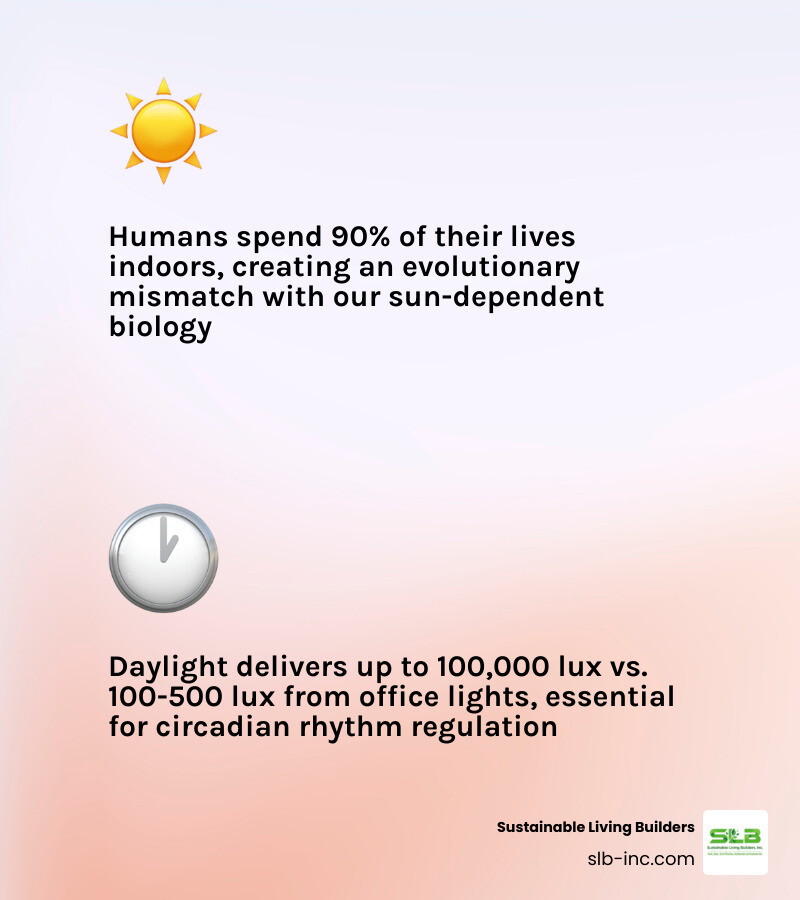
For thousands of years, human life revolved around the sun. Our biology evolved to depend on it — from the hormones we produce to the way our brains regulate mood and energy. But today, we spend close to 90% of our lives indoors. That gap between how we evolved and how we actually live has real consequences for our physical and mental health.
The research is clear: this is not just about feeling cheerful on a sunny day. Natural light drives fundamental biological processes that artificial lighting simply cannot replicate. Daylight delivers up to 100,000 lux of light intensity. A typical office fluorescent fixture delivers around 100 to 500 lux. That is not a small difference — it is the difference between a fully functioning body clock and one that is constantly out of sync.
An estimated 1 billion people worldwide are vitamin D deficient. About 6% of the population suffers from Seasonal Affective Disorder (SAD), and another 14% experience what is commonly called the “winter blues.” These are not minor inconveniences. They are signs that our modern indoor lifestyle is working against our basic biological needs.
The good news is that even small, intentional changes in how you access natural light — especially at home — can make a measurable difference. That is what this guide is here to help you understand.
I’m Karlo Jarina, marketing lead at Sustainable Living Builders, where I focus on helping homeowners find sustainable solutions that improve both their living spaces and their quality of life — including understanding how natural light improves your health and wellbeing through smarter home design. In the sections ahead, we will walk through the science, the practical strategies, and the home improvements that can help you get more of the light your body needs.
The Biological Power of the Sun: Vitamin D and Beyond
When we talk about the sun, the first thing that usually comes to mind is Vitamin D. Often called the “sunshine vitamin,” it isn’t actually a vitamin at all—it’s a hormone that our skin synthesizes when exposed to UVB rays. This process is the most efficient way to maintain healthy levels, far surpassing what we can typically get from diet alone.
Research shows that there are 4 Benefits Of Installing Skylights In Your Home, and chief among them is the consistent access to the UV rays needed for this synthesis. Vitamin D is the silent architect of our bodies; it is essential for calcium absorption, which maintains bone density and prevents conditions like rickets in children or osteoporosis in adults. But its reach goes further. It modulates our immune system, helping us fight off infections and even reducing the risk of autoimmune diseases like multiple sclerosis.
Beyond Vitamin D, sunlight triggers the release of nitric oxide in our skin. This molecule helps dilate blood vessels, which can lower blood pressure and improve overall cardiovascular health. Despite these massive benefits, we are currently facing a global “shadow” pandemic: an estimated 1 billion people worldwide have vitamin D deficiency or insufficiency. In regions like Sonoma and Marin County, where we might spend more time indoors during the cooler months, ensuring your home harvests as much light as possible is vital.
| Feature | Vitamin D from Sunlight | Vitamin D from Supplements |
|---|---|---|
| Source | Natural UVB synthesis in skin | Synthetic or sheep-wool derived |
| Overdose Risk | None (body self-regulates) | Possible with high doses |
| Additional Perks | Nitric oxide & serotonin boost | None |
| Efficiency | High (5-30 mins exposure) | Variable absorption rates |
How natural light improves your health and wellbeing through better sleep
It might seem counterintuitive, but the quality of your sleep tonight depends heavily on the light you see tomorrow morning. This is because of your circadian rhythm—the internal 24-hour clock that regulates when you feel alert and when you feel drowsy.

When bright natural light hits your retinas in the morning, it sends a clear signal to your brain to stop producing melatonin (the sleep hormone) and start producing cortisol (the alertness hormone). This “morning spike” sets a timer in your brain. Roughly 15 hours after that first exposure to bright light, your body will naturally begin to produce melatonin again, making it easier to fall asleep.
Installing a Deck Mounted Skylight in a bedroom or hallway ensures you get that vital morning “reset” even on days when you stay indoors. Studies have shown that office workers with more exposure to natural light sleep an average of 46 minutes more per night than those in windowless environments. By maximizing daylight, you reduce “sleep latency”—that frustrating time spent tossing and turning—and improve the overall depth of your rest. This is especially important in our modern world, where the blue light from our phones at night tries to trick our brains into thinking it’s still daytime. Morning sunlight is the best “antidote” to evening artificial light.
Mental Health, Mood Regulation, and Cognitive Performance
Have you ever noticed how your mood instantly lifts when you step outside on a clear day? That isn’t just a psychological “feeling”—it’s a chemical reaction. Sunlight exposure increases the brain’s release of serotonin, a hormone associated with boosting mood and helping a person feel calm and focused.
Without enough light, serotonin levels can drop, which is a primary trigger for Seasonal Affective Disorder (SAD). While SAD affects about 6% of the population, a much larger group (14%) deals with the “winter blues,” characterized by low energy and irritability during shorter days. Adding a Roof Window to your living space can provide the consistent “light therapy” needed to keep these symptoms at bay.
Furthermore, natural light helps regulate dopamine, which is responsible for our sense of pleasure and motivation. By managing our cortisol levels through regular light cycles, we also reduce overall stress and anxiety. In fact, 75% of people with anxiety disorders report that fluorescent lighting actually worsens their symptoms, whereas natural light provides a soothing, full-spectrum alternative.
Boosting focus: how natural light improves your health and wellbeing at work
As we move into 2026, the “home office” has become a permanent fixture for many in Napa and Sonoma County. If you’re working from home, the placement of your desk relative to a window is one of the most important “productivity hacks” available.
Workers in environments with natural elements like sunlight report a 15% higher level of creativity and a 6% higher level of productivity. It isn’t just about “feeling good”—it’s about how your eyes and brain function. Natural light reduces eye strain by up to 84%, significantly cutting down on the headaches and blurred vision that come from staring at screens under harsh artificial lights. If your current workspace feels like a cave, it might be time to Find Local Companies That Can Install A New Roof Window In Sebastopol to brighten your professional life.
Architectural Wellness and Healthier Building Design
At Sustainable Living Builders, we believe that a home should do more than just provide shelter; it should actively contribute to your health. This is the core of “wellness architecture.” One of the most overlooked benefits of natural light is its role in sanitation.
Dark, damp corners are breeding grounds for mould and mildew, which can trigger respiratory issues and allergies. Sunlight, specifically UV radiation, acts as a natural disinfectant. By installing a Kitchen Roof Window, you bring direct light into areas prone to moisture, helping to keep your air cleaner. Similarly, a Bathroom Skylight With Exhaust Fan combines the power of ventilation with the antimicrobial properties of the sun.
From an energy perspective, “daylighting”—the strategic use of windows and skylights—reduces the need for electric lighting, which can account for a third of a building’s energy bill. Modern thermal glazing allows us to harvest this light without losing heat in the winter or overheating in the summer, making your home more energy-efficient and moving us closer to carbon-neutral living.
Designing for life: how natural light improves your health and wellbeing indoors
You don’t always need to move walls to increase the light in your home. There are several Reasons To Get Skylights And Sun Tunnels For Your Home, but you can also maximize the light you already have through smart interior choices:
- Mirror Placement: Place mirrors directly opposite windows to bounce sunlight into the darker corners of a room.
- Reflective Surfaces: Use eggshell or satin paint finishes rather than matte. These have a slight sheen that reflects light back into the space.
- Light-Colored Rugs: Dark floors absorb light; light-colored rugs help keep the “luminous energy” bouncing around the room.
- Ditch Heavy Drapes: Swap thick, dark curtains for sheer fabrics that provide privacy while still letting the sun’s rays through.
Practical Strategies for Increasing Daily Light Exposure
Even with the best home design, getting enough light requires a few healthy habits. We recommend a “light first” approach to your morning.
Try to get 10-20 minutes of daylight as soon as possible after waking up. Even an overcast day in Santa Rosa provides significantly more lux than the brightest indoor bulb. If you have a dark hallway or a windowless bathroom, a Bathroom Sun Tunnel can bring in natural light from the roof through a highly reflective tube, transforming a “dead” space into a bright, healthy one.
Sunny’s Expert Tip: “If you can’t get outside for a walk, try to eat your breakfast or drink your coffee right by your largest window. The goal is to get that morning light into your eyes early to set your internal clock for the next 24 hours!”
Frequently Asked Questions about Natural Light
How much daily sun exposure is recommended for Vitamin D?
For most people, 5 to 15 minutes of sun exposure on the arms and legs, two to three times a week, is sufficient to maintain vitamin D levels. However, this varies. If you have darker skin, you may need up to 30 minutes, as melanin acts as a natural filter. The most efficient time is midday when UVB rays are strongest, but always be mindful of your skin’s sensitivity.
Can you get the benefits of natural light through a window?
Yes and no. Most standard glass blocks the majority of UVB rays, meaning you won’t produce much Vitamin D while sitting behind a closed window. However, the visible light spectrum still passes through, which is what regulates your circadian rhythm, boosts serotonin, and improves your mood. So, while a window won’t help your bone density much, it will definitely help your mental health!
What are the best ways to combat Seasonal Affective Disorder (SAD)?
The gold standard for treating SAD is light therapy using a 10,000-lux lightbox for about 30 minutes each morning. However, structural changes to your home, like adding skylights or larger windows, provide a more permanent and “passive” solution that works year-round without you having to sit in front of a lamp.
Conclusion
At Sustainable Living Builders, we are passionate about the intersection of home efficiency and human health. As we look toward the remainder of 2026, the trend is clear: we are moving away from “cubicle living” and back toward environments that honor our biological need for the sun.
Whether it’s through a simple interior refresh or installing high-performance Skylights Sun Tunnels, increasing the natural light in your home is one of the most effective investments you can make in your long-term wellbeing. By aligning your living space with the natural rhythms of the day, you aren’t just saving on energy—you’re powering your own body and mind.
If you’re ready to see how your home in Sonoma, Marin, or Napa County can be transformed by the power of the sun, our team is here to help you design a brighter, healthier future.