How California Homeowners Can Save Big with the Inflation Reduction Act in 2026
Inflation reduction act benefits for california homeowners are more substantial than most people realize — and in 2026, they’re still very much on the table. If you’re a California homeowner trying to cut energy costs, go solar, or upgrade to a heat pump, here’s a quick look at what’s available right now:
Key IRA Benefits for California Homeowners at a Glance:
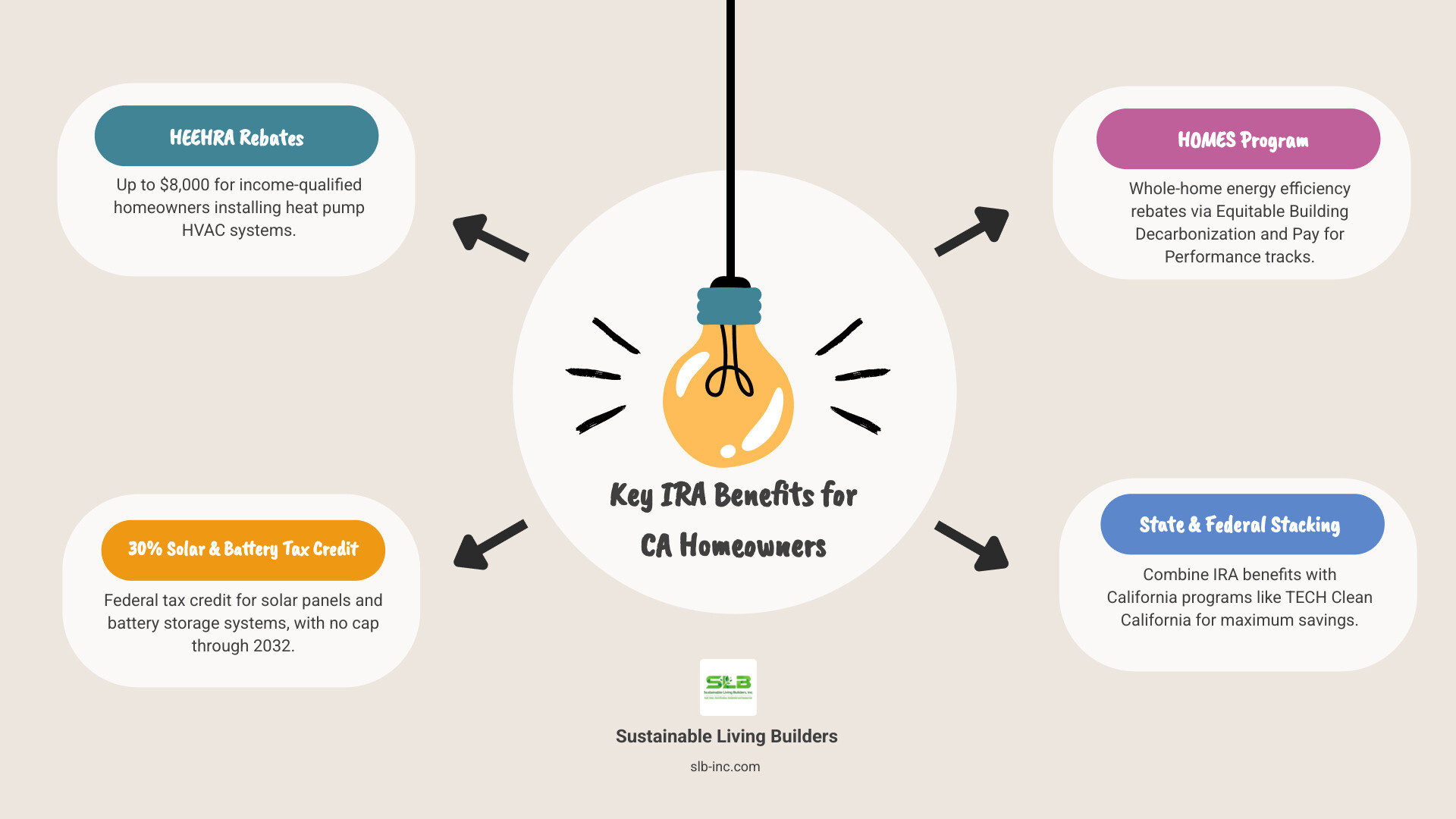
- HEEHRA rebates – Up to $8,000 for income-qualified homeowners installing a heat pump HVAC system
- HOMES program – Whole-home efficiency rebates through the Equitable Building Decarbonization and Pay for Performance tracks
- Residential Clean Energy Credit (25D) – 30% federal tax credit on solar panels and battery storage systems, no dollar cap, available through 2032
- Energy Efficient Home Improvement Credit (25C) – Tax credits for insulation, windows, doors, and more
- Standalone battery storage – Systems over 3 kWh qualify for the 30% federal tax credit, even without solar
- EV tax credits – Up to $7,500 for new electric vehicles, $4,000 for used
- State stacking – IRA benefits can be combined with California programs like TECH Clean California and Equitable Building Decarbonization
California was awarded a total of $590 million from the U.S. Department of Energy for Home Energy Rebates alone. That’s real money available to real homeowners — but accessing it requires knowing which programs are open, who qualifies, and how to apply without falling for scams.
Energy costs in California keep climbing, and the 2025 Los Angeles fires brought the state’s home insurance crisis into sharp focus — with the FAIR Plan insuring nearly $700 billion in property after growing 317% since 2021. For many households, reducing energy consumption and moving away from fossil fuels isn’t just about the environment anymore. It’s about financial survival.
This guide walks you through every major IRA benefit available to California homeowners right now, including program statuses, income thresholds, how to stack state and federal incentives, and how to find legitimate contractors.
I’m Karlo Jarina, marketing lead at Sustainable Living Builders, where I’ve spent years helping California homeowners understand inflation reduction act benefits for california homeowners and how solar, roofing, and energy upgrades can work together as a long-term investment. In the sections ahead, we’ll break down everything you need to make confident, well-informed decisions about your home.
Understanding the Inflation Reduction Act Benefits for California Homeowners

The Inflation Reduction Act (IRA), signed into law in late 2022, represents the most significant federal climate legislation in U.S. history. For those of us living in the North Bay—from the vineyards of Napa to the coastal hills of Marin—these inflation reduction act benefits for california homeowners are designed to make the transition to clean energy affordable. The primary goals are to reduce greenhouse gas emissions, lower monthly utility bills, and bolster energy reliability.
By utilizing home energy incentives, we can move toward state-wide decarbonization goals. In California, where natural gas is still used for 59% of water heating and 32% of space heating, the shift to electric alternatives is a major priority. When we increase home energy efficiency, we aren’t just saving money; we are making our homes more resilient against the extreme weather and power outages that have become all too common in Sonoma County.
Who Qualifies for Inflation Reduction Act Benefits for California Homeowners?
Eligibility for IRA benefits often depends on your household income relative to the Area Median Income (AMI). The HEEHRA (Home Electrification and Appliance Rebates) program, for instance, specifically targets low-to-moderate income (LMI) households.
- Low-Income: Households earning less than 80% of the AMI can have up to 100% of their project costs covered by rebates (up to specific caps).
- Moderate-Income: Households earning between 80% and 150% of the AMI may qualify for rebates covering 50% of the costs.
- Single-Family & Multifamily: Benefits apply to both single-family homes and multifamily properties. Even renters can benefit if their landlords participate in home electrification upgrades for the building.
Long-Term Savings from Inflation Reduction Act Benefits for California Homeowners
The financial impact of these upgrades goes far beyond the initial rebate or tax credit. By switching to high-efficiency appliances, many households save an average of $372 every year through weatherization alone. Heat pump water heaters, for example, are two to three times more efficient than conventional ones.
Beyond the bills, these incentives help address the insurance challenges facing our region. By making homes more resilient and efficient, we can potentially mitigate some of the risks that lead to rising premiums. We often recommend starting with energy audit services to identify where your home is losing energy, ensuring that every dollar spent on upgrades maximizes your ROI and minimizes your carbon footprint.
I’m looking to upgrade my home’s efficiency. What are the HEEHRA and HOMES rebate statuses?
Navigating the two main rebate “buckets”—HEEHRA and HOMES—can be a bit confusing. As of April 2026, California has made significant progress in deploying these funds through the California Energy Commission (CEC).
If you’re wondering whether to replace ac with heat pump technology, the HEEHRA program is your primary target for point-of-sale discounts. Meanwhile, the HOMES program focuses on “whole-home” performance, offering rebates based on how much total energy you save, rather than specific appliance choices.
| Feature | HEEHRA (Electrification) | HOMES (Efficiency) |
|---|---|---|
| Focus | Specific electric appliances (Heat pumps, etc.) | Whole-home energy reduction |
| Eligibility | Income-restricted (LMI) | Open to all (higher rebates for LMI) |
| Savings Metric | Equipment type | Modeled or measured energy savings |
| Max Rebate | Up to $14,000 total | Varies by savings (up to $8,000+) |
California HEEHRA Rebate Details for 2026
The HEEHRA program provides substantial rebates for a variety of upgrades. For a single-family home in Santa Rosa or Napa, these can include:
- Heat Pump HVAC: Up to $8,000.
- Heat Pump Water Heater: Up to $1,750.
- Electric Stoves/Induction Cooktops: Up to $840.
- Heat Pump Clothes Dryer: Up to $840.
- Electrical Panel Upgrades: Up to $4,000 (essential if you need to increase home energy efficiency but your current panel can’t handle the load).
- Wiring Upgrades: Up to $2,500.
Status of California’s $590 Million IRA Funding
California received a total award of $590 million, split roughly down the middle between HEEHRA ($290M) and HOMES ($291M). Here is the current landscape as of early 2026:
- HEEHRA Phase I: Launched in late 2024. For single-family homes, rebates were so popular that they became fully reserved statewide by February 2026.
- Waitlist Management: Currently, new single-family requests are being placed on a waitlist as the CEC processes existing reservations.
- October 2025 Reopening: While Phase I funds are tight, the CEC is preparing for a Phase II reopening, expected to bring another $152 million into the rebate pool by late 2025 or early 2026.
How can I use the 30% tax credit for solar and battery storage in Santa Rosa?
While rebates are income-dependent, the federal tax credits are available to almost everyone with a tax liability. The Residential Clean Energy Property Credit (Section 25D) is a game-changer for solar adoption in the North Bay.
If you are looking for santa rosa solar installers, you should know that the 30% credit applies to the total cost of the system, including labor and energy storage batteries. One of the most significant changes under the IRA is that standalone battery storage systems (over 3 kWh) now qualify for the 30% credit, even if you don’t have solar panels. This is a huge benefit for homeowners who want backup power during “Public Safety Power Shutoff” events but aren’t ready for a full solar array.
When researching solar energy system introduction common types, this credit is not a “deduction”—it’s a dollar-for-dollar reduction of the taxes you owe.
Maximizing the Investment Tax Credit (ITC) Through 2032
The 30% rate is locked in through 2032, before it begins to taper off (26% in 2033 and 22% in 2034). There is no dollar cap on this credit. Whether you choose a traditional rack-mounted system or a sleek tesla solar roof, the 30% credit applies.
We often get asked about solar shingles vs solar panels. Both qualify for the credit, but shingles can sometimes be integrated into a broader roofing project. Pairing solar with battery backup provides the ultimate grid independence, allowing you to store sun-generated power for use at night or during outages.
Additional Federal Tax Credits for Energy Efficiency
Beyond solar, the Energy Efficient Home Improvement Credit (Section 25C) offers annual credits for smaller upgrades. Unlike the solar credit, this one has annual limits:
- Annual Total Limit: Generally capped at $1,200 per year.
- Heat Pumps: A separate $2,000 annual limit specifically for heat pump HVACs and water heaters.
- Exterior Doors: Up to $250 per door ($500 total).
- Windows: Up to $600.
- Insulation and Air Sealing: Up to 30% of the cost.
By planning your upgrades over several years, you can maximize these home energy incentives and have the government chip in for your windows one year and your insulation the next.
How do I safely apply for IRA incentives and avoid scams in the Bay Area?
With hundreds of millions of dollars on the table, scammers are unfortunately active. They often claim to represent the CEC or the “Inflation Reduction Act department” (which doesn’t exist). To stay safe in the Bay Area, we recommend these steps:
- Use Official Databases: Only work with contractors who are TECH Clean California-certified and HEEHRA-trained. You can find them using the “Switch Is On” contractor finder tool.
- Pre-Approval is Key: For HEEHRA rebates, your contractor must secure an approved reservation before work begins. There are no retroactive rebates for HEEHRA.
- Protect Your Data: Never share your social security number or financial details with someone who calls or knocks on your door unsolicited.
- Energy Audits: Start with professional energy audit services to get a roadmap of what your home actually needs, rather than what a salesperson wants to sell you.
Combining IRA Benefits with California State Programs
The real magic happens when you “stack” incentives. Inflation reduction act benefits for california homeowners can often be combined with state-level programs to drive your out-of-pocket costs even lower.
- TECH Clean California: This state initiative provides its own set of rebates for heat pumps that can sometimes be layered with federal credits.
- Equitable Building Decarbonization: This program offers no-cost retrofits for low-income households, focusing on those most impacted by energy costs.
- Clean Vehicle Rebate Project (CVRP): While the IRA provides up to $7,500 for new EVs, California offers additional rebates ranging from $1,000 to $7,500 depending on income.
- GoGreen Financing: If the remaining cost of an upgrade is still a hurdle, the state’s GoGreen program offers attractive financing terms for home electrification projects.
Frequently Asked Questions about IRA Benefits
Are IRA rebates retroactive for projects completed in 2024 or 2025?
For the HEEHRA and HOMES rebates, the answer is generally no. These programs require a pre-approved reservation through a certified contractor. However, federal tax credits (25C and 25D) can be claimed for any qualifying equipment “placed in service” during the tax year you are filing for.
Can renters in California access IRA-funded appliance rebates?
Yes! Renters can benefit from HEEHRA rebates if they purchase eligible “plug-in” appliances like heat pump clothes dryers or induction cooktops, provided they meet income requirements. For permanent upgrades like HVAC, renters should work with their landlords, as the property owner must authorize the installation.
What is the difference between a tax credit and a point-of-sale rebate?
A rebate (like HEEHRA) is a discount applied at the time of purchase, meaning you pay less upfront. A tax credit (like the 30% solar credit) is something you claim on your federal tax return the following year, which reduces the amount of tax you owe or increases your refund.
Conclusion
At Sustainable Living Builders, we believe that every homeowner in Sonoma, Marin, and Napa County deserves a home that is comfortable, affordable, and sustainable. By taking advantage of inflation reduction act benefits for california homeowners, you’re not just upgrading your appliances—you’re joining a movement toward a cleaner, more resilient California.
Whether you’re interested in energy-efficient roofing to protect your home from the elements, solar panels to power your life, or smart home systems to manage it all, we’re here to help. Our friend Sunny often says that the best time to start your energy journey was yesterday, but the second best time is today.
Ready to see how much you could save? Check out our home energy incentives page and let’s build a more sustainable future together.