Why Home Energy Incentives Matter More Than Ever
Home energy incentives are financial programs like tax credits and rebates that help homeowners afford energy-efficient upgrades. Thanks to the Inflation Reduction Act of 2022, Americans can access significant savings—up to $3,200 annually in federal tax credits and up to $14,000 in state rebates for qualifying improvements.
Quick Answer: What Are Home Energy Incentives?
- Federal Tax Credits: Reduce your tax bill by 30% of the cost for upgrades like windows, insulation, heat pumps, and solar panels.
- State & Local Rebates: Get instant or mail-in cash back for appliances and whole-home retrofits.
- Low-Income Programs: Access free weatherization and bill assistance through WAP and LIHEAP.
- Financing Options: Use low-interest loans for energy improvements.
These programs can cover a large part of your investment in a more sustainable home, whether you’re replacing a water heater or building new. Understanding these incentives is the first step to lowering utility bills. Ready to get started? Contact Sustainable Living Builders to learn which incentives apply to your project.
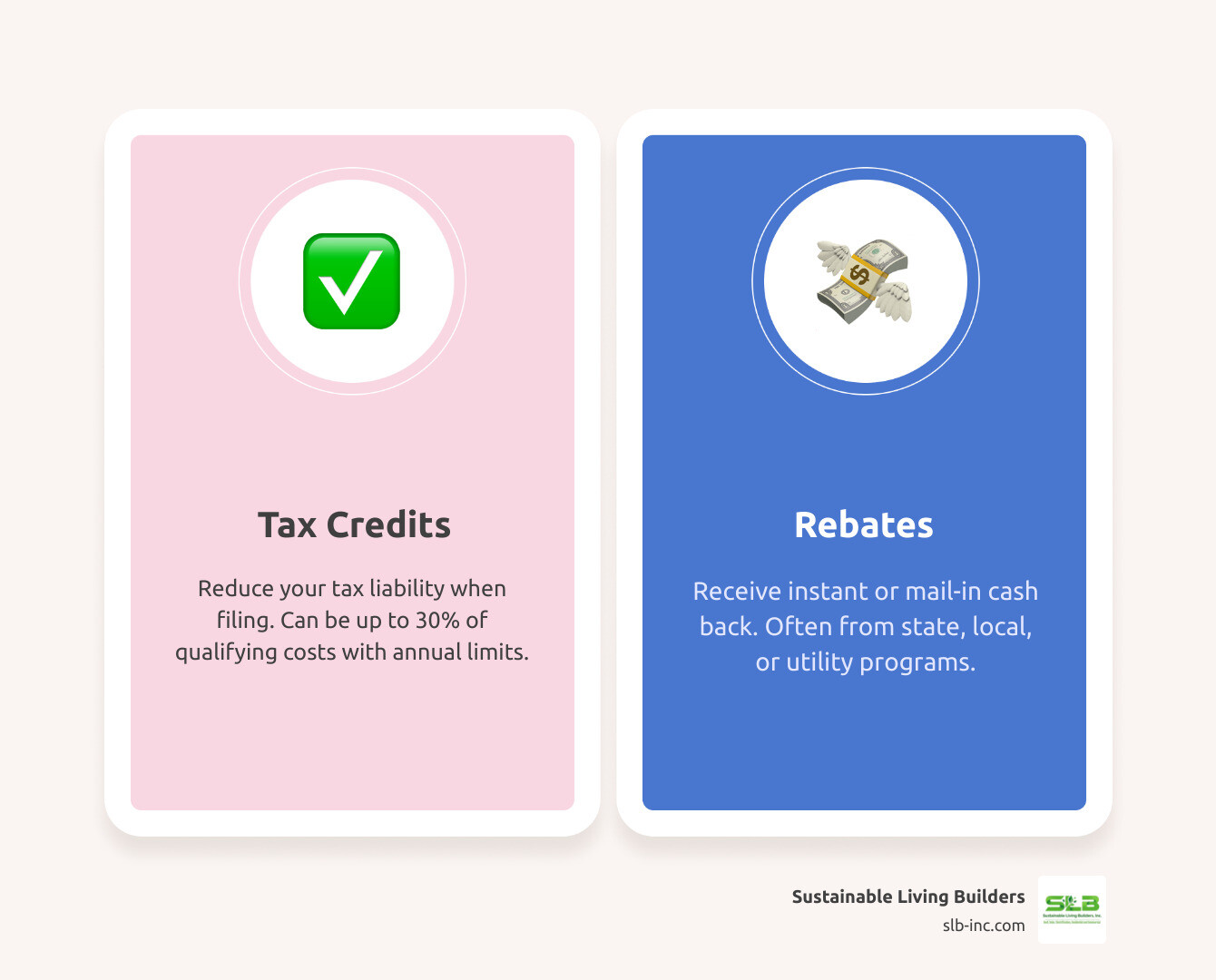
Tax credits and rebates differ in timing. Tax credits reduce your IRS bill when you file your return, while rebates provide cash back at purchase or shortly after. Homeowners can often stack both for the same project, maximizing their savings.
Understanding the Types of Home Energy Incentives
Making your home more energy-efficient is easier with financial help. Several types of home energy incentives are available to maximize your savings and lower your monthly bills. The main categories are federal tax credits, state and utility rebates, and low-income assistance programs.
Federal Tax Credits
A federal tax credit directly reduces your IRS tax bill, dollar for dollar. For example, a $300 credit on a $1,000 tax bill means you only owe $700. This is more valuable than a deduction, which only lowers your taxable income.
Most energy tax credits are nonrefundable, meaning they can reduce your tax liability to zero but won’t generate a refund. You claim them on your annual tax return for the year the upgrade was completed. Thanks to recent legislation, these credits are available through December 31, 2032. Since tax situations vary, we recommend consulting a tax professional to confirm if your upgrades qualify for federal tax credits.
State, Local, and Utility Rebates
Unlike tax credits, state, local, and utility rebates provide more immediate cash back.
- Point-of-sale discounts are applied at checkout, lowering your upfront cost.
- Mail-in rebates require you to submit documentation after purchase to receive a check.
These programs are highly localized, so incentives in Santa Rosa may differ from those in Napa or Marin County. Your utility provider often has its own programs, allowing you to stack savings. The Database of State Incentives for Renewables & Efficiency (DSIRE) is the best place to search for local programs by zip code.
Low-Income Assistance Programs
Several federal programs help low-income households reduce energy costs.
- The Weatherization Assistance Program (WAP) provides free energy efficiency improvements like insulation and air sealing. On average, families save $372 or more annually on utility bills.
- The Low Income Home Energy Assistance Program (LIHEAP) helps eligible households pay heating and cooling bills, offers emergency assistance, and funds weatherization.
These programs are grants and services, not loans. You can learn more and see if you qualify through the LIHEAP Clearinghouse website to find assistance in your area.
Major Federal Home Energy Incentives You Should Know
The Inflation Reduction Act of 2022 significantly expanded federal home energy incentives, making it more affordable to invest in energy efficiency and renewables. Homeowners can save up to $3,200 annually on qualified improvements, plus an additional 30% for clean energy systems. For details, visit the Federal Tax Credits for Energy Efficiency resource.
The Energy Efficient Home Improvement Credit (25C)
This credit is for making your existing primary residence more energy-efficient. It covers 30% of qualified expenses, with an annual cap of $3,200. This cap is broken down into:
- Up to $1,200/year for building envelope improvements (insulation, air sealing) and energy-efficient central air conditioners, furnaces, and boilers.
- Exterior Doors: $250 per door ($500 total)
- Exterior Windows & Skylights: $600 total
- Home Energy Audits: $150
- Up to $2,000/year for electric or natural gas heat pumps, heat pump water heaters, and biomass stoves or boilers.
Upgrading your home’s envelope (windows, doors, insulation) can cut energy bills by up to 20%. High-efficiency heat pumps use up to 65% less electricity than traditional heating. Our Step-by-Step Guide to Transitioning from Gas to Electric Heating Systems can help you plan. Even electrical panel upgrades needed for new equipment can qualify for up to $600. We offer Energy Audit Services to identify the most impactful upgrades for your home.
The Residential Clean Energy Credit (25D)
This credit supports investments in renewable energy systems for new or existing homes. It provides a credit for 30% of the cost with no overall dollar limit. If the credit exceeds your tax liability, you can carry the unused portion to future years.
Qualifying equipment includes:
- Solar Energy Systems: Generate your own electricity. Learn more with our guide on Solar Panels.
- Geothermal Heat Pumps: Use the earth’s stable temperature for efficient heating and cooling.
- Battery Storage Technology: Store energy for use during outages or peak hours. See the benefits of Energy Storage Batteries.
- Small Wind Turbines & Fuel Cells
Wondering if solar is right for you? Our article Are Solar Panels Worth It? provides a detailed analysis.
Maximizing Your Federal Home Energy Incentives
To get the most from these incentives, plan strategically.
- Spread Upgrades Across Years: The 25C credit has a $3,200 annual cap. If you have multiple large projects, consider doing them in different tax years to claim the maximum credit each year. This works well for major investments like a Solar Roof (Tesla).
- Stack Your Credits: You can claim both the 25C and 25D credits in the same year for different projects (e.g., a heat pump and solar panels).
- Understand Subsidies: Some utility rebates may reduce the cost basis for your federal tax credit, but state incentives generally do not. Keep detailed records of all costs and rebates to ensure accurate tax filing.
State Rebate Programs: Stacking Your Savings
State and local rebate programs offer more ways to save on energy-efficient upgrades, especially for homeowners in Santa Rosa, Sonoma County, Marin County, and Napa County. You can often stack these savings by combining federal tax credits with state and utility rebates for the same project.
The Database of State Incentives for Renewables & Efficiency website is the best resource for finding programs in California. Two major federal programs, implemented at the state level, are particularly noteworthy:
Home Efficiency Rebates (HOMES) Program
The HOMES Program supports comprehensive, whole-house retrofits that significantly reduce energy consumption. Rebates are based on the percentage of energy saved, with larger rebates for greater savings.
- Eligibility: Projects must reduce home energy use by at least 20%.
- Rebate Amount: Up to $8,000, depending on your household income and the project’s energy savings. Low-income households can qualify for larger rebates.
- Requirements: All installed heating, cooling, or water heating products must meet ENERGY STAR criteria.
California is currently implementing its version of this program. Check the Home Efficiency Rebates (HOMES) Program page for federal guidelines.
Home Electrification and Appliance Rebates (HEAR) Program
The HEAR Program focuses on helping low-to-moderate-income households switch to high-efficiency electric appliances. Rebates are applied as point-of-sale discounts, reducing upfront costs.
- Eligibility: Households earning less than 150% of the area median income.
- Rebate Amount: Up to $14,000 in total rebates. Costs may be 100% covered for low-income families and 50% for moderate-income families.
- Covered Upgrades:
- Electric heat pumps (up to $8,000)
- Heat pump water heaters (up to $1,750)
- Electric stoves, cooktops, and heat pump clothes dryers (up to $840 each)
- Electrical panel upgrades (up to $4,000)
- Electrical wiring (up to $2,500)
- Insulation, air sealing, and ventilation (up to $1,600)
This program is a key part of Home Electrification. If your home needs an electrical system update to support these new appliances, we can help you Install New Electrical Panel.
How to Find and Apply for Incentives
Finding and applying for home energy incentives is a straightforward process with the right approach. We’ve guided many homeowners in Santa Rosa, Sebastopol, and the surrounding counties through it. The Energy Saver guide offers more tips on cutting energy use.
Finding Available Home Energy Incentives
Since programs vary by location, start by researching what’s available in your area.
- National Databases: Use the Database of State Incentives for Renewables & Efficiency (DSIRE) and the ENERGY STAR Rebate Finder to search for federal, state, and local incentives by zip code or product.
- Local Resources: Check these sites for specific programs in our service areas:
- Santa Rosa: Rebates & Services
- Bay Area: BayREN residential programs
- Sonoma Clean Power: Offers and rebates
- Marin County: Electrify Marin rebate program
- Napa: Conserving energy resources
- Home Energy Audit: A professional audit identifies where you’re losing energy and which upgrades offer the best return. The audit itself may qualify for a $150 federal tax credit. Our Energy Audit Services provide a clear roadmap for your project.
Applying for Tax Credits and Rebates
Once you’ve identified eligible incentives, focus on the application.
For Federal Tax Credits:
- Verify Product Eligibility: Before purchasing, ensure products meet ENERGY STAR or other required efficiency standards.
- Keep Meticulous Records: Save all receipts, invoices, and manufacturer certification statements.
- File with Your Taxes: Complete and file IRS Form 5695, “Residential Energy Credits,” with your federal tax return for the year the improvements were installed.
For State and Local Rebates:
- Some rebates are instant point-of-sale discounts.
- Others are mail-in rebates that require you to submit an application with proof of purchase and installation after the fact.
- Check Deadlines: Each program has its own timeline, so be sure to submit all paperwork before the deadline.
- Work with Qualified Contractors: Many programs require installation by certified professionals to ensure the work meets performance standards. Our guide on 4 Tips for Finding the Right Contractor for Your Solar Installation offers advice applicable to any energy project.
Partnering with an experienced professional simplifies this process. At Sustainable Living Builders, we guide clients every step of the way to ensure you capture all available savings.
Frequently Asked Questions about Home Energy Incentives
We’ve helped many homeowners in Santa Rosa, Sonoma County, Marin County, and Napa County steer home energy incentives. Here are answers to the most common questions:
Can I claim both a federal tax credit and a state rebate for the same upgrade?
Yes, you can “stack” incentives. For example, you can claim the 30% federal tax credit for a new heat pump and also receive a state or utility rebate for the same installation. This is a great way to maximize savings. Just be aware that some utility rebates may need to be subtracted from your total project cost when calculating your federal credit. We recommend consulting a tax professional to ensure you’re calculating it correctly.
What’s the difference between the Energy Efficient Home Improvement Credit and the Residential Clean Energy Credit?
They serve different purposes:
-
The Energy Efficient Home Improvement Credit (25C) is for upgrades that reduce your home’s energy use, like insulation, efficient windows, and heat pumps. It has an annual cap of $3,200 and applies only to your primary residence.
-
The Residential Clean Energy Credit (25D) is for systems that generate renewable energy, such as solar panels, geothermal heat pumps, and battery storage. It provides a 30% credit with no dollar limit, and you can carry unused credit forward to future tax years.
You can claim both credits in the same year for different qualifying projects.
Do I need a home energy audit to qualify for incentives?
It depends on the program. For most basic upgrades and federal tax credits, an audit is not required. However, for whole-home retrofit programs like the Home Efficiency Rebates (HOMES) Program, an audit is often necessary to prove your project meets the required energy savings.
Even when not required, we highly recommend an audit. It provides a personalized roadmap to prioritize the most effective upgrades for your home. Plus, the audit itself can qualify for a federal tax credit of up to $150. Our Energy Audit Services can help you get started.
Conclusion: Invest in Your Home’s Future
Making your home more energy-efficient is an investment in your family’s comfort, your property’s value, and a sustainable future. The benefits go far beyond the initial savings from home energy incentives.
You’ll enjoy lower utility bills, a more comfortable living space free of drafts, and an increased home value, as today’s buyers seek out energy-efficient features. Our article, 4 Benefits of Home Solar: Why You Should Make the Switch, explores how solar, in particular, boosts property values. Most importantly, by reducing your energy consumption, you shrink your carbon footprint and contribute to a healthier planet.
Navigating federal tax credits, state rebates, and local programs can be complex. At Sustainable Living Builders, we specialize in this. We serve homeowners in Santa Rosa, Sebastopol, Marin County, and Napa County, staying current on every available incentive to help you stack savings and maximize your return on investment. We look at your home as an integrated system to recommend improvements that deliver the best results.
The current window of opportunity for these incentives won’t last forever. Now is the time to act.
Ready to transform your home? We’re here to guide you. Learn more about building a sustainable home with Sustainable Living Builders, and let’s start open uping the full potential of your home together.