The Smartest Way to Cut Your Energy Bills Starts With the Right Tax Incentives
Battery storage tax credits and incentives can put thousands of dollars back in your pocket — and right now, most homeowners have no idea they exist.
Here is a quick look at the key incentives available as of April 2026:
| Incentive | Who It’s For | Credit Amount |
|---|---|---|
| Federal 25D Residential Clean Energy Credit | Homeowners and renters (installed by Dec 31, 2025) | 30% of qualified costs, uncapped |
| Federal 48E Clean Electricity Investment Credit | Commercial and utility-scale projects | 6% base, up to 30% with prevailing wage requirements |
| Bonus adders (domestic content, energy communities, low-income) | Commercial projects meeting extra criteria | Up to 70% total |
| State programs (e.g., California SGIP) | Varies by state | Varies |
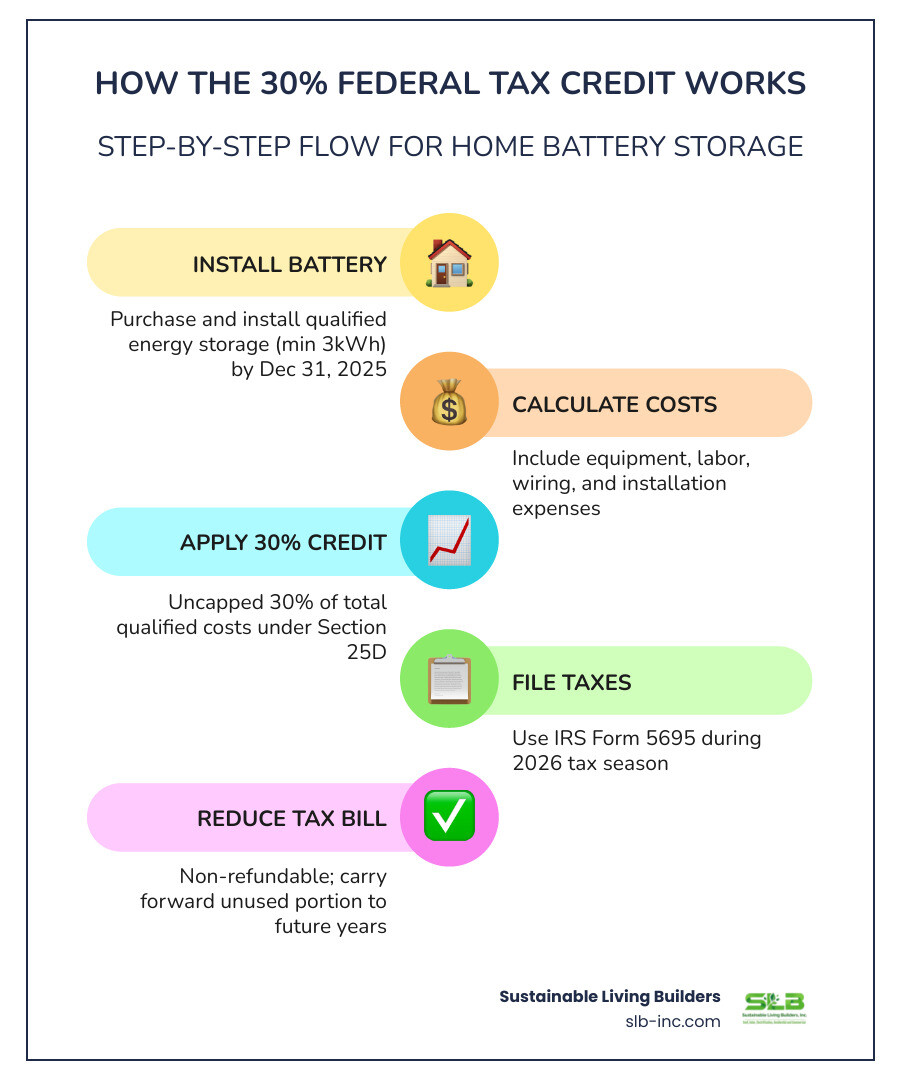
If you installed a home battery system by December 31, 2025, you can claim a 30% federal tax credit on the full cost when you file your 2025 taxes in 2026 — with no dollar cap. That means a $10,000 battery installation could translate to a $3,000 reduction in what you owe the IRS.
For commercial and utility-scale projects, the 48E Clean Electricity Investment Credit keeps flowing well beyond 2025, with the potential to stack bonus credits that push the total even higher.
High energy bills and grid uncertainty are pushing more homeowners toward energy independence every year. The good news is that the federal government has built real financial incentives to help you get there. Whether you are a homeowner who just installed a battery system, a renter trying to understand your options, or a property owner exploring commercial-scale storage, understanding these credits is the first step to making the most of them.
This guide breaks down everything you need to know — from eligibility rules and qualified expenses to state programs and the latest legislative changes — so you can keep more of your money while building a more resilient home.
Understanding the Federal battery storage tax credits and incentives
As we navigate the April 2026 tax season, many of our neighbors in Santa Rosa and Napa are realizing that Energy Storage Batteries are more than just backup power; they are a strategic financial asset. The primary driver for this is the Section 25D Residential Clean Energy Credit.
This federal incentive allows you to deduct 30% of the cost of your system from your federal income taxes. Unlike some other tax breaks, this one is uncapped. Whether your system costs $10,000 or $30,000, the 30% rate remains the same. It is important to remember that this is a non-refundable credit. This means it can reduce the taxes you owe to zero, but the IRS won’t send you a check for any leftover amount. However, there is a silver lining: you can carry forward any unused portion of the credit to future tax years.
For those who completed their installations by December 31, 2025, now is the time to claim those Home Energy Incentives. If you are just starting your journey in 2026, the landscape is shifting toward newer legislative frameworks, but the core goal of energy independence remains the same.
Eligibility Requirements for Residential battery storage tax credits and incentives
To qualify for the 25D credit, your system must meet several specific criteria. First, the battery must have a capacity of at least 3 kilowatt-hours (kWh). This is a relatively low bar, as most modern home batteries—like those paired with a Span Panel—easily exceed this threshold.
The credit applies to:
- Principal Residences: Your primary home where you live most of the year.
- Second Homes: A vacation home or secondary residence, provided you live there part-time and do not rent it out to others.
- New Equipment: The battery must be new and being used for the first time; used or refurbished equipment does not qualify.
- Location: The dwelling must be located within the United States.
Whether you are retrofitting an existing home in Sonoma County or installing storage in a new construction project in Marin, these credits are designed to support your transition to clean energy.
Qualified Expenses for Homeowners
When calculating your 30% credit, you aren’t just looking at the price tag of the battery itself. The IRS allows you to include a variety of “qualified expenditures.” This is where many homeowners leave money on the table. You can include:
- The full cost of the battery storage equipment.
- Labor costs for onsite preparation and assembly.
- Original installation costs.
- Necessary piping and wiring to connect the system to your home.
Integrating smart technology can also play a role. For instance, understanding How Can A Span Panel Help Monitor Electricity Usage can help you optimize how your battery discharges, potentially increasing your long-term savings while the initial wiring for such smart panels may be included in your project scope.
How the OB3 Act and OBBB Impact Your Energy Savings
The legislative landscape for battery storage tax credits and incentives has evolved significantly with the passage of the “One Big Beautiful Bill” (OBBB) and the subsequent OB3 Act. While residential credits have specific deadlines, these laws have ensured that the broader energy storage market continues to thrive.
The OB3 Act notably shifted the focus toward technology-neutral incentives. Under the 48E Clean Electricity Investment Credit, projects that achieve net-zero greenhouse gas emissions can qualify for significant tax breaks through 2033. This stability has encouraged massive growth in the sector; in fact, 10.3 gigawatts of utility-scale storage were installed in 2024 alone. By the end of 2025, forecasts suggested that number would jump by another 18 gigawatts.
However, these incentives come with “recapture” provisions. If a project stops meeting the clean energy requirements within 10 years of being placed in service, the IRS can take back a portion of the credit.
Foreign Entity of Concern (FEOC) Requirements
One of the most critical updates in 2026 involves where your battery components come from. To encourage domestic manufacturing, the government has implemented Foreign Entity of Concern (FEOC) requirements. Starting in 2026, projects must meet a material assistance ratio where at least 55% of the costs come from non-FEOC sources (avoiding countries like China, which currently dominates the battery supply chain).
This threshold is scheduled to tighten, rising to 75% by 2030. For homeowners and developers, this means auditing supply chains is no longer optional—it’s a requirement for financial compliance.
Residential vs. Commercial: Which Credit Applies to You?
Choosing the right path depends on the scale of your project. Residential systems typically fall under Section 25D, while larger commercial or multi-family projects often look toward Section 48 or 48E.
| Feature | Residential (25D) | Commercial/Utility (48/48E) |
|---|---|---|
| Base Rate | 30% | 6% |
| PWA Bonus | N/A | Boosts rate to 30% |
| Transferability | No | Yes (Direct Transfer) |
| Capacity Requirement | 3 kWh+ | Varies |
In the first half of 2025, standalone storage and hybrid solar+storage systems accounted for 26% of all tax credits sold. For commercial entities, the ability to use “direct transfer” deals—selling the tax credit to a third party for cash—has become a vital financing tool.
Bonus Adders for battery storage tax credits and incentives
For commercial projects, the 30% credit is often just the beginning. The government offers “adders” that can push the total credit as high as 70%:
- Domestic Content Bonus: +10% for using American-made steel, iron, and manufactured products.
- Energy Communities: +10% for building in areas historically dependent on fossil fuel industries.
- Low-Income Communities: +10% to +20% for projects serving disadvantaged populations or affordable housing.
Common Pitfalls and Frequently Asked Questions
Claiming your battery storage tax credits and incentives requires precision. The most common mistake is failing to use the correct paperwork. For residential claims, you will need IRS Form 5695. For commercial projects, Form 3468 is the standard.
Another pitfall involves public utility subsidies. If your local utility in Sebastopol or Napa gave you a direct rebate for your battery, you must subtract that rebate from the total cost before calculating your 30% credit. However, net metering credits (the money you get back for sending power to the grid) do not reduce your tax credit eligibility.
Can renters and tax-exempt entities claim incentives?
Yes! Renters who purchase and install a qualifying battery in their primary residence can claim the 25D credit. Landlords, however, generally cannot claim the residential credit for properties they do not live in.
For tax-exempt entities like local governments or non-profits in Sonoma County, a mechanism called “Elective Pay” (or Direct Pay) allows them to receive the value of the credit as a direct payment from the IRS, since they don’t owe federal income taxes to offset.
What happens if I use my home for business?
If you have a home office or run a business out of your residence, the IRS has specific allocation rules. If the business use of your home is less than 20%, you can generally claim the full credit. If it is more than 20%, you must prorate the credit based on the percentage of the home used for residential purposes.
Are there state-specific incentives beyond federal credits?
Absolutely. In California, the Self-Generation Incentive Program (SGIP) has historically provided significant rebates for home batteries. While federal credits are calculated after subtracting these rebates, stacking them is still the best way to lower your total investment. Always check for local programs in Marin and Napa counties that might offer additional perks for grid resiliency.
Conclusion
At Sustainable Living Builders, we believe that energy independence should be accessible to everyone. By taking advantage of battery storage tax credits and incentives, you aren’t just helping the planet—you’re making a savvy investment in your home’s future. From smart home integration to holistic sustainable solutions, we are here to help you navigate the technical and financial aspects of going green.
Whether you are looking to reduce your carbon footprint or simply want to keep the lights on during the next North Bay outage, now is the time to Discover Energy Storage Batteries and the incentives that make them more affordable than ever.