Why Insulating Ductwork in a Finished Basement Matters for Your Home
Insulating ductwork in a finished basement can save you 20-30% on energy costs while improving comfort throughout your home. Here’s what you need to know:
Quick Answer:
- Should you do it? Yes, especially if your basement ducts are in unconditioned space or you notice temperature imbalances.
- Best insulation types: Fiberglass wrap (R-6 to R-8), rigid foam board, or spray foam encapsulation.
- Key benefits: Lower energy bills, consistent room temperatures, condensation prevention, and reduced HVAC strain.
- Critical first step: Seal all duct leaks with mastic or foil tape before insulating.
- Supply vs. return: Prioritize insulating supply ducts; return ducts need less insulation.
If your HVAC system works overtime while certain rooms stay uncomfortably cold or hot, the culprit could be uninsulated ducts. When ducts run through a finished basement, they can lose significant heat or cooling energy before the air reaches your living spaces, wasting money and reducing comfort.
If you’re working toward a more sustainable home, insulating your basement ductwork is a high-impact project. For professional help with this upgrade, our team offers expert insulation services custom to your home’s needs.
This is often a manageable DIY project that delivers immediate results. By properly sealing and wrapping your ducts, you create a thermal barrier that keeps conditioned air at the right temperature from the furnace to your vents.
The “Why”: Unpacking the Benefits of Insulating Basement Ducts
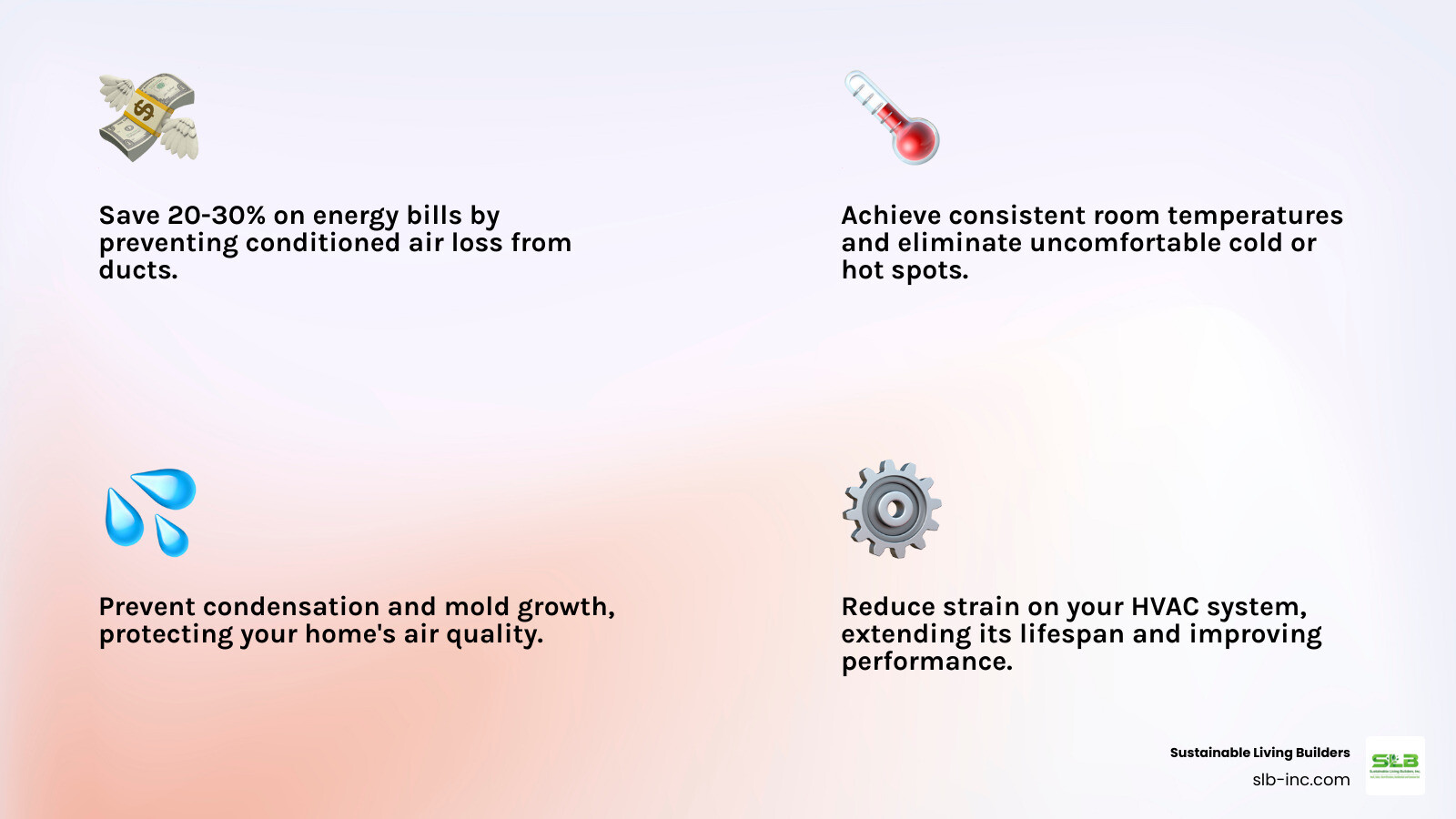
Your home’s ductwork is the delivery system for comfort, but when it runs through a basement that’s cooler or warmer than your living spaces, it can be a major source of energy loss. Poorly sealed and uninsulated ducts can leak 20 to 30 percent of the conditioned air your HVAC system produces, forcing it to work harder and driving up your utility bills. Properly insulating your basement ductwork offers several key benefits.
Lower Energy Bills and Greater Efficiency
Metal ducts are excellent conductors of heat. Without insulation, the air inside them quickly loses or gains heat from the surrounding basement air. This forces your furnace or air conditioner to run longer to maintain the thermostat setting. By wrapping your ducts, you create a thermal barrier that maintains the air’s temperature as it travels to your rooms. The result is a reduced workload for your HVAC system, which translates directly into lower energy consumption and noticeable savings on your utility bills. For insulation to be effective, however, you must first seal all air leaks. This one-two punch of sealing and insulating is a core principle of creating a sustainable home.
Improved Home Comfort
Frustrating temperature imbalances—like a stuffy upstairs bedroom or a chilly basement office—are often caused by uninsulated ducts. Insulation ensures that the air arriving at your registers is still at its intended temperature, eliminating hot and cold spots. Your home will reach comfortable temperatures faster and maintain them more consistently between floors. This transforms the basement from a less comfortable zone into a genuinely inviting area, perfect for a home office, gym, or entertainment space. This is a key part of making sustainable living starts at home a reality.
Condensation Prevention and Healthier Air
In the summer, cold air moving through ducts in a warmer, more humid basement can cause condensation to form on the metal exterior. This moisture creates a breeding ground for mold and mildew, which can damage your home and negatively impact indoor air quality. Duct insulation acts as a vapor barrier, keeping the warm, moist air from reaching the cold duct surface. This prevents condensation, protecting your home’s structure and your family’s health. As a bonus, insulation also dampens the sound of air moving through the ducts, creating a quieter home environment.
Longer HVAC System Lifespan
When your HVAC system doesn’t have to constantly overcome temperature loss in the ductwork, it experiences less wear and tear. This reduced strain can lead to fewer repairs and a longer operational life for your heating and cooling equipment.
Choosing Your Armor: Best Insulation Types for Basement Ducts
Choosing the right insulation depends on your duct type, budget, and DIY comfort level. The effectiveness of insulation is measured by its R-value; the higher the R-value, the better it resists heat flow. For basement ducts, an R-value between R-4 and R-8 is typical.
The three main options are fiberglass duct wrap, rigid foam board, and closed-cell spray foam. For most DIY projects, fiberglass wrap and rigid foam board are the most practical choices.
| Insulation Type | R-Value (per inch) | Application | Pros | Cons |
|---|---|---|---|---|
| Fiberglass Duct Wrap | R-4 to R-8 (total) | Rolled blankets for rigid ducts, typically foil-faced | Readily available, cost-effective, good for irregularly shaped ducts, common DIY choice. | Can be messy to install, requires careful sealing of seams to prevent moisture/air gaps, R-value can be reduced if compressed. |
| Rigid Foam Board | R-4 to R-6.5 | Best for rectangular ducts | High R-value per inch, easy to cut precisely, provides a clean finish, good vapor barrier when sealed. | Less flexible for round or irregular ducts, requires precise cutting and sealing of all edges with mastic or foil tape, can be more labor-intensive for complex duct shapes. |
| Closed-Cell Spray Foam (ccSPF) | R-6 to R-7 | Encapsulation, professional application | Excellent air and vapor barrier, conforms to any shape, high R-value, prevents condensation effectively. | Requires professional application, higher initial cost, needs proper ventilation during application, not a typical DIY solution for existing finished basements due to access and complexity. |
| Elastomeric Foam (e.g., Armaflex) | R-1.4 to R-1.86 (for 3/8″ to 1/2″) | Pipes & smaller ducts, especially for condensation control | Excellent vapor barrier, flexible, easy to cut and adhere, specifically designed for condensation prevention. | Lower R-value per inch compared to others, can be more expensive, usually for smaller runs or specific condensation issues. |
Many flexible ducts come pre-insulated, but if you have exposed rigid ducts, you’ll need to add insulation. For homeowners in Santa Rosa, Sebastopol, Sonoma County, Marin County, and Napa County, our team can help you select from the best Insulations for your home.
Fiberglass Duct Wrap
This is the workhorse for DIY duct insulation. It’s a flexible, rolled insulation that typically comes with a foil facing that acts as a vapor barrier. It’s ideal for wrapping both round and rectangular ducts, as it easily conforms to irregular shapes.
Installation involves wrapping the insulation around the duct with the foil side out, overlapping the seams by about two inches. It’s crucial not to compress the fiberglass, as this reduces its R-value. Secure the seams with UL-181 approved foil tape. When working with fiberglass, always wear long sleeves, gloves, and a dust mask to avoid irritation.
Rigid Foam Board Insulation
For rectangular ducts, rigid foam board (like XPS or polyiso) offers a high R-value per inch and a clean, professional finish. This method involves cutting panels to fit each flat side of the duct.
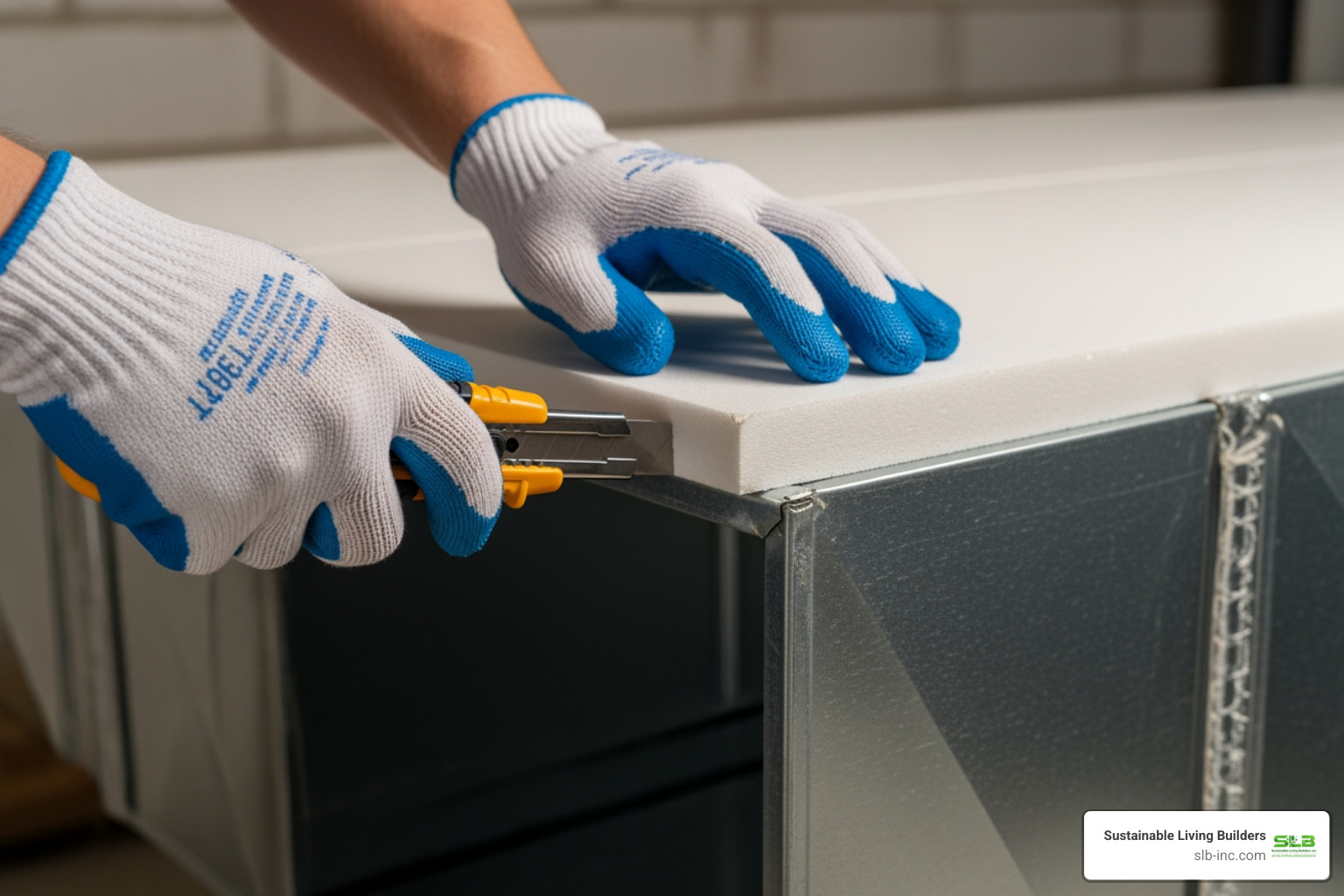
The key to success is to seal every seam and edge where the boards meet with duct mastic or foil tape. This creates a continuous air and moisture barrier. While it requires more precise cutting than fiberglass wrap, the result is excellent thermal performance and a tidy appearance that’s perfect for a finished basement.
The Step-by-Step Guide to Insulating Ductwork in a Finished Basement
With the right preparation, insulating ductwork in a finished basement is a manageable DIY project. Before you start, gather your safety gear (gloves, goggles, dust mask) and materials: duct mastic, UL-181 approved foil tape, your chosen insulation, a utility knife, and a measuring tape.

Step 1: Preparation is Key – Seal Before You Insulate
Never insulate over leaky ducts. Sealing first is a critical step required by modern building codes. Start by finding leaks; run your hand along seams and joints while the HVAC is on to feel for escaping air. Pay close attention to where ducts connect to registers.
Next, wipe down the duct surfaces to remove dust so the sealant can adhere properly. Apply a generous layer of duct mastic over all seams, joints, and connections with a paintbrush. For straight seams, you can also use UL-181 approved foil tape, pressing it down firmly to remove air bubbles. This step alone can prevent the 20-30% air loss common in unsealed systems.
Step 2: Proper Installation for Insulating Ductwork in a Finished Basement
With your ducts sealed, you’re ready to insulate.
-
For fiberglass duct wrap: Measure the duct’s circumference, add two inches for overlap, and cut the wrap. Wrap it snugly—but do not compress it—around the duct with the foil side facing out. Overlap the seam by two inches and secure it with UL-181 approved foil tape. A continuous strip of tape along the entire seam provides the best seal.
-
For rigid foam board: Measure each flat side of your rectangular duct and cut a precise panel to fit. Attach the panels to the duct and seal all seams where the foam boards meet with foil tape or mastic. This creates a continuous thermal barrier.
Ensure all ends and transition points are thoroughly sealed to prevent air leakage. For homeowners who prefer a professional touch, our team provides expert Insulation Installation in Santa Rosa, CA and can manage the entire process.
Step 3: Special Considerations for Insulating Ductwork in a Finished Basement
Not all ducts are created equal. Prioritize insulating your supply ducts, which carry conditioned air from your HVAC system to your rooms. These lose the most energy. Return ducts, which bring ambient air back to the system, are a lower priority, especially if your basement is already a conditioned space.
For tricky areas like elbows, tees, and boots, you’ll need patience. Cut smaller, custom-fit pieces of insulation and use mastic and foil tape liberally to ensure a continuous, sealed barrier. In tight spaces between joists, flexible fiberglass wrap is often easier to work with than rigid board.
At Sustainable Living Builders, we understand every home is unique. Learn more about What Services Sustainable Living Builders Provides to see how we can support your home improvement goals.
Avoiding Pitfalls: Common Mistakes and Condensation Prevention
To ensure your project is a success, avoid these common mistakes when insulating ductwork in a finished basement.
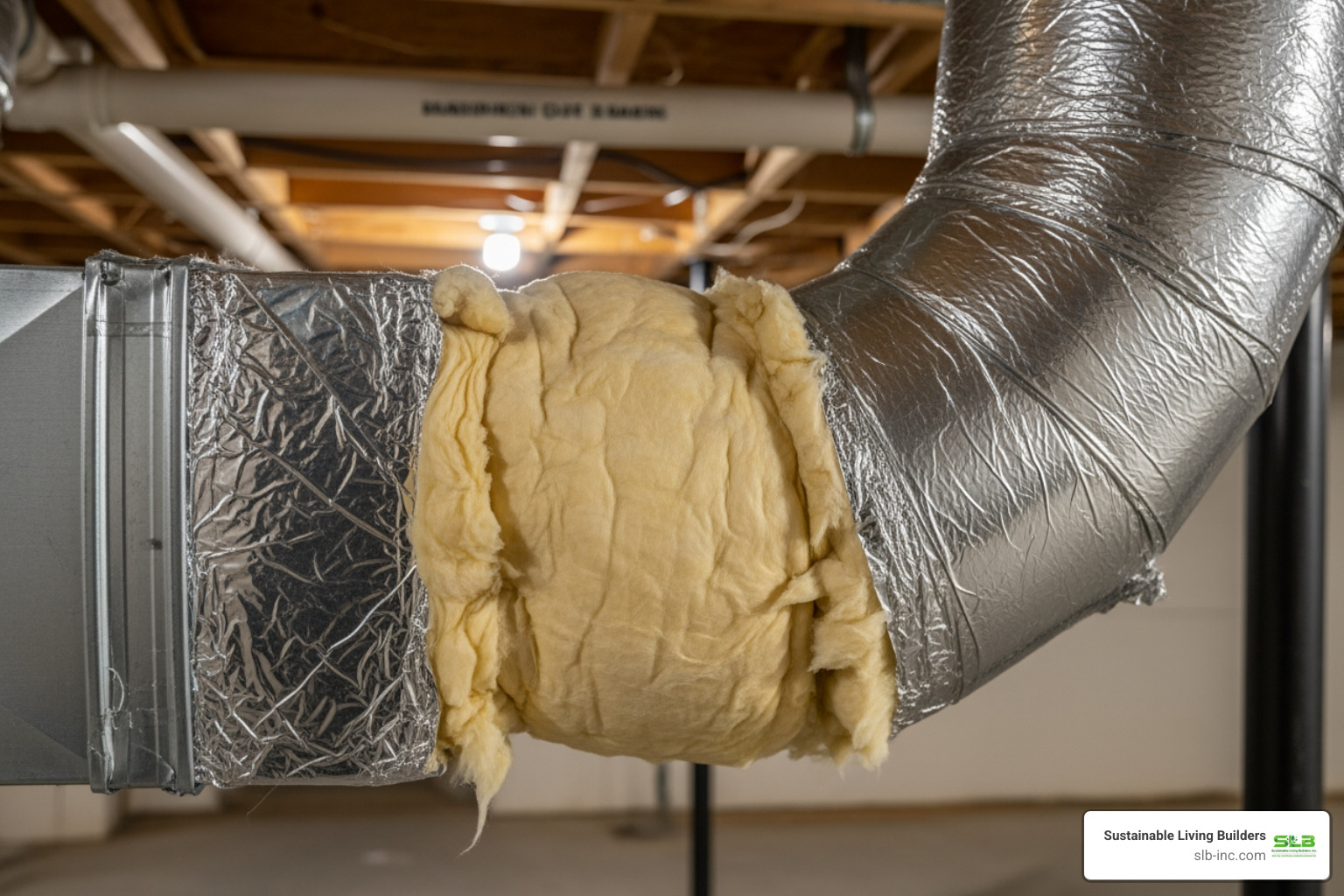
- Ignoring Duct Damage: Never wrap insulation over dented, corroded, or damaged ducts. Repair and seal all issues first.
- Compressing Insulation: Squeezing fiberglass wrap or flex duct crushes the air pockets that give it insulating power. Aim for a snug, not squashed, fit.
- Poor Sealing: Gaps in insulation or poorly taped seams create thermal bridges where energy escapes, defeating the purpose of your work.
- Damaging the Vapor Barrier: The foil or vinyl facing on duct insulation is a critical vapor barrier. If it’s installed backward, torn, or not sealed at the seams, moisture can get in and cause condensation.
How to Prevent Condensation on Ducts
Condensation on ducts can lead to mold, mildew, and structural damage. Proper insulation is your best defense, but it works in tandem with humidity control.
First, control basement humidity. Use a dehumidifier during humid months and air seal your basement by sealing gaps in the rim joists and other areas where outside air can infiltrate. The less moisture in the air, the lower the risk of condensation.
Second, ensure the vapor barrier is perfectly sealed. The foil or vinyl jacket on the insulation must face outward, and all seams must be completely sealed with UL-181 approved tape or mastic. Any breach allows moist air to reach the cold duct, causing condensation. For areas prone to heavy condensation, consider specialized products like vinyl-jacketed insulation or elastomeric foam.
Understanding Building Code Requirements
Adhering to local building codes is essential for safety and efficiency. In Santa Rosa, CA, and surrounding counties, codes are in place to protect your investment.
- Sealing is Mandatory: Modern codes require all duct seams and joints to be sealed with duct mastic or UL-181 approved foil tape. Standard cloth-backed duct tape is not permitted as it degrades over time.
- R-Value Minimums: Codes often specify minimum insulation R-values, especially for ducts in unconditioned spaces (typically R-8 for supply ducts and R-6 for return ducts). These are good benchmarks even for a finished basement.
- Fire Safety: Insulation materials must meet fire rating requirements. Always choose products that comply with local safety standards.
For complex projects or if you’re unsure about local codes, professional consultation is recommended. Our team at Sustainable Living Builders is well-versed in The Guide to Sustainable Building Practices: Strategies & Trends and can ensure your project is fully compliant.
When to Hold Off: Scenarios Where Duct Insulation Isn’t Necessary
While we advocate for insulating ductwork in a finished basement, there are situations where it may not be a high-priority project.
If your basement is fully conditioned and maintains the same temperature as the rest of your home year-round, the ducts are already running through a thermally stable environment. In this case, energy loss is minimal, as any heat transfer simply contributes to conditioning a space you already use.
Similarly, if you have never had condensation issues on your ducts, even during humid summers, then a primary driver for insulation (moisture control) is not a concern. Short duct runs that travel only a few feet within the conditioned basement also may not lose enough energy to justify the project.
Finally, consider the radiant heat benefit in winter. Some homeowners appreciate the gentle warmth that uninsulated heating ducts provide to an otherwise cool basement. If this passive heat helps keep the space comfortable, insulating the ducts might make the basement feel colder.
Even in these cases, sealing duct leaks is always recommended. Our team at Sustainable Living Builders can provide an honest assessment for your home in Santa Rosa, CA, or the surrounding areas. That straightforward approach is central to our mission, as you can learn more about at Why Choose Sustainable Living Builders in Santa Rosa.
Conclusion
Properly insulating your basement ductwork is a smart investment that delivers lasting returns in energy savings, home comfort, and system longevity. By sealing leaks and wrapping your ducts, you prevent the 20-30% air loss common in many homes, creating a more efficient and pleasant living environment.
You’ll enjoy more consistent temperatures, eliminate frustrating hot and cold spots, and protect your home from the mold and mildew caused by condensation. A properly insulated system also reduces strain on your HVAC equipment, helping it last longer with fewer repairs.
Whether you choose fiberglass wrap for its flexibility or rigid foam board for its clean finish, the key is meticulous installation: seal first, insulate without compression, and ensure a continuous vapor barrier. These steps separate a good project from a great one.
At Sustainable Living Builders, we see insulating ductwork in a finished basement as a key part of a holistic approach to creating sustainable homes in Santa Rosa, Sebastopol, Sonoma, Marin, and Napa Counties. It complements other green upgrades, like transitioning from gas to electric heating systems, to lower your carbon footprint and improve your quality of life.
If you’re ready to improve your home’s efficiency and comfort, explore our professional insulation services. Our team is ready to provide expert guidance and ensure your project is done right, meeting all codes and exceeding your expectations.