Your Electric Bill Is Too High — Here’s What Solar Actually Does About It
How solar panels reduce your electric bill is simpler than most people think: your panels generate electricity from sunlight, which powers your home directly — so you buy less from your utility. The less you pull from the grid, the lower your bill.
Here’s a quick breakdown of the key ways solar cuts what you owe each month:
- Direct offset — Solar energy powers your home in real time, replacing grid electricity hour by hour during daylight
- Net metering credits — Excess power your panels produce gets sent to the grid, and your utility credits you for it on your next bill
- Peak-hour savings — In areas with time-of-use rates, solar production often aligns with the most expensive hours of the day, cutting your highest-cost consumption first
- Battery storage — A home battery lets you use stored solar energy at night or during peak hours, reducing grid dependence even further
- Long-term rate protection — Once your system is installed, your solar electricity costs are fixed, shielding you from utility rate increases that average around 2.8% every year
The numbers back this up. According to Lawrence Berkeley National Laboratory, rooftop solar saves homeowners an average of $1,987 per year on electricity — a 90%+ reduction for a typical household. Over 25 years, the average U.S. homeowner saves around $61,000, with savings ranging as high as $154,000 depending on location and local electricity rates.
And yet, for many homeowners staring at a bill that keeps climbing, the “how” still feels like a mystery. That’s exactly what this guide is here to clear up.
If you’re a homeowner in the Santa Rosa area watching your electricity costs rise year after year, you’re not alone — and you’re not out of options. According to Aurora Solar’s 2025 Solar Snapshot, 72% of homeowners who go solar do it specifically to lower their electricity bills. The decision isn’t just about sustainability anymore. It’s a financial one.
This guide walks you through everything: how your panels physically reduce what you consume from the grid, how net metering and time-of-use rates work in your favor, what your bill actually looks like after going solar, and how to calculate your own savings and payback period.
My name is Karlo Jarina, and as the marketing lead at Sustainable Living Builders, I’ve spent years helping homeowners understand how solar panels reduce your electric bill — cutting through the jargon so the math and mechanics are clear. Let’s get into it.
The Science of Savings: How Solar Panels Physically Offset Grid Consumption
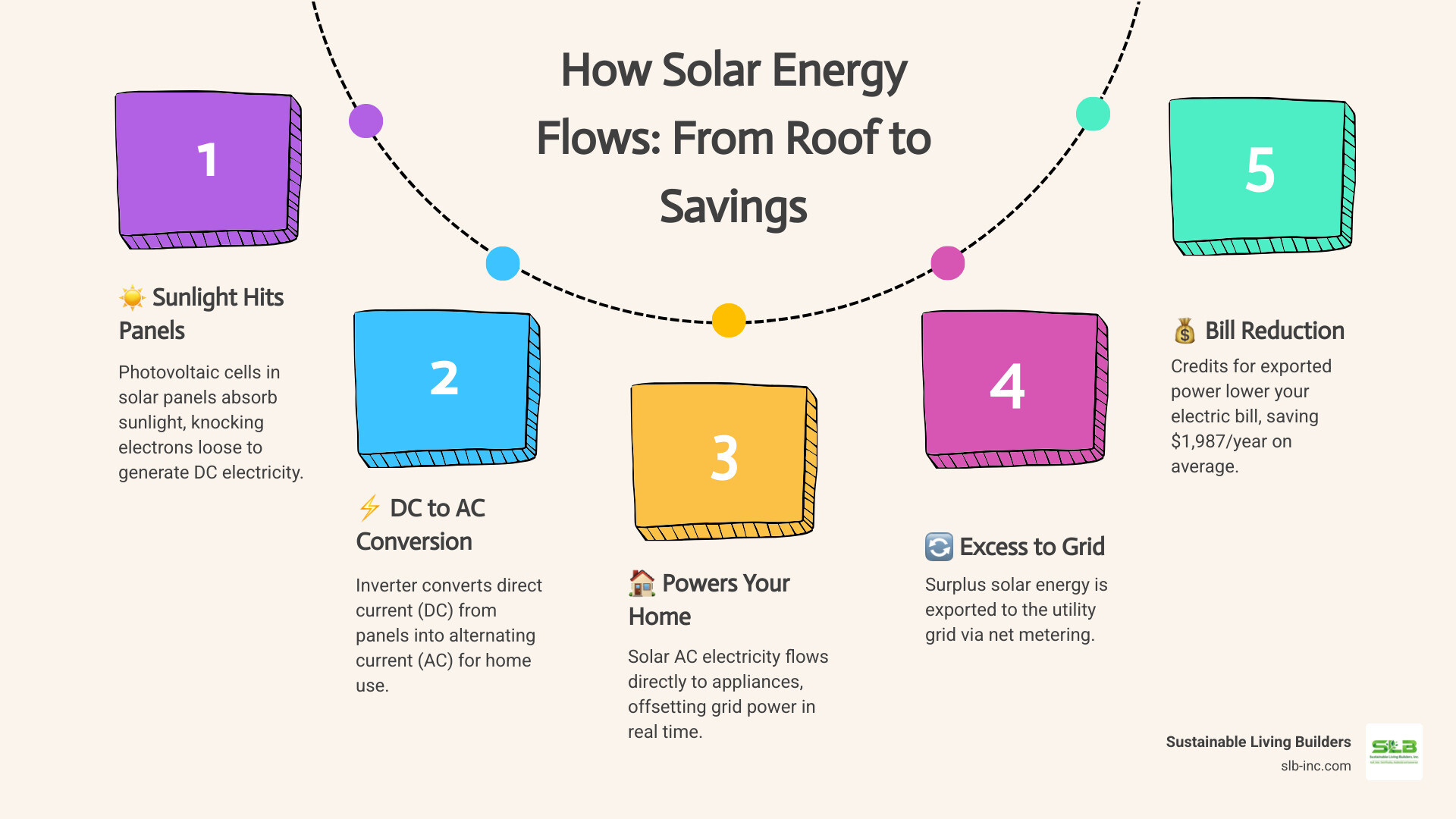
To understand how solar panels reduce your electric bill, we first have to look at the physics of your roof. It all starts with the photovoltaic (PV) process. When sunlight hits the silicon cells in your solar panels, it knocks electrons loose, creating an electric current. This is Direct Current (DC) electricity.
However, your home runs on Alternating Current (AC). This is where your inverter comes in. It acts as the “brain” of the system, converting that DC power into usable AC power for your fridge, lights, and laptop. Solar Energy System Introduction Common Types vary, but the goal remains the same: real-time offset.
Every kilowatt-hour (kWh) your panels produce is a kWh you don’t have to buy from PG&E or your local utility in Sonoma or Marin County. Think of it like growing your own vegetables in a garden; every tomato you pick is one less you have to pay for at the grocery store. This immediate consumption is the most direct way harnessing the power of the sun slashes your monthly overhead.

How Solar Panels Reduce Your Electric Bill Through Net Metering and TOU Rates
While direct consumption is great, the sun doesn’t always shine when we need the most power, and it often shines brightest when we aren’t home. This is where the financial “magic” of the grid comes into play.
In California, and specifically across Napa and Sonoma Counties, the relationship between your home and the grid is governed by two main factors: Net Energy Metering (NEM) and Time-of-Use (TOU) rates. Understanding these is vital when asking are solar panels worth it for your specific household.
Several factors influence these savings:
- System Sizing: A system that is too small won’t cover enough of your bill, while one that is too large might produce more than you can realistically get credited for.
- Roof Orientation: In our region, south-facing roofs generally see the most sun, but west-facing roofs can be incredibly valuable for hitting those expensive afternoon peak hours.
- Solar Resource: Even in the occasional morning fog of Santa Rosa, modern panels are efficient enough to generate significant power.
One of the biggest boosters to your initial ROI is the Federal Investment Tax Credit (ITC). As of April 2026, homeowners can still take advantage of a 30% tax credit on the total cost of their solar installation. This doesn’t just lower the “sticker price”—it accelerates your payback period significantly, making the benefits of home solar even more apparent.
Navigating Time-of-Use (TOU) rates: how solar panels reduce your electric bill during peak windows
If you’ve looked at your bill lately, you’ve noticed that electricity doesn’t cost the same amount all day. Under TOU rates, utilities charge significantly more during “peak hours”—typically in the late afternoon and early evening when everyone gets home and turns on the AC.
This is actually a secret weapon for solar owners. Because solar energy systems produce heavily during the afternoon, they are often generating their most valuable power exactly when the utility is charging the highest rates. By offsetting those expensive peak-hour “supply” charges, your panels are essentially saving you more money per kilowatt-hour than they would at noon.
Maximizing export credits: how solar panels reduce your electric bill via net metering
What happens when your panels are cranking out power while you’re at work? That excess energy doesn’t go to waste; it flows back onto the grid to power your neighbor’s house.
Through Net Energy Metering, your meter literally spins backward (or tracks the credit digitally). You earn credits for that exported power, which sit in a “virtual bank.” When the sun goes down and you start pulling power from the grid again, you use those credits first before you’re charged a cent. This is a core part of bringing the power of solar energy into your home. At the end of the year, your utility performs a “True-Up” statement, balancing out all the credits you earned in the summer against the extra power you might have needed in the winter.
Beyond the Panels: Enhancing Efficiency with Batteries and Smart Tech
As we move through 2026, the “solar-only” model is evolving. To truly master how solar panels reduce your electric bill, many homeowners in Sebastopol and Napa are adding battery storage.
A home battery allows you to store your own excess midday production and use it during the 4 PM to 9 PM peak window. This is called “load shifting.” Instead of selling your power to the utility for a credit and buying it back later, you just keep your own “fuel” at home. This maximizes self-consumption and offers protection during the wildfires or grid outages we sometimes face in Northern California.
Sunny’s Tip for Appliance Timing: Our fictional solar expert, Sunny, always recommends “solar snacking.” Try to run your dishwasher, laundry, or pool pump between 10 AM and 2 PM. By using your appliances when your panels are at peak production, you ensure you’re using 100% free, “home-grown” energy.
To keep that energy flowing, don’t forget maintenance. Knowing how often to clean solar panels—especially after a dusty North Bay summer—can keep your efficiency from dipping. When installing solar panels in your home, always ask about smart home integration so you can automate this savings process.
Tracking performance: how solar panels reduce your electric bill through monitoring
You can’t manage what you don’t measure. Most modern systems come with a monitoring app that shows you exactly how much you’re producing and consuming in real-time. By watching these patterns, you can identify “energy vampires” in your home—like an old fridge in the garage—and adjust your habits to save even more. Solar energy made simple means having the data right on your smartphone.
What to Expect on Your Utility Statement After Going Solar
One common myth is that your electric bill completely disappears. While your usage charges might hit zero, you will likely still receive a monthly statement. Here is what a typical transition looks like:
| Bill Item | Pre-Solar Home | Post-Solar Home |
|---|---|---|
| Supply/Generation | $150 – $300+ | $0 (Offset by Solar) |
| Delivery Charges | $80 – $150 | $0 (Offset by Credits) |
| Minimum Delivery Fee | $0 | ~$10 – $15 (Fixed connection fee) |
| City/State Taxes | $15 – $30 | Minimal (Based on net usage) |
| Total Monthly | $250 – $480 | $10 – $20 |
Even if you still pay a small connection fee, the savings are massive. Furthermore, these savings contribute to a larger financial picture. A famous study by the Lawrence Berkeley National Laboratory found that solar panels increase home value by an average of $15,000. For homeowners looking for home solar in Santa Rosa, this means your “savings” aren’t just in the monthly bill—they are building equity in your property. If you’re ready to make the jump, consulting with Santa Rosa solar installers can help you map out this exact table for your home.
Frequently Asked Questions About Solar Savings
Do I still get a bill if my panels cover all my usage?
Yes. Most utilities charge a “minimum delivery fee” or “account maintenance fee” to keep your home connected to the grid. This is usually a small amount (often under $20), but it ensures that if your panels stop producing (like at night), the lights stay on.
Why is my bill higher in the winter months?
In Sonoma and Napa Counties, winter means shorter days and more cloud cover. Your panels will produce less energy, while you might be using more for heating and lighting. However, if you built up enough “NEM credits” during our sunny California summers, those credits will often cover your winter grid usage.
How does solar affect my property taxes in California?
Great news here: California has a property tax exclusion for many solar energy systems. This means that while your home value increases (making it a better investment), your property taxes won’t automatically spike just because you added solar panels.
Conclusion
At Sustainable Living Builders, we believe that the best way to predict your future energy costs is to create them yourself. By understanding how solar panels reduce your electric bill, you move from being a “renter” of expensive, fluctuating utility power to being an owner of a clean, fixed-cost energy plant right on your roof.
Whether you are looking for solar panels in Marin County or energy-efficient roofing in Napa, our goal is holistic sustainability. We don’t just slap panels on a roof; we look at your home’s entire envelope. Using our Smart Roof Calculator, we can help you determine the perfect balance of insulation, roofing material, and solar capacity to maximize your ROI.
Stop letting your hard-earned money disappear into the grid. Start owning the sun today. Reach out to us at Sustainable Living Builders, and let’s build a more efficient, affordable future for your home in the North Bay.