The Federal Solar Tax Credit Window Is Closing — Here’s What Homeowners Need to Know
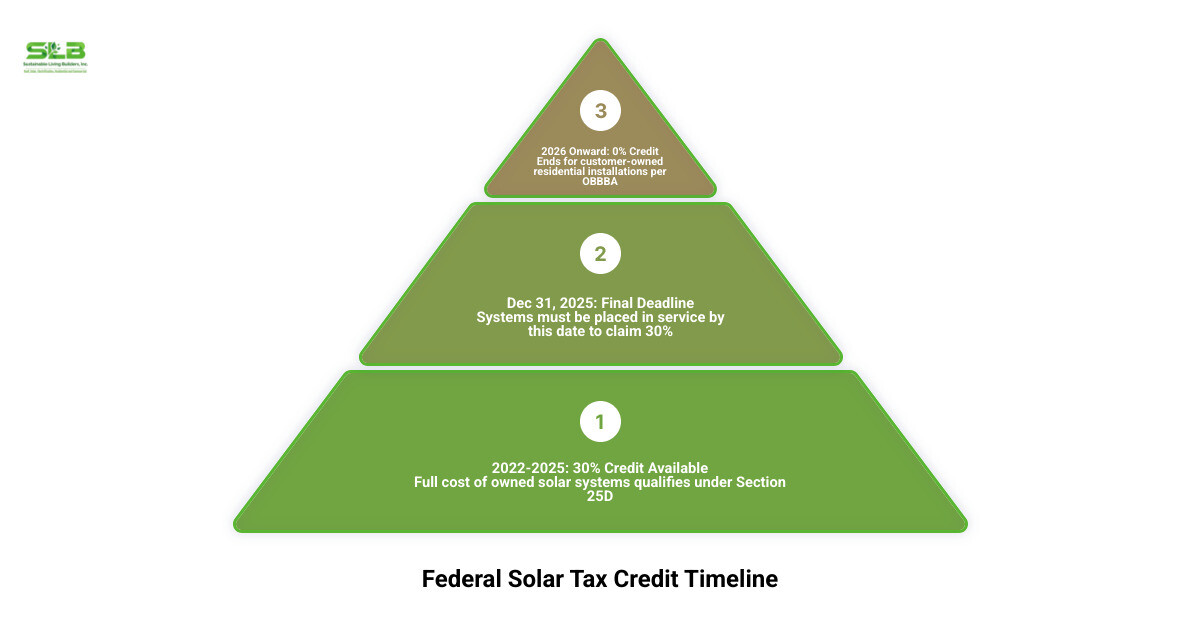
The federal solar investment tax credit for homeowners — officially called the Residential Clean Energy Credit under Section 25D of the U.S. Tax Code — gave homeowners a 30% tax credit on the full cost of a purchased and installed solar system. That credit applied to systems placed in service through December 31, 2025. As of January 1, 2026, the credit dropped to 0% for customer-owned residential systems following the passage of the One Big Beautiful Bill Act.
Here’s a quick summary of where things stand right now:
| Question | Answer |
|---|---|
| What is the credit? | A dollar-for-dollar reduction on your federal tax bill — 30% of your qualified solar system costs |
| Who qualifies? | Homeowners (or renters) who own their solar system installed on a U.S. residence |
| What’s the income limit? | None |
| What’s the dollar cap? | None |
| Is it refundable? | No — but unused credit carries over to future tax years |
| When did it expire? | December 31, 2025 for new customer-owned residential installations |
| Can I still claim it? | Yes — if your system was installed and placed in service by December 31, 2025, you can claim it on your 2025 tax return |
| How do I claim it? | File IRS Form 5695 with your federal tax return |
If your solar system was up and running before the end of 2025, you likely still have money on the table. Read on to make sure you claim every dollar you’re owed.
I’m Karlo Jarina, marketing lead at Sustainable Living Builders, where I’ve spent years helping homeowners understand how incentives like the federal solar investment tax credit for homeowners can make going solar a smarter financial decision. Let’s walk through exactly how this credit works, who qualifies, and how to claim it correctly on your 2025 taxes.
Understanding the Federal Solar Investment Tax Credit for Homeowners

When we talk about the federal solar investment tax credit for homeowners, we are looking at Section 25D of the Internal Revenue Code. For those of us living in Santa Rosa or Napa, this has been the single most important financial tool for making solar accessible.
It is vital to understand that this is a tax credit, not a tax deduction. A deduction lowers the amount of income you are taxed on, but a credit is a dollar-for-dollar reduction of the actual taxes you owe. If you owe the IRS $8,000 and you have a $5,000 solar tax credit, your tax bill drops to $3,000. It’s essentially the government writing a check to cover 30% of your Solar Energy Systems costs.
The credit is “nonrefundable,” which sounds a bit scary, but it just means the IRS won’t give you back more than you owe in a single year. However, the beauty of the Residential Clean Energy Credit is the carryover provision. If your credit is larger than your tax liability for the 2025 tax year, you don’t lose the rest! You can roll that remaining balance forward to future years. This has been a lifesaver for many of our retired neighbors in Sonoma County who might not have a massive tax bill in a single year but still want to invest in their homes.
To qualify, the system must be installed on a residence you use as a home in the United States. While it’s usually for a primary residence, it can also apply to secondary homes (like a vacation cottage in Sebastopol) as long as you aren’t using that second home as a full-time rental property.
What Changed in 2026? The Impact of the One Big Beautiful Bill Act
As we sit here in April 2026, the landscape has shifted significantly. For the last decade, we’ve seen the solar tax credit extended and expanded, most notably by the Inflation Reduction Act of 2022, which set the rate at 30% through 2032. However, the political winds shifted.
In July 2025, Congress passed the “One Big Beautiful Bill Act” (OBBBA). This legislation made several sweeping changes to energy policy, including the abrupt termination of the 30% credit for customer-owned residential solar systems. As of January 1, 2026, the credit value for a homeowner who buys their own panels has fallen to 0%.
This is why we are seeing such a frenzy this tax season. If you are asking Are Solar Panels Worth It in 2026, the answer is still yes because of the long-term utility savings—which can average $60,000 over 25 years—but the upfront math has changed. Without that 30% federal “discount,” the initial cost or loan amount for Home Solar In Santa Rosa Ca is effectively 30% higher than it was just a few months ago.
The OBBBA didn’t just affect solar; it changed the timeline for many Home Energy Incentives. While some commercial credits still exist for third-party owned systems (which we’ll get into later), the era of the direct 30% homeowner “check” from Uncle Sam for new 2026 installations has officially ended.
Claiming the federal solar investment tax credit for homeowners on 2025 tax returns
If you managed to get your system installed before the clock struck midnight on December 31, 2025, you are in the “Golden Zone.” You are eligible to claim the full 30% credit on the tax return you are filing right now in April 2026.
To do this, you need IRS Form 5695, “Residential Energy Credits.” This form is where you calculate your credit based on your total system cost. The IRS uses the “placed in service” date to determine eligibility. In solar, this generally means the day the installation was completed and the system was ready to generate power—even if the utility company hadn’t granted “permission to operate” (PTO) just yet.
One common question our team at Sustainable Living Builders gets is: “What if I don’t owe enough taxes this year to use the whole credit?” Don’t worry! Even though the credit has expired for new 2026 installs, the IRS allows you to carry over the unused portion of your 2025 credit into 2026 and beyond. If your 30% credit was $9,000 but you only owed $5,000 in taxes for 2025, you can apply the remaining $4,000 to your 2026 taxes.
Eligibility and Qualifying Equipment for Clean Energy Credits
The federal solar investment tax credit for homeowners wasn’t just for blue rectangular panels on the roof. It covered a wide range of clean energy technology. One of the most popular additions we’ve seen in Marin and Sonoma counties recently is Energy Storage Batteries.
Starting in 2023, the law was clarified to include battery storage with a capacity of at least 3 kilowatt-hours (kWh), even if the battery wasn’t installed at the same time as the solar panels. This allowed homeowners to “retrofit” their systems with backup power and still claim the 30% credit.
Another qualifying technology is the Tesla Solar Roof. Unlike traditional shingles, which do not qualify for the credit, solar roofing tiles and shingles are considered “solar electric property” because they actually generate electricity.
Here is a quick look at what was covered under the 2025 rules:
| Qualifying Expense | Non-Qualifying Expense |
|---|---|
| Solar PV panels and shingles | Traditional roof shingles or tiles |
| Energy Storage Batteries (≥3kWh) | Roof trusses or structural repairs |
| Solar water heaters (SRCC certified) | Pool or hot tub heaters |
| Geothermal heat pumps (Energy Star) | Interest or loan origination fees |
| Labor for onsite prep and assembly | Trees/landscaping for shade removal |
| Inverters, wiring, and mounting | Maintenance or “cleaning” contracts |
For solar water heaters, they must be certified by the Solar Rating & Certification Corporation (SRCC) or a comparable entity endorsed by the state. Geothermal systems likewise must meet Energy Star requirements at the time of purchase.
Expenses covered by the federal solar investment tax credit for homeowners
When we help our clients calculate their total project cost, we make sure they don’t leave anything out. The credit applies to the entire cost of the system, not just the Solar Panels.
According to the IRS, qualified solar electric property expenses include:
- The cost of the panels themselves.
- Labor costs for onsite preparation, assembly, or original installation. This includes the hard work our crews do in the sun!
- Piping or wiring to connect the system to the home.
- Inverters, which convert the DC power from the sun into the AC power your TV and fridge use.
- Mounting equipment and racking.
- Sales taxes on all the above.
When Powering Your Future With Teslas Solar Solutions, for example, the entire integrated system—from the sleek glass tiles to the Powerwall battery—falls under the umbrella of qualified expenses. Just remember to subtract any utility rebates from the total cost before you calculate your 30% credit.
Navigating Complex Scenarios: Leases, New Builds, and Carryovers
Not every solar installation is a straightforward “I bought it, I own it” situation. Things get a little tricky when we talk about third-party ownership.
If you have a Solar Lease or a Power Purchase Agreement (PPA), you generally cannot claim the federal solar investment tax credit for homeowners. Why? Because technically, you don’t own the system—the solar company does. In these cases, the company claims the commercial tax credit (under Section 48E). While you don’t get the tax credit on your return, these companies often pass the savings to you through lower monthly payments.
With the 2026 changes, third-party owned systems have become even more relevant. While the residential credit for owners hit 0% on January 1, the commercial credit (which these companies use) has different expiration timelines, often staying available for projects that start construction before 2026 or meet specific “placed in service” windows through 2028.
What if you bought a brand-new home in a development in Santa Rosa? If the builder installed the solar before you moved in, you can still claim the credit for the year you moved in, provided the home was completed in 2025. You’ll need a written statement from the builder breaking down the cost of the solar system so you can prove the “basis” of your credit to the IRS.
As Santa Rosa Solar Installers, we often see homeowners who are worried about their “unused” credits. Our friend Sunny, a fictional homeowner we use for training, recently asked: “If I finish my 2025 taxes and still have $2,000 in solar credits left over, can I use them in 2027?” The answer is yes! As long as the credit was established on a 2025 or earlier installation, you can keep rolling it forward until it’s used up.
Frequently Asked Questions about Solar Tax Credits
How do state rebates and utility incentives affect my federal credit?
This is where the math gets a bit “fun.” If your utility company gives you a one-time rebate for installing solar, you must subtract that rebate from the total cost of the system before calculating your federal tax credit. For example, if your system cost $20,000 and the utility gave you a $1,000 rebate, your “basis” for the federal credit is $19,000.
However, state tax credits (like those sometimes offered in California) usually do not reduce your federal basis. You get the full federal credit, and then you get the state credit on top of it. It’s a great way to stack Home Energy Incentives to maximize your ROI. “Net metering” credits (where the utility pays you for extra power you send to the grid) do not affect your tax credit eligibility at all.
Can I claim the credit for a system on a second home or rental property?
You can claim the credit for a second home as long as you live there for part of the year and do not rent it out to others when you aren’t there. If you use the home as a vacation rental, you can only claim a prorated portion of the credit based on the percentage of time you personally use the home.
One big exception: Fuel cells are only eligible for the credit on your principal residence. You can’t put a fuel cell in your Sebastopol vacation home and claim the credit. Also, if you are a landlord who doesn’t live at the property, you aren’t eligible for the residential credit, though you might qualify for the commercial version.
Does the federal credit apply to off-grid systems or community solar?
Yes, off-grid systems absolutely qualify! As long as the system provides electricity for a residence located in the U.S., it doesn’t matter if it’s connected to the utility grid or not.
Community solar is a bit more nuanced. If you are a “tenant-stockholder” in a cooperative housing corporation or a member of a condominium, you can claim your proportional share of the credit for a system installed by the association. However, if you are just “subscribing” to a community solar farm owned by a third party, you usually don’t qualify for the tax credit because you don’t own the equipment.
Conclusion
At Sustainable Living Builders, we believe that understanding the federal solar investment tax credit for homeowners is the key to unlocking a more sustainable future for our community. While the 2026 expiration of the customer-owned credit marks the end of an era, those who acted in 2025 are now reaping the rewards as they file their taxes this month.
Our team, led by experts like Sunny, is here to help you navigate the remaining 4 Benefits Of Home Solar Why You Should Make The Switch. Even without the 30% federal “bump” for new 2026 projects, solar remains a powerful way to insulate yourself from rising utility rates and reduce your carbon footprint.
If you’re ready to see how the current 2026 landscape affects your home, Explore your options with Home Energy Incentives and let us help you build a smarter, greener home in Sonoma, Marin, or Napa County. We are in this together, and we are here to ensure your transition to clean energy is as smooth and affordable as possible.