I’m looking to lower my electricity bills with natural light. Who in Santa Rosa specializes in energy-efficient skylight installations?
How skylights reduce energy use from lighting is simpler than most homeowners realize: they replace the need for electric lights during the day by channeling natural sunlight directly into your living spaces. Here’s a quick breakdown of how it works:
- Natural light replaces artificial light — Skylights flood rooms with daylight, so you keep the lights off longer.
- More light per square foot — Skylights deliver roughly double the daylight of a vertical window of the same size.
- Significant energy savings — Buildings with well-designed daylighting can cut lighting energy use by 20% to 60%.
- Less demand on your electrical system — Natural daylight at equivalent brightness levels can require up to five times less energy than electric lighting.
- Works in nearly every room — Tubular skylights (sun tunnels) can bring daylight even into interior spaces with no direct roof access.
For homeowners dealing with high electricity bills, the math is straightforward: every hour your skylights light a room is an hour your electric lights stay off.
I’m Sunny from Sustainable Living Builders, and my work in sustainable home improvement has given me a front-row seat to just how effectively daylighting strategies — including understanding how skylights reduce energy use from lighting — can transform both energy bills and home comfort. In the sections ahead, we’ll walk you through everything you need to know to make skylights work hard for your home.
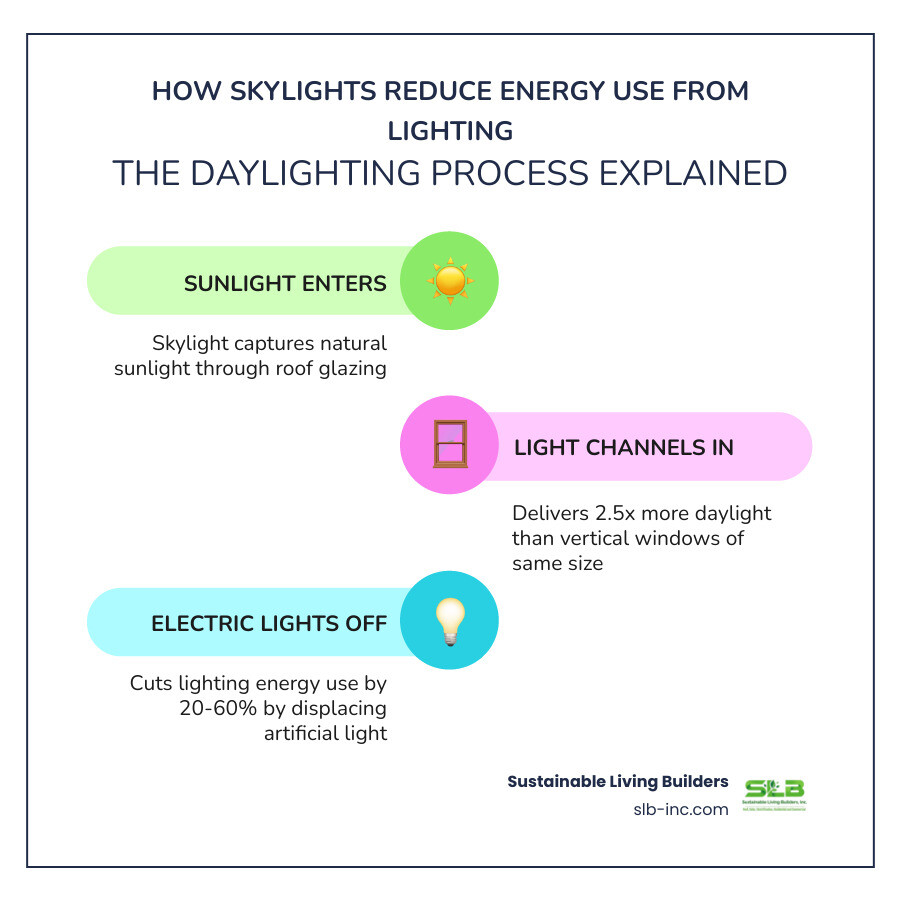
How Skylights Reduce Energy Use from Lighting

When we talk about how skylights reduce energy use from lighting, we are looking at a powerhouse of efficiency. A standard 2’x4’ skylight isn’t just a window in your ceiling; it’s an illumination engine. In fact, a single skylight of this size can let in more than 2.5 times the amount of light as a vertical wall window. To put that in perspective, one well-placed skylight can generate as many lumens as eleven 100-watt lightbulbs.
By capturing sunlight from above—where the sun is at its brightest—skylights allow homeowners in Santa Rosa and Sonoma County to keep their light switches in the “off” position for the majority of the day. Research shows that buildings incorporating these natural daylighting solutions can reduce their lighting energy consumption by 20% to 60%. This is one of the most effective 4 Benefits of Installing Skylights in your Home because it addresses one of the most consistent energy drains in a household.
Understanding the Science of Daylighting
Daylighting is the practice of placing windows, skylights, and reflective surfaces so that natural light provides effective internal illumination. Unlike the “yellow” or “cool blue” hues of artificial bulbs, natural sunlight provides a full spectrum of light. This isn’t just better for your eyes; it’s better for your home’s energy balance.
When we rely on electric lighting to provide the same “lux” (brightness) levels that daylight provides naturally, the total energy demand—including the heat those bulbs put off—can be five times greater than a home using well-designed glazing. There are many Reasons to get Skylights and Sun Tunnels for your Home, but the visual comfort of diffused, natural light is often what our clients in Marin County love the most.
How Skylights Reduce Energy Use from Lighting During Daytime Hours
In April 2026, we are seeing a massive shift toward “passive” home technologies. Skylights are the ultimate passive lighting tool. During peak daylight hours, the need for artificial light is essentially zero in rooms with overhead glazing.
To maximize this, many modern homes now use photosensors and smart home integration. These systems detect when the skylight is providing enough “free” light and automatically dim or turn off LED fixtures. When you Increase Home Energy Efficiency through these automated layers, you ensure that you aren’t paying for a single watt of electricity that the sun is already providing for free.
How Skylights Reduce Energy Use from Lighting in Windowless Spaces
We all have that one “cave” in our house—usually a hallway, a walk-in closet, or a small bathroom—where the light stays on 24/7 because there are no windows. This is where a Bathroom Sun Tunnel becomes a game-changer. These devices use highly reflective tubes to “pipe” light from your roof down into interior rooms. Even in spaces where a traditional window is impossible, you can eliminate the need for daytime electric lighting entirely.
Maximizing Daylighting with Advanced Roof Windows and Sun Tunnels
Choosing the right hardware is essential for performance. While both traditional skylights and sun tunnels reduce energy use, they serve different purposes.
| Feature | Traditional Skylight | Tubular Sun Tunnel |
|---|---|---|
| Best For | Large rooms, views, ventilation | Small rooms, hallways, closets |
| Light Output | Extremely high (up to 11 bulbs) | High (equivalent to ~3 bulbs) |
| Heat Impact | Moderate (minimized by Low-E) | Very Low |
| Installation | Involved (requires shaft) | Simple (fits between rafters) |
Whether you choose Skylights Sun Tunnels or a classic Roof Window, the goal remains the same: capturing the maximum amount of light with the minimum amount of heat transfer.
High-Performance Glazing and Coatings
In the past, people worried that skylights would turn their homes into greenhouses. In April 2026, that simply isn’t the case. Modern units use Low-E (low-emissivity) coatings and argon gas between double or triple panes. These technologies act as a thermal barrier. When selecting a unit, we always look for National Fenestration Rating Council (NFRC) labels and ENERGY STAR standards. These ratings ensure the skylight blocks the heat of the Napa County sun while letting the visible light flood in.
The Efficiency of Tubular Daylighting Devices
If you have a small space, a Bathroom Sun Tunnel is often the most efficient choice. These use sun-tracking technology or highly reflective interior “pipes” to deliver light even on cloudy days. Because the surface area on the roof is smaller than a traditional skylight, there is almost no heat gain or loss, making them an incredibly “green” way to brighten up a dark corner without impacting your HVAC bill.
Strategic Design: Placement and Orientation for Efficiency
Where you put your skylight is just as important as what kind you buy. To truly master how skylights reduce energy use from lighting, you have to work with the sun’s path across the California sky.
Optimizing Slope and Orientation
In our region, the orientation of your roof dictates your light quality:
- North-facing: Provides consistent, cool, and diffused light all day without glare or massive heat gain.
- South-facing: Offers the most intense light and can provide “passive solar heating” in the winter.
- East-facing: Great for morning light (perfect for kitchens!).
- West-facing: Provides strong afternoon light but can get very warm in the summer.
A pro tip for efficiency: the optimum slope for a south-facing skylight is your geographical latitude plus about 5 to 15 degrees. This angle maximizes the “low” winter sun for both light and heat while minimizing the “high” summer sun. For a Deck Mounted Skylight, this positioning is key to year-round performance.
Sizing for Balanced Illumination
A common mistake is going too big. To balance light and temperature, a good rule of thumb is that the skylight should be no more than 5% of the floor area in a room with many windows, and no more than 15% in a room with few windows. This ensures you get plenty of light to replace your lamps without creating “hot spots” or excessive glare.
Specialized Solutions for Every Room in the House
Every room in your Sebastopol or Sonoma home has different lighting needs.
Enhancing Kitchens and Living Areas
Kitchens require high-quality “task lighting.” By installing a Kitchen Roof Window, you can illuminate your countertops with natural light that renders colors more accurately than any LED. In large, open-concept living areas, a Deck Mounted Skylight can help the light reach the center of the house where wall windows can’t reach.
Bathroom and Small Space Innovations
Bathrooms are often the most “light-hungry” rooms. We frequently recommend a Bathroom Skylight With Exhaust Fan. This dual-purpose unit reduces energy use from lighting while also using passive or active ventilation to remove moisture, protecting your home from mold and reducing the load on your HVAC system.
Frequently Asked Questions about Energy-Efficient Skylights
How much light does a standard skylight provide compared to a window?
As we’ve noted, skylights are significantly more efficient at delivering light. Because they face the sky directly, they provide double the daylight of a vertical window of the same area. In many cases, a single skylight provides 2.5 times the light of a window because it isn’t blocked by trees, fences, or neighboring houses.
Do skylights cause unwanted heat gain in the summer?
Not if they are designed correctly! By using units with high-quality Low-E coatings and low Solar Heat Gain Coefficients (SHGC), you can block the heat while keeping the light. Additionally, many of our clients in the Bay Area opt for remote-controlled shades. These allow you to “dim” the sun during the hottest part of a July afternoon, keeping your home cool.
Can skylights be integrated with smart home systems?
Absolutely. In 2026, “smart” skylights are the standard for sustainable living. These units can include moisture sensors that automatically close the vent if it starts to rain, and they can be programmed to open in the evening to let out trapped heat (the “stack effect”). This reduces the need for both artificial lighting and air conditioning.
Conclusion
At Sustainable Living Builders, we believe that the best way to save energy is to stop using it where it’s not needed. Nature provides us with all the light we need; we just have to let it in. Whether you are looking for a dramatic roof window for your living room or a discreet sun tunnel for a dark hallway, our team is here to help you find the perfect fit.
If you’re curious about how much you could save, check out our Smart Roof Calculator or reach out to Sunny and the rest of our expert team. We serve homeowners throughout Santa Rosa, Sebastopol, and the surrounding North Bay counties, providing holistic, sustainable solutions that make sense for your wallet and the planet.
Ready to brighten your home? Explore our options for Skylights Sun Tunnels today and start enjoying the “bright savings” of natural sunlight!