Why Sonoma County’s Climate Is One of the Biggest Threats — and Opportunities — for Your Home
How Sonoma County climate affects your roof and energy system is something every local homeowner needs to understand before the next heat wave, wildfire season, or atmospheric river rolls through.
Here’s a quick breakdown:
| Climate Factor | Impact on Roof | Impact on Energy System |
|---|---|---|
| 262+ sunny days/year | UV degradation, thermal expansion | High solar generation potential |
| Wildfire season & embers | Up to 90% of home loss from embers | Increased HVAC demand, air quality strain |
| Coastal fog & salt air | Moisture damage, moss, corrosion | Reduced solar panel output |
| Inland heat spikes | Shingle cracking, shortened lifespan | Higher cooling loads, HVAC stress |
| Atmospheric rivers | Drainage failures, leaks, rot | Duct leaks worsen in wet conditions |
| Wide temperature swings | Material fatigue from expansion/contraction | Inconsistent heating and cooling demand |
Sonoma County is a place of dramatic contrasts. On any given week in summer, you might have dense morning fog burning off into 100°F inland heat — then spend the next month watching fire evacuation maps. In winter, atmospheric rivers can dump inches of rain in hours. Your roof sits at the intersection of all of it.
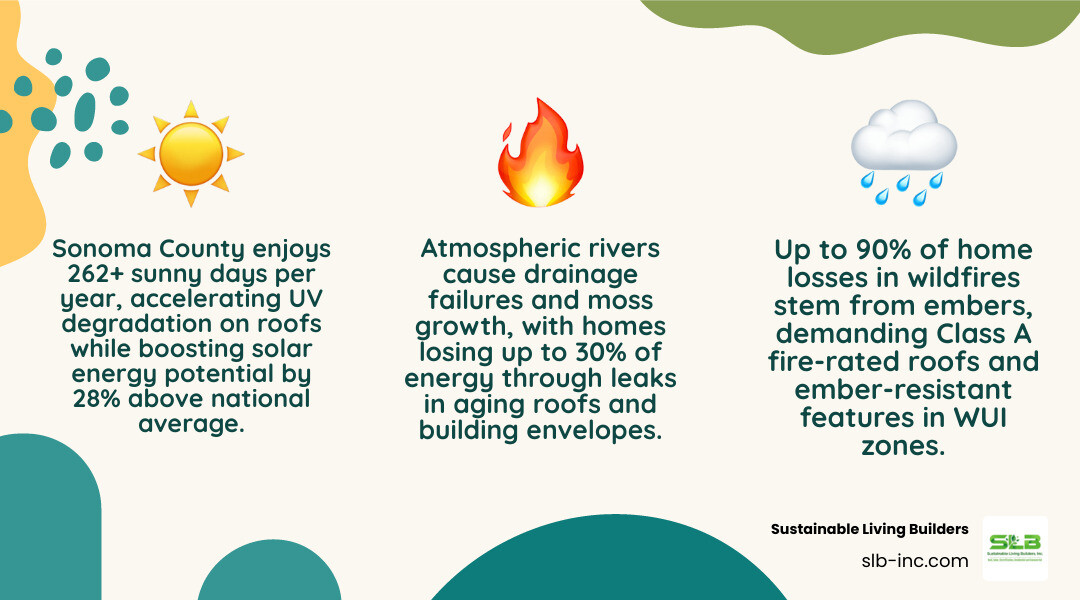
The challenge is that most homes in the county weren’t built to handle these extremes as they exist today. Climate conditions are intensifying, and a roof or energy system that was “good enough” a decade ago may already be falling short. Homes can lose up to 30% of their heated or cooled air through building envelope leaks alone — and that’s before you factor in an aging roof, poor attic insulation, or outdated HVAC equipment.
The good news? Sonoma County also receives 28% more solar radiation than the national average. That means the same climate that stresses your home also gives you a powerful tool to fight back — if your roof and energy systems are up to the job.
This guide walks you through exactly how local conditions shape what your roof and energy systems need to perform, last, and keep your household safe and efficient in May 2026 and beyond.
How Sonoma County climate affects your roof and energy system
Living in Santa Rosa or Sebastopol, we are all too familiar with the “Sonoma Swing.” One day you’re enjoying a crisp coastal breeze, and the next, the thermometer is pushing triple digits. This isn’t just a matter of personal comfort; it is a relentless workout for your home’s exterior.

UV Degradation and Thermal Expansion
With 262 sunny days per year, our roofs are under a constant barrage of ultraviolet (UV) radiation. Over time, UV rays break down the chemical bonds in roofing materials. Traditional asphalt shingles can become brittle, lose their protective granules, and eventually crack.
Furthermore, the temperature swings—where it might be 50°F at dawn and 95°F by 3 PM—cause materials to expand and contract rapidly. This “thermal shock” can pull at fasteners and cause shingles to buckle. To combat this, choosing the most durable roofing materials for California’s climate is essential. Materials like metal, clay tile, or high-performance composites are designed to handle this movement without failing.
The Coastal Fog vs. Inland Heat Tug-of-War
In coastal areas or parts of the county influenced by the marine layer, moisture is the primary enemy. Constant fog can lead to moss and lichen growth, which traps water against the roof surface and accelerates rot. Conversely, inland areas face extreme heat that can turn an unventilated attic into an oven, reaching temperatures upwards of 150°F. This heat doesn’t just age the roof; it forces your air conditioner to work overtime, significantly increasing your energy bills and shortening the lifespan of your HVAC system.
Understanding how Sonoma County climate affects your roof and energy system during wildfire season
In May 2026, wildfire resilience is no longer optional—it is a cornerstone of responsible homeownership in Northern California. Research shows that up to 90% of home losses during wildfires are caused by embers, not the main fire front. These embers can travel miles ahead of a fire, landing on roofs or being sucked into vents.
- Class A Fire-Rating: This is the gold standard. A Class A roof is designed to withstand a burning brand for one hour without burning through. Materials like asphalt fiberglass shingles, clay tiles, and metal are top choices for meeting this requirement.
- WUI Zones and Home Hardening: If you live in a Wildland Urban Interface (WUI) zone, ignition-resistant construction is mandated. This includes “home hardening” features like ember-resistant vents. Unlike traditional vents, these are designed to block flames and embers while still allowing your attic to breathe.
- Noncombustible Gutters: Embers often land in gutters filled with dry leaves. Replacing gutters with metal versions and installing noncombustible gutter covers can prevent a small spark from turning into a house fire.
Optimizing how Sonoma County climate affects your roof and energy system with cool materials
One of the most effective ways to lower your carbon footprint and your utility bill is through “cool roofing.” These materials are engineered to reflect more sunlight and absorb less heat than standard roofing.
Under California’s Title 24 energy standards, cool roofs are often a requirement for new builds or significant reroofing projects. By reflecting solar radiation, these roofs keep the building shell much cooler. This reduces the “cooling load”—the amount of work your HVAC system has to do.
However, a cool roof is only part of the equation. We often tell homeowners that the attic is the largest energy-saving opportunity in the house. Adding robust attic insulation and ensuring proper ventilation keeps heat from migrating into your living space. Since homes can lose up to 30% of their conditioned air through enclosure leaks, sealing those gaps is a high-priority “resilience” upgrade. To see if your roof has survived the recent seasons unscathed, you should refer to the essential post-winter roof damage checklist.
I’m looking to upgrade my home’s efficiency. How do local sun patterns impact solar and heat pumps?
Sonoma County is a solar goldmine. Because we receive 28% more solar radiation than the national average, our solar panels can operate at peak efficiency for roughly 72% of the year. This makes the transition to an all-electric home not just an environmental choice, but a financial one.
Solar PV and Roof Condition
Before you install solar, we always recommend checking the “health” of your roof. Installing a 25-year solar system on a 15-year-old roof is a recipe for future headaches. Interestingly, solar panels can actually extend the life of the roofing material beneath them by shading it from UV rays, and they can even reduce indoor climate control energy use by about 12% by acting as an extra layer of insulation. However, you must account for seasonal changes; for instance, you should understand the impact of rain on solar panels and how to protect them to ensure they remain productive during our wet winters.
The Rise of Heat Pumps and Electrification
As Sonoma County moves toward decarbonization, many homeowners are switching from gas furnaces to electric heat pumps and heat pump water heaters.
- Efficiency: Heat pump water heaters are up to four times more efficient than standard models because they move heat rather than creating it.
- Zoned Comfort: Ductless heat pumps allow you to heat or cool specific rooms, eliminating the energy loss associated with leaky ducts.
- Demand on the Roof: Electrification often means more equipment is tied to your home’s electrical panel, which is increasingly powered by the sun. Ensuring your roof is optimized for solar—and perhaps battery storage—is key to achieving a “Zero Net Energy” home.
Preparing for atmospheric rivers and coastal moisture in Sonoma County
While we love our sunny days, Sonoma County is also the land of the “Atmospheric River.” These intense moisture plumes can dump a season’s worth of rain in a few days, putting immense pressure on your roof’s drainage system.
Drainage and Moisture Management
A roof is only as good as its ability to shed water. Clogged gutters or poorly designed valleys can lead to water backing up under shingles, causing rot and interior mold. Knowing how to keep your roof drainage system ready for heavy rains is a critical maintenance task for every local.
The pitch of your roof also plays a role. When debating flat vs sloped roofs: Which is the best choice for rainy weather?, sloped roofs generally win for water shedding, while flat roofs require specialized membranes like spray foam to stay watertight.
Coastal Corrosion and Salt Air
If you are closer to the coast, salt air is a silent roof-killer. It can corrode metal flashings and fasteners much faster than inland conditions. For these homes, we recommend salt-resistant materials and frequent inspections. Before the storm clouds gather, it’s wise to go through a preparing your roof for storms: A complete rainy season checklist and understand how heavy rains impact your roof and how to prepare.
Frequently Asked Questions about Sonoma County Home Resilience
What is a Class A fire-rated roof and why is it required in WUI zones?
A Class A fire-rated roof provides the highest level of protection against fire. It is designed to withstand severe fire exposure and prevent flames from penetrating into the attic for at least one hour. In Wildland Urban Interface (WUI) zones, this rating is often mandated by law because it significantly reduces the chance of a home igniting from wind-blown embers, which are responsible for 90% of home losses during wildfires.
How do cool roofing materials reduce energy consumption during hot summers?
Cool roofing materials use special pigments that reflect infrared light (heat) rather than absorbing it. By keeping the roof surface temperature significantly lower—sometimes by as much as 50°F—less heat is transferred into the attic and living spaces. This reduces the load on your air conditioner, leading to energy savings of 10% to 30% and extending the life of your HVAC system.
What role does roof condition play in solar PV system efficiency?
Your roof is the foundation for your solar energy system. If the roof is sagging or structurally compromised, the solar racks won’t sit level, which can affect the angle of the panels and their energy production. Furthermore, if the roof needs replacement in five years, you will have to pay to have the solar panels removed and reinstalled. We recommend that a roof have at least 15-20 years of life remaining before adding solar.
Conclusion
At Sustainable Living Builders, we believe that your home should be your sanctuary, not a source of stress. The how Sonoma County climate affects your roof and energy system equation is complex, but it’s one we’ve mastered over years of serving Santa Rosa, Sebastopol, and the surrounding areas.
Whether you’re looking to “harden” your home against wildfires, slash your energy bills with a cool roof, or achieve true energy independence with solar and battery storage, we are here to help. Our friend Sunny often says that resilience is about being proactive—fixing the “hula-hoop sized hole” in your home’s efficiency before the next heat wave hits.
We encourage you to use our Smart Roof Calculator to see how your current setup stacks up. And don’t forget, programs like the Sonoma County Energy Independence Program (SCEIP) can provide financing for these critical upgrades, making it easier than ever to build a safer, more sustainable future.
Contact our experts for a sustainable roofing and energy solution