California Solar Rights Act: What Every Homeowner Needs to Know Before Going Solar
Solar panel options for california homeowners have never been more important — or more complicated — than they are right now in April 2026.
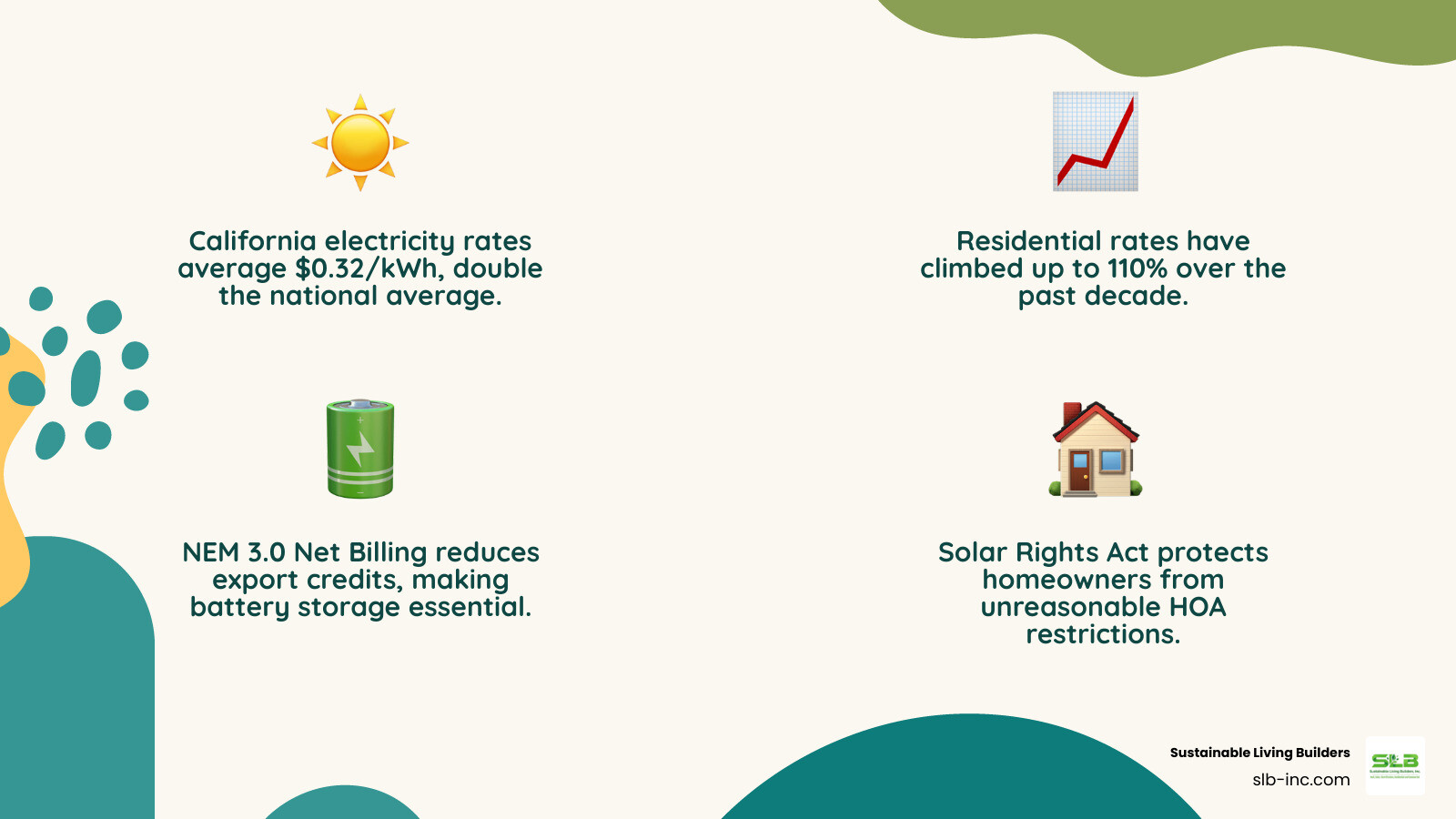
California has the highest electricity rates in the contiguous U.S., averaging around $0.32 per kilowatt-hour. That’s roughly double the national average. Over the past decade, residential rates have climbed as much as 110%. For homeowners already watching every dollar, that’s a serious problem.
At the same time, the rules around solar have shifted. The federal residential solar tax credit was repealed in early 2026. California’s net metering program was replaced by NEM 3.0 (Net Billing), which dramatically reduced the credits homeowners earn for sending excess energy to the grid. And HOAs across the state are still — sometimes illegally — pushing back against solar installations.
Here’s the good news: California law is on your side. The California Solar Rights Act protects homeowners from unreasonable HOA restrictions on solar. And with the right system design, solar is still one of the smartest long-term investments you can make for your home.
Before diving into the details, here’s a quick snapshot of your main solar options in California right now:
Solar Panel Options for California Homeowners at a Glance:
| Option | Best For | Key Consideration |
|---|---|---|
| Rooftop solar panels (purchased) | Maximum long-term savings | Higher upfront cost; no federal tax credit in 2026 |
| Solar + battery storage | NEM 3.0 households | Essential under current net billing rules |
| Solar lease or PPA | Low upfront cost | Check escalator clause carefully |
| DAC-SASH program | Income-qualified homeowners | Free installation in qualifying communities |
| Community solar | Renters or shaded roofs | No roof installation needed |
| Solar shingles/BIPV | New construction or re-roofing | Higher cost; integrated aesthetic |
Simple solar panel options for california homeowners glossary:
- how do solar panels work for your home
- how solar panels reduce your electric bill
- solar panel benefits for homeowners
Navigating Solar Panel Options for California Homeowners Under NEM 3.0

The landscape for solar panel options for california homeowners changed significantly with the arrival of the Net Billing Tariff, commonly known as NEM 3.0. For those of us living in areas served by PG&E or SCE, the way we are credited for solar energy has shifted from a simple retail-rate swap to a more complex “avoided-cost” model.
Under the old rules, every kilowatt-hour (kWh) you sent to the grid was worth roughly the same as what you paid for it—about $0.32. Today, those export credits have dropped to an average of $0.05 to $0.08 per kWh. This represents a reduction of about 75% in the value of exported energy. While this might sound discouraging, it simply means we have to be smarter about how we use the energy we produce.
The goal now is self-consumption. Instead of selling your power to the utility for pennies and buying it back for quarters, you want to use as much of your own solar power as possible during the day. This is where harnessing the power of the sun becomes a strategy of timing. By shifting high-energy tasks—like running the dishwasher or charging an EV—to peak daylight hours, you keep that $0.32 in your pocket rather than settling for an $0.08 credit.
Many people ask, are solar panels worth it under these new rules? The answer is a resounding yes, but the math has changed. While the payback period for an 8 kW system in California is now roughly 6.1 years, the total 25-year savings can still reach a staggering $108,800. To hit those numbers, we focus on solar energy systems that prioritize efficiency and smart management.
Maximizing Savings with Smart Technology
To truly beat the utility at their own game, we recommend utilizing smart home technology to navigate Time-of-Use (TOU) rates. Since electricity is most expensive in the late afternoon and evening, smart monitoring systems can automatically throttle your home’s grid reliance when prices are highest. By integrating energy-efficient upgrades alongside your solar, you reduce the overall “load” your system needs to cover, making every panel more effective.
The Shift from Net Metering to Net Billing
The transition to net billing was largely driven by utility rate hikes and policy updates from major providers like PG&E. On January 1, 2024, PG&E rates increased by an average of $32.50 monthly for residential customers. These constant increases make the fixed cost of solar even more attractive. Even without the high export credits of the past, owning your power generation remains the only way to “opt out” of the utility’s annual price hikes.
Why Battery Storage is Essential for Your Santa Rosa Solar System
If you are looking at home solar in Santa Rosa CA, a battery is no longer just a “nice-to-have” accessory; it is the heart of the system. In Sonoma and Marin Counties, we face unique challenges like Public Safety Power Shutoffs (PSPS) during wildfire season. A battery provides the outage protection the grid cannot guarantee.
Under NEM 3.0, a battery allows you to store the excess energy your panels produce during the noon sun and “export” it to your own home during the expensive evening hours. This process, known as peak shifting, is the primary way to maximize your return on investment. Furthermore, the Self-Generation Incentive Program (SGIP) still offers significant rebates for battery storage, sometimes covering a large portion of the equipment cost for those in high-fire-threat districts or low-income areas.
When exploring solar energy system introduction common types, you’ll find that modern lithium-ion batteries are compact, safe, and incredibly efficient. Here are the core benefits of adding storage:
- Energy Independence: Power your home during grid failures or blackouts.
- Financial Optimization: Use stored power when utility rates are at their highest.
- Grid Resilience: Help stabilize the local grid by reducing demand during peak times.
- Environmental Impact: Ensure 100% of your energy comes from the sun, even at midnight.
Storing Energy for Peak Demand
By focusing on self-generation, you become less of a consumer and more of a micro-utility. A typical battery setup allows you to capture the 5 to 7.5 peak sun hours we enjoy daily in California and deploy that energy precisely when you need it. This is one of the primary 4 benefits of home solar that we emphasize for homeowners in our region.
Reducing System Size with Storage
Interestingly, adding a battery can actually make your solar array more efficient. Research shows that using a battery can reduce the amount of energy a solar system requires by up to 40%. Specifically, if a battery has a storage capacity of 7.4kWh or more, the physical size of the solar system can often be reduced by 25%. This is vital for homeowners with limited roof space who still want to know how many solar panels for 4000 kWh or more of annual usage.
Wildfire Safety, Roofing, and the California Solar Mandate
In Napa and Sonoma Counties, we don’t just think about the sun; we think about fire safety. When considering solar panel options for california homeowners, the roof underneath those panels is just as important as the silicon on top. California’s Wildland-Urban Interface (WUI) regulations require “hardening” homes against wildfires, which means Class A fire-rated roofing is a must.
Your roof and solar system should have a symbiotic relationship. It makes little sense to install 25-year solar panels on a 10-year-old asphalt shingle roof. We often recommend metal roofing or high-quality tile because their lifespans (40-70 years) far exceed the panels themselves. Furthermore, metal roofs act as “cool roofs,” reflecting heat and helping panels stay efficient. For every degree above 77°F, solar panels lose about 0.45% in efficiency. A cooler roof means more power.
| Material | Lifespan | Solar Compatibility | Fire Rating |
|---|---|---|---|
| Asphalt Shingles | 12-20 years | Moderate (heavy) | Class A |
| Metal Roofing | 40-70 years | Excellent (lightweight) | Class A |
| Clay/Concrete Tile | 50+ years | Good (requires special mounts) | Class A |
| Solar Shingles | 25+ years | Integrated | Class A |
Napa’s microclimates also mean we have to consider the impact of rain on solar panels. While rain helps naturally clean your panels, seasonal high winds and heavy downpours require expert installation to ensure your roof remains watertight for decades.
Understanding the California Solar Mandate
Many homeowners ask if the California Solar Mandate applies to them. Currently, the mandate requires solar PV systems on all new residential construction and major renovations. The goal is to move the state toward generating 50% of its electricity from renewables by 2030. If you are installing solar panels in your home as part of a significant remodel, you may be required to meet these energy efficiency standards. Even for existing homes, following these standards is the best way to ensure long-term value.
Overcoming HOA Restrictions and the Solar Rights Act
Don’t let a “No Solar” clause in your HOA agreement stop you. The California Solar Rights Act explicitly limits the ability of HOAs to prohibit solar. While they can request “reasonable” aesthetic modifications, they cannot significantly increase the cost of the system (more than $1,000) or decrease its performance (more than 10%). Solar energy made simple starts with knowing your legal rights to the sunshine hitting your roof.
Frequently Asked Questions about California Solar Regulations
Is solar still worth it under NEM 3.0 for solar panel options for california homeowners?
Yes, but it is a “solar-plus-battery” game now. Because California electricity rates are nearly double the national average ($0.32/kWh vs $0.16/kWh), every bit of energy you produce for yourself is incredibly valuable. While you earn less for sending power back to the grid, you save more than ever by not buying power from the utility. With a 6.1-year payback period, it remains one of the best financial moves a homeowner can make.
What low-income solar panel options for california homeowners are available in 2026?
Several programs exist to ensure clean energy is accessible to everyone. The DAC-SASH program provides $3/W for systems up to 5 kW (up to $15,000) for income-qualified homeowners in disadvantaged communities. Additionally, the SOMAH program covers up to 100% of solar costs for qualifying multifamily affordable housing. For those who cannot install rooftop solar, the DAC-GT program offers a 20% bill discount for participating in community solar projects.
Does adding solar panels affect my property taxes in California?
No. California has a Property Tax Exclusion for Solar Energy Systems. This means that while solar panels can increase your home’s resale value by approximately 4.1%, that added value is 100% excluded from your property tax assessment through 2025. You get the benefit of a more valuable home without the sting of a higher tax bill.
Conclusion
Navigating the solar panel options for california homeowners doesn’t have to be a solo journey. Whether you are in Santa Rosa, Sebastopol, or the wider Napa and Marin areas, the goal is the same: achieving holistic sustainability while protecting your wallet from rising utility costs.
At Sustainable Living Builders, we believe in a “smart roof” approach. This means looking at your home as a complete system—integrating energy-efficient roofing, high-performance solar, and smart battery storage to create a home that works for you. Sunny and our team of experts are here to guide you through the process, from understanding the latest NEM 3.0 updates to using our Smart Roof Calculator to find your perfect fit.
Ready to take control of your energy future? Explore solar panel options with us today and start turning that California sunshine into long-term savings.