Why Summer Is Both the Best and Most Challenging Season for Solar Production
If you want to know how to maximize solar panel output in summer, here’s a quick breakdown of the most effective steps:
- Keep panels clean — remove dust, pollen, and debris before and during peak season
- Ensure airflow under panels — proper ventilation reduces heat buildup
- Optimize tilt angle — aim for around 25 degrees to match the high summer sun
- Reduce shading — trim trees and remove obstructions during peak hours (10am–4pm)
- Shift appliance use to midday — run dishwashers, washing machines, and EV chargers during peak solar hours
- Use battery storage or net metering — store or bank excess summer energy for later use
- Monitor system performance — catch efficiency drops early before they cost you
Summer delivers the longest days and strongest sunlight of the year — and your solar panels know it. Spring and summer together account for roughly 60–70% of a solar system’s annual energy output, with some regions seeing production nearly triple compared to winter months.
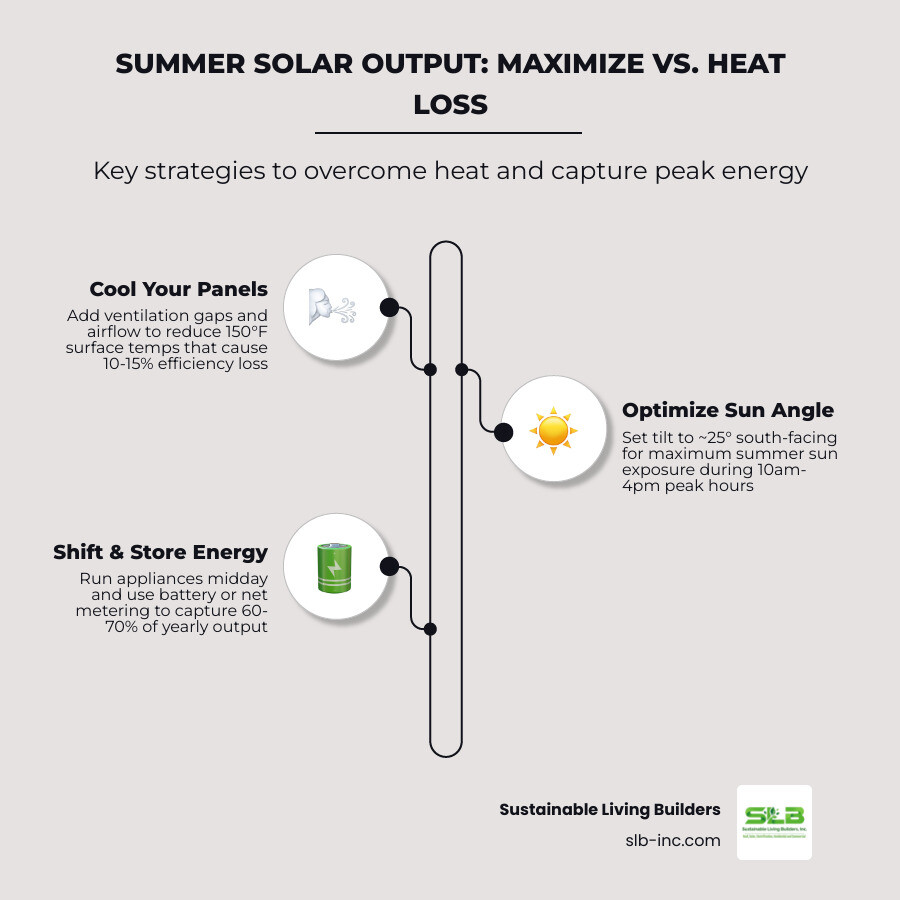
But here’s the twist most homeowners don’t expect: more sun doesn’t always mean more power. Solar panels are tested under ideal lab conditions at 77°F (25°C). On a hot summer afternoon, panel surface temperatures can climb to 150°F or higher. For every degree Celsius above that baseline, efficiency typically drops by 0.3% to 0.5%. On a scorching day, that can translate to a 10–15% reduction in output — even while the sun is blazing.
So summer is both your biggest opportunity and your biggest challenge. The good news? With the right strategies, you can capture far more of that energy than the heat tries to take away.
Understanding the Impact of Heat on Solar Efficiency
It sounds counterintuitive, but solar panels actually prefer a crisp, cool morning to a sweltering July afternoon. This is because of the way the photovoltaic effect works. Solar panels convert light, not heat, into electricity. In fact, heat is the enemy of efficiency.

Every solar panel comes with a “temperature coefficient.” Most panels are rated at a standard test condition of 25°C (77°F). Once the panel surface exceeds this temperature, the internal resistance within the cells increases. This leads to a voltage reduction, which directly lowers the total power output.
In our sunny California service areas—from the valleys of Napa to the coastal hills of Marin—panel surface temperatures can easily reach 150°F. When this happens, you might see a 6% to 10% reduction in energy harvest. Over time, extreme heat can even contribute to heat-related degradation, shortening the lifespan of your equipment. Understanding this relationship is the first step in learning how to maximize solar panel output in summer. By managing the “heat factor,” we can ensure your Solar Energy Systems continue to shine even when the pavement is melting.
Practical Steps for How to Maximize Solar Panel Output in Summer
To fight back against the heat, we need to focus on cooling and reflection. Think of your solar array like an athlete; it needs to “breathe” to perform at its peak.
One of the most effective ways to keep panels cool is through passive cooling. When we install systems, we ensure there is an adequate air gap between the roof and the panels. This allows for natural airflow to whisk away rising heat. If your panels are mounted too flush to the roof, heat gets trapped, acting like an oven and cooking your efficiency.
Another professional trick involves the roof itself. Using cool roof coatings or highly reflective materials can lower the ambient temperature around your array. Homeowners in Sonoma County who have upgraded to spray foam roofing or reflective coatings often report that their interiors stay 30-40% cooler, which also helps the solar panels stay within a more efficient operating range. When you harness the power of the sun, you want that energy going into your battery, not into heating up your attic.
| Month | Avg. Daylight Hours | Panel Temp (Est.) | Relative Efficiency |
|---|---|---|---|
| May | 14.5 | 75°F – 90°F | 100% |
| July | 15.0 | 110°F – 150°F | 85% – 95% |
As the table shows, May is often the “golden month” because it balances long days with cooler temperatures. By July, we have more sun but less efficiency, which is why optimization is so critical.
Optimizing Tilt and Orientation to Maximize Solar Panel Output in Summer
The sun’s path across the sky changes with the seasons. In the winter, the sun sits low in the southern sky, but in the summer, it tracks much higher, almost directly overhead at midday. To maximize solar panel output in summer, your panels should ideally be tilted at an angle that matches this higher trajectory.
For most homes in Northern California, a 25-degree tilt is the “sweet spot” for summer production. While a steeper angle (closer to your latitude) is better for year-round averages, a flatter 25-degree angle captures the most direct rays during the long summer days. If you have a flat roof or a ground-mounted system, seasonal adjustments can boost your output by about 3-4%. For more details on positioning, check out The Homeowners Guide to Catching Rays.
Shading Mitigation to Maximize Solar Panel Output in Summer
Shading is a silent “solar killer.” Even if a small corner of one panel is covered by a stray branch, it can significantly drag down the performance of the entire string. In the summer, trees are in full bloom, and those lush green leaves can cast new shadows that weren’t there in the spring.
We recommend working with a certified arborist to prune back overhanging branches, especially those that cast shadows between 10 a.m. and 4 p.m. If you have a roof with complex angles or unavoidable chimneys, we often suggest using microinverters or bypass diodes. These technologies allow each panel to operate independently, so one shaded panel doesn’t “bottleneck” the rest of your system. Part of learning how to maintain your solar panels is staying vigilant about these growing obstructions.
Maintenance and Cleaning for Peak Performance
You wouldn’t drive your car for six months without washing the windshield, right? Solar panels are the same. Over the dry California summer, dust, pollen, and bird droppings build up on the glass.
Research shows that dirty panels can be 5% to 20% less efficient. In fact, a heavy layer of fine dust can reduce efficiency by as much as 32%! To maximize solar panel output in summer, a quick cleaning in early April and another in mid-summer is essential.
When cleaning, always use a soft-bristled brush and plain water. Avoid harsh detergents or pressure washers, which can damage the anti-reflective coating on the glass. It is best to clean them in the early morning or on an overcast day when the panels are cool; spraying cold water on a 150°F panel can cause the glass to crack! For a deeper dive, read How Often to Clean Solar Panels and our Ultimate Guide to Spring Solar Panel Maintenance.
Beyond cleaning, keep an eye on your inverter health. The inverter is the brain of your system, and like the panels, it can suffer from thermal shutdowns if it gets too hot. Ensure it’s installed in a shaded, well-ventilated area to prevent it from throttling your production during a heatwave.
Strategic Energy Management and Storage
Maximizing output is only half the battle; the other half is maximizing self-consumption. This means using the power while you’re making it, rather than selling it back to the grid for a lower rate.
The peak production window in the summer is typically between 10 a.m. and 4 p.m. This is the time to do your “heavy lifting.” Shift your high-energy tasks—like running the dishwasher, doing laundry, or charging your EV—to these midday hours. This “load shifting” ensures you are using your own free, green energy instead of pulling from the grid in the evening when rates are highest.
Battery storage is a game-changer here. A battery allows you to “bank” that massive summer surplus and use it at night to run your air conditioning. In areas like Sebastopol and Santa Rosa, where net metering policies are evolving, having a battery ensures you get the full value of every watt you produce. If you’ve ever wondered Are Solar Panels Worth It?, the answer is a resounding yes when you pair them with smart storage and bring the power of solar into your home effectively.
Frequently Asked Questions about Summer Solar
Does rain help clean solar panels in summer?
While a heavy downpour can rinse away loose dust, light summer rain often does more harm than good. It can turn dust into mud streaks or leave behind mineral deposits that actually block more light. We usually recommend a manual rinse with a hose to ensure a truly clean surface. Learn more about the impact of rain on solar panels.
Can mirrors be used to boost summer output?
While some DIY enthusiasts use mirrors to reflect extra light onto panels, we generally advise against it for residential rooftops. Adding mirrors can create “hotspots” that exceed the panel’s temperature rating, potentially causing permanent damage or even fire risks. It can also void your manufacturer’s warranty. Stick to cleaning and proper orientation instead!
How does monitoring help in hot weather?
Monitoring software is your early warning system. It allows you to track real-time data and notice if one panel is underperforming compared to the others. In hot weather, it can alert you to a “thermal shutdown” where the system turns itself off to protect the hardware. Without proper monitoring, you might go weeks without realizing your system is underperforming during the most productive time of the year.
Conclusion
At Sustainable Living Builders, we believe that a truly efficient home is a holistic one. From the roof over your head to the smart systems that manage your power, every detail matters. Whether you’re in Sonoma County, Marin County, Napa County, or Mendocino County, our team—guided by Sunny’s expertise—is here to help you navigate the summer heat.
By following these steps to maximize solar panel output in summer, you aren’t just saving money; you’re reducing your carbon footprint and taking control of your energy future. Don’t let the summer sun go to waste! Use our Smart Roof Calculator to see how your home measures up and see how to optimize your system for the summer months with a professional consultation today.