Why Home Battery Storage Options Explained Simply Can Change How You Power Your Home
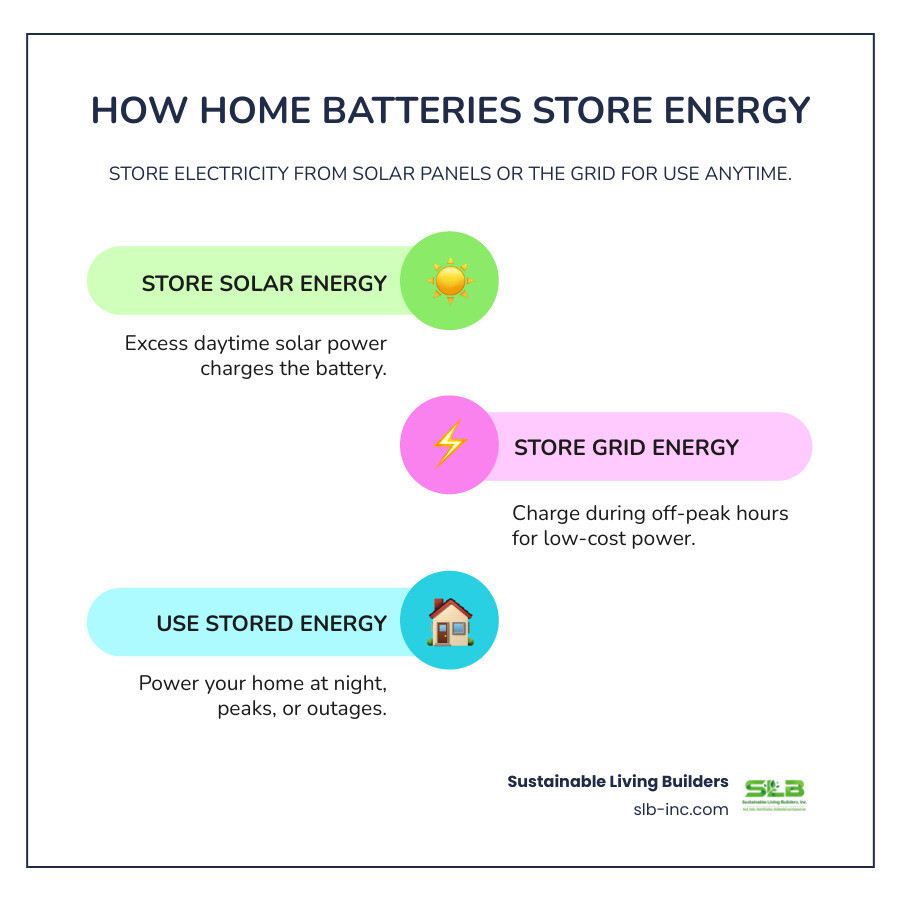
Home battery storage options explained in plain terms: these are rechargeable systems that store electricity — either from your solar panels or the grid — so you can use it when you need it most, whether that’s at night, during peak rate hours, or when the power goes out.
Here is a quick look at the main types available to homeowners today:
| Battery Type | Lifespan | Depth of Discharge | Best For |
|---|---|---|---|
| Lithium-Ion (LFP) | 10-20+ years | 80-100% | Most homes, solar pairing |
| Lead-Acid (AGM) | 3-7 years | 50-80% | Budget backup, cold climates |
| Flow Battery | 20-30+ years | Up to 100% | Large-scale, long-duration storage |
If you have been watching your electricity bills climb while grid reliability seems to be heading in the opposite direction, you are not alone. The average U.S. electricity customer experienced 11 hours of power interruptions in 2024 — nearly double the figure from a decade ago. Add extreme weather events, aging infrastructure, and rising time-of-use electricity rates to the mix, and it is easy to see why more homeowners are taking a serious look at energy storage.
A home battery gives you a way to take back some control. Whether your goal is to keep the lights on during a blackout, lower your monthly bill, reduce your carbon footprint, or get the most out of your solar panels — there is a battery system designed to help you do exactly that.
I’m Karlo Jarina, and through my work in marketing at Sustainable Living Builders I’ve spent years helping homeowners understand home battery storage options explained in a way that makes the decision feel less overwhelming. In the sections ahead, we will walk you through everything you need to know to pick the right system for your home.
Understanding Home Battery Storage Options Explained
When we talk about Energy Storage Batteries, we are essentially looking at a giant version of the battery in your laptop or phone, but designed to keep your refrigerator humming and your lights glowing. In 2026, the demand for these systems has skyrocketed. Why? Because grid reliability isn’t what it used to be. Across the U.S., weather-related power outages have increased significantly, with over 1,500 major events recorded between 2000 and 2021.
For those of us in areas like Santa Rosa and Napa County, the motivation for installing a battery often starts with resilience. Having a backup power source means your family stays comfortable when the grid goes dark. However, the benefits of modern Solar Energy Systems go far beyond emergency use.
Two key concepts to understand are “self-consumption” and “energy arbitrage.” Self-consumption means using the solar energy you produce during the day to power your home at night, rather than selling it back to the utility for a low credit. Energy arbitrage involves charging your battery when electricity is cheap (like at 2:00 AM) and discharging it when rates are high (usually between 4:00 PM and 9:00 PM). By doing this, homeowners can reduce their peak electricity demand by up to 65%.

Comparing Battery Chemistries and Lifespans
Not all batteries are built the same. If you’re looking at home battery storage options explained for your specific home, the “chemistry” inside the box dictates how long it will last and how much energy it can hold.
Lithium-Ion: The Gold Standard
Most modern homes use lithium-ion technology, specifically Lithium Iron Phosphate (LiFePO4 or LFP). These are the industry favorites because they are incredibly safe, have a high energy density, and offer a long lifespan of 10 to 20 years. They also boast a high “Depth of Discharge” (DoD), meaning you can use almost all the energy stored (80% to 98%) without damaging the battery.
Lead-Acid: The Budget Alternative
While lead-acid batteries (like AGM) are more affordable upfront, they are becoming less common for residential use. They typically only last 3 to 7 years and have a lower DoD of about 50% to 80%. If you drain them too far, their lifespan drops even faster. They are also less efficient, with approximately 80% efficiency compared to the 95% seen in lithium models.
Flow Batteries: The New Frontier
Flow batteries are a newer entry into the residential market. They use liquid tanks to store energy and can last 20 to 30+ years. They offer a 100% depth of discharge, but they are currently quite large and better suited for very large properties or commercial applications.
When you pair these chemistries with high-quality Solar Panels, you create a powerhouse of efficiency. To see which chemistry fits your home, you can Get to Know Our Solar Products and compare how they integrate with different storage technologies.
| Feature | Lithium-Ion (LFP) | Lead-Acid (AGM) | Flow Battery |
|---|---|---|---|
| Lifespan | 10-20 Years | 3-7 Years | 20-30+ Years |
| Efficiency | ~95% | ~80% | ~75-85% |
| Maintenance | Low | Moderate | Low |
| Safety | High (LFP is very stable) | Moderate (Venting needed) | Very High |
System Architecture: AC-Coupled vs. DC-Coupled
How your battery connects to your home and solar panels matters. This is known as “coupling,” and it affects how much energy is lost during conversion.
DC-Coupled Systems: In this setup, the DC electricity from your solar panels goes directly into the battery. It only gets converted to AC (the power your house uses) once. This is highly efficient because you avoid multiple conversion steps where about 10% of energy is lost each time. Many new Solar Energy System Introduction: Common Types favor this architecture.
AC-Coupled Systems: These are often used when you already have solar panels and want to add a battery later. The solar energy is converted to AC by your solar inverter, then converted back to DC to be stored in the battery, and finally back to AC when you need it. While slightly less efficient, AC-coupled systems are much easier to retrofit into existing homes.
In some cases, you might need to Upgrade House Electrical Panel to handle the bidirectional flow of energy. Hybrid inverters are also a popular choice; they are “battery-ready” and can handle both your solar panels and your battery in one unit, though they can be about 30% more expensive than standard inverters.
Key Factors for Selecting Your System
Choosing a battery isn’t just about picking the biggest one. You need to consider how you live. Home Electrification is a growing trend, and if you plan on adding an Electric Vehicle (EV) or a heat pump in the future, you’ll need a system that can grow with you.
- Continuous Power vs. Surge Capacity: Continuous power is what the battery can provide steadily (like keeping the lights on). Surge capacity is the “burst” of power needed to start heavy appliances like an air conditioner or a well pump.
- Climate Considerations: If you live in a hotter part of Sonoma or Napa, you’ll want a battery with a good thermal management system. Heat is the number one enemy of battery longevity.
- Incentives: Don’t forget that Home Energy Incentives can significantly change the math. Homeowners who install storage with solar may qualify for a federal 30% tax credit through 2032.
Sizing Your Home Battery Storage Options Explained
An average household consumes around 20kWh per day. However, you don’t necessarily need to back up your entire home. Most people choose to power “critical loads” — things like the fridge, Wi-Fi, a few lights, and medical equipment.
The most economical battery size for an average home is typically between 6kWh and 10kWh. If you want to go 24 hours without any grid power or solar production, you might need 20kWh or more. We always recommend looking at your utility bills to Increase Home Energy Efficiency first, as a more efficient home requires a smaller, less expensive battery.
Maintenance for Home Battery Storage Options Explained
Modern lithium batteries are largely “set it and forget it,” but they aren’t completely maintenance-free.
- Battery Management Systems (BMS): This is the internal “brain” that monitors cell health and prevents overcharging.
- Temperature Control: Ensure your battery is installed in a cool, dry place, like a garage, away from direct sunlight.
- Firmware Updates: Just like your phone, battery inverters occasionally need software updates to stay efficient.
- Cleaning: Keep the area around the unit clear of dust and debris to ensure proper ventilation.
Maximizing Benefits with Smart Technology
The smartest way to manage your energy is to pair your battery with a smart electrical panel, like the SPAN Panel. But How Can a SPAN Panel Help Monitor Electricity Usage? It allows you to choose exactly which circuits to back up from your phone. If a storm hits and you see your battery running low, you can remotely turn off the dishwasher circuit to save power for the refrigerator.
This technology also helps with Time-of-Use (TOU) rates. By automatically discharging during peak hours, the system saves you money without you having to lift a finger. Some homeowners even join “Virtual Power Plants” (VPPs), where they allow the utility to draw a small amount of power from their battery during grid emergencies in exchange for payments.
For those looking for a seamless, aesthetic integration, the Tesla Solar Roof paired with storage is a top-tier option. You can learn more about Powering Your Future with Tesla’s Solar Solutions to see how these integrated systems provide both beauty and resilience.
Common Questions Regarding Home Battery Storage Options Explained
Can I use a home battery without solar panels?
Yes! This is called “standalone storage.” You can charge the battery from the grid when rates are low and use that stored energy when rates are high. It also provides a reliable backup during outages, though unlike a solar-paired system, it won’t be able to recharge if the grid stays down for several days.
Will a battery allow me to go completely off-grid?
While it is technically possible, it is very difficult and expensive for the average homeowner. Going off-grid requires enough battery capacity to last through several days of rainy or cloudy weather in the winter. Most people find that staying “grid-tied” with a battery is the best of both worlds — you have backup and savings, but the grid is there as a safety net.
How long do modern home batteries typically last?
Most lithium-ion batteries are warrantied for 10 years, but they typically last 15 years or more. Over time, they experience “capacity degradation,” meaning they might only hold 70% of their original charge after a decade. Most are rated for 6,000 to 10,000 “cycles” (one full charge and discharge).
Conclusion
At Sustainable Living Builders, we believe that energy independence shouldn’t be a mystery. Whether you are in Sebastopol, Marin County, or anywhere in our beautiful North Bay service area, our goal is to provide holistic, sustainable solutions that fit your life.
Sunny and our entire team are here to help you navigate these home battery storage options explained so you can find the perfect fit for your home. From expert advice to our Smart Roof Calculator, we’re committed to reducing your energy costs and your carbon footprint. Ready to take the next step toward a more resilient home? Explore our Energy Storage Batteries options today and let’s build a more sustainable future together.