Why Home Battery Storage Benefits Explained Matters for Today’s Homeowners
Home battery storage benefits explained simply: a home battery stores electricity — from your solar panels or the grid — so you can use it later, on your own terms.
Here’s a quick look at the core benefits:
- Backup power — Keep your lights and essentials running during outages
- Lower energy bills — Store cheap off-peak electricity and avoid expensive peak rates
- Solar self-consumption — Use more of the solar energy you generate instead of sending it back to the grid at reduced rates
- Energy independence — Rely less on your utility and protect yourself from rising electricity prices
- Reduced carbon footprint — Pair with solar to cut greenhouse gas emissions significantly
- Potential income — Some programs pay you to share stored energy with the grid during high-demand periods
The case for home batteries has never been stronger. The average U.S. electricity customer experienced 11 hours of power interruptions in 2024 — nearly double the figure from a decade ago. Meanwhile, electricity rates keep climbing, net metering policies are becoming less generous in many states, and extreme weather events are putting more pressure on an aging grid. For homeowners who want reliable, affordable, and cleaner energy, a home battery system is quickly moving from a luxury item to a practical necessity.
Think about it this way: imagine a stormy night with the washing machine running and the TV on — and then the neighborhood goes dark. With a home battery paired to your solar system, you might not even notice the outage happened.
I’m Karlo Jarina, marketing lead at Sustainable Living Builders, where I focus on helping homeowners understand sustainable energy solutions — including home battery storage benefits explained in clear, practical terms. In the sections ahead, we’ll walk you through everything you need to know to decide if a home battery is right for your home.
I’m looking for energy independence in Santa Rosa. How does home battery storage work?

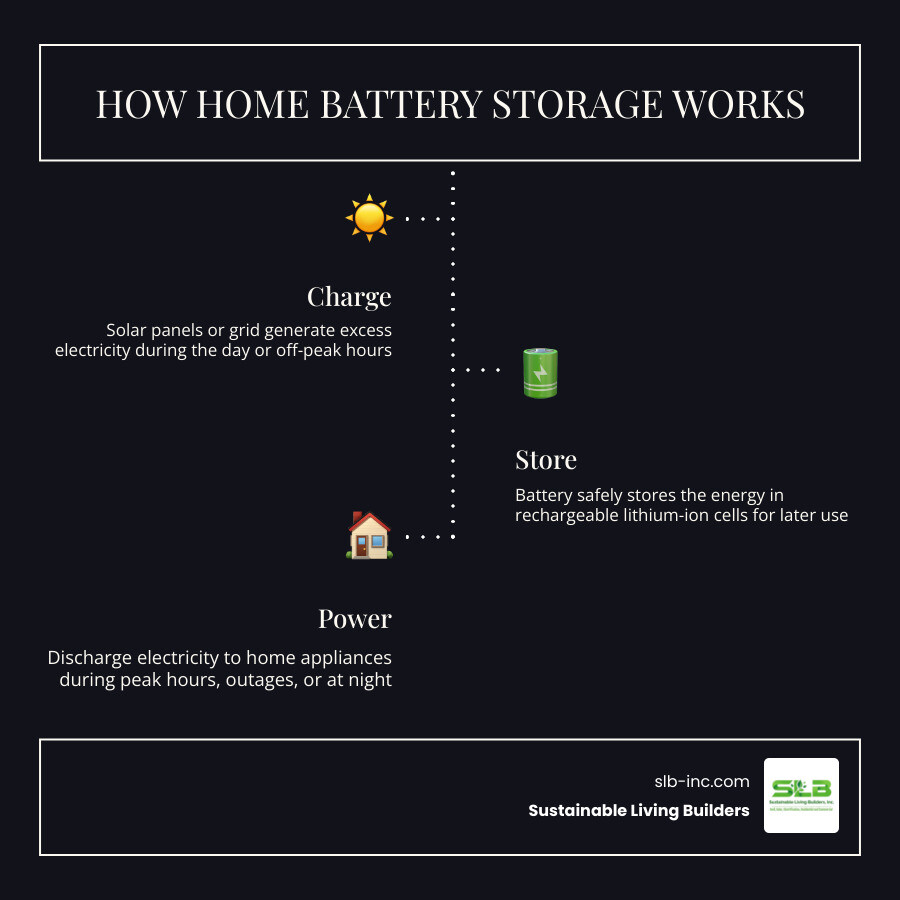
Whether you live in Santa Rosa, Sebastopol, or the wider Sonoma County area, the concept of energy independence starts with understanding the “energy bucket.” A home battery is essentially a large-scale version of the rechargeable battery in your phone, but instead of powering a screen, it powers your refrigerator, lights, and HVAC system.
There are two primary ways these systems are set up: with solar panels or as standalone units.
Solar Integration and the “Islanding” Effect
When paired with Solar Energy System Introduction Common Types, your battery acts as a reservoir. During the day, your panels often produce more electricity than your home needs. Instead of that excess power flowing back to the grid for a small credit, it fills up your battery. When the sun goes down, your home automatically switches to using that stored energy.
A critical feature we often discuss with our neighbors in Marin and Napa is “islanding.” Most standard solar systems are required by law to shut down during a grid outage to prevent back-feeding electricity into lines that utility workers might be repairing. However, with a battery and a smart gateway, your home can “island” itself, creating its own mini-grid that keeps your power on even when the rest of the street is dark.
AC vs. DC Coupling: The Technical “Handshake”
When you install a battery, it has to communicate with your home’s electrical system. This happens in one of two ways:
- DC Coupling: The electricity from your solar panels stays as Direct Current (DC) as it moves into the battery. This is highly efficient because about 10% of energy is lost each time electricity is converted from AC to DC or vice versa. By keeping it in DC for storage, you maximize every watt your panels produce.
- AC Coupling: This is common for “retrofitting” or adding a battery to an existing solar system. The solar energy is converted to Alternating Current (AC) for the home, then converted back to DC to be stored in the battery. While there are slight conversion losses, modern systems have become incredibly efficient, making this a great option for existing solar owners in Sonoma County.
Home Battery Storage Benefits Explained: Why Homeowners in Napa are Switching
We’ve noticed a significant shift in why homeowners in Napa and Marin Counties are reaching out to us. It’s no longer just about being “green” — it’s about practical resilience and financial strategy. When we look at home battery storage benefits explained through a local lens, three major factors stand out.
First, there is the sheer reliability. Between 2000 and 2021, the U.S. saw over 1,500 weather-related power outages. In our part of Northern California, we are all too familiar with the tension that comes with high-wind days or winter storms. A battery provides a silent, automatic safety net.
Second, there is the environmental impact. Integrating battery storage with renewable energy can cut greenhouse gas emissions by up to 80% in some scenarios. By using your own stored solar power at night rather than pulling from a grid that might still rely on fossil fuels during peak hours, you are directly contributing to a cleaner local environment.
Finally, there is the concept of Increase Home Energy Efficiency. A battery allows you to be a “prosumer” — someone who both produces and consumes energy intelligently. Homes with battery storage systems can reduce their peak electricity demand by up to 65%, which takes an enormous amount of pressure off our local grid infrastructure.
Maximizing Solar Self-Consumption with Home Battery Storage Benefits Explained
The financial landscape for solar changed significantly with the introduction of policies like NEM 3.0. In the past, you could send excess solar power to the grid and get a generous credit on your bill. Now, those “export credits” have been reduced.
This makes Solar Panels much more valuable when paired with a battery. Instead of selling your power to the utility for a few cents and buying it back later for much more, you keep it. You are “self-consuming” your own clean energy, which is the most effective way to ensure your solar investment pays off in today’s regulatory environment.
Protecting Your Home During Outages with Home Battery Storage Benefits Explained
For many of our clients in Sebastopol and Sonoma, the “benefit” they care about most is peace of mind. When the grid fails, a battery system responds in milliseconds. This is vital for Home Electrification goals, especially if you rely on electricity for medical equipment, home offices, or well pumps. You don’t have to worry about the food in your fridge spoiling or being left in the dark during a multi-day grid interruption.
Comparing Battery Technologies: Which Type is Best for Your Home?
Not all batteries are created equal. If you’ve looked into Energy Storage Batteries/, you’ve likely seen terms like “Lithium-ion” and “LFP.” Understanding these chemistries is key to choosing a system that will last.
Lithium-ion (LFP vs. NMC)
Most modern home batteries use lithium-ion technology, but there’s a specific subtype called Lithium Iron Phosphate (LFP) that is becoming the gold standard. LFP batteries are known for:
- Safety: They have a much lower risk of “thermal runaway” (overheating).
- Longevity: They typically have a lifespan of 10–15+ years.
- Efficiency: They offer around 95% round-trip efficiency.
Lead-Acid and AGM
Older technology, like Absorbent Glass Mat (AGM) lead-acid batteries, is still available. While these might be used in very specific off-grid or budget-conscious scenarios, they generally don’t hold up as well for daily home use. They have shorter lifespans (3–5 years) and much lower “depth of discharge,” meaning you can’t use all the energy in the tank without damaging the battery.
| Feature | Lithium-ion (LFP) | Lead-Acid (AGM) |
|---|---|---|
| Lifespan | 10–15+ Years | 3–5 Years |
| Efficiency | ~95% | ~80% |
| Maintenance | None | Minimal |
| Depth of Discharge | Up to 100% | ~50% |
| Size/Weight | Compact & Light | Heavy & Bulky |
For most homeowners in the North Bay, LFP is the clear winner for its “set it and forget it” reliability.
Experiencing frequent power outages in Sebastopol. Is a home battery better than a generator?
This is a question we hear constantly in Sebastopol and rural Sonoma County. While gas or propane generators have been the traditional go-to for backup power, home batteries offer several distinct advantages that are hard to ignore.
1. Silence is Golden: Generators are loud. If you’ve ever lived through a neighborhood outage where three neighbors have gas generators running, you know the constant drone can be exhausting. Batteries are completely silent.
2. No Fuel, No Fumes: A generator requires you to store flammable fuel (gasoline or propane) and produces exhaust fumes that can be dangerous if not vented properly. A battery is “fueled” by the sun or the grid, meaning no trips to the gas station during a storm.
3. Seamless Transition: When the power goes out, a generator usually takes a few seconds or even minutes to kick on, causing your clocks to reset and your computers to crash. A battery system transitions so fast that most electronics don’t even flicker.
4. Daily Value: A generator sits idle 99% of the year, only providing value during an outage. A battery works for you every single day by managing your energy loads and avoiding peak utility rates. It’s an active part of your House Electrical Panel Complete Guide, whereas a generator is purely reactive.
Determining the Right Size and Maintenance for Your System
Sizing a battery system isn’t about the size of your house; it’s about the size of your needs. We look at “kilowatt-hours” (kWh), which measures how much energy the battery can hold.
- Essential Backup: If you just want to keep the lights, fridge, and Wi-Fi on, a smaller system (10–13.5 kWh) is usually sufficient.
- Whole-Home Backup: If you want to run your AC, electric oven, and laundry during an outage, you’ll likely need multiple battery units stacked together.
Maintenance Tips by Sunny
Our resident expert, Sunny, always emphasizes that while batteries are low-maintenance, they aren’t “no-maintenance.” Here are Sunny’s top tips for keeping your system in peak shape:
- Keep it Cool: Batteries prefer stable temperatures. While most modern units are weather-resistant and can be installed outdoors in Napa or Sonoma, keeping them out of direct afternoon sun helps preserve their lifespan.
- Monitor the App: Most systems come with a smartphone app. Sunny recommends checking it once a week to ensure your solar panels are charging the battery correctly and to see if there are any firmware updates.
- Clear the Area: Ensure there is proper ventilation around the unit. Don’t stack boxes or gardening tools against the battery casing.
- Avoid Deep Discharges: While LFP batteries are tough, try not to let them sit at 0% charge for long periods. Your smart management system should handle this automatically, but it’s good to keep an eye on it during long stretches of cloudy weather.
For more on how these systems integrate with your overall setup, check our Solar Energy System Introduction Common Types guide.
Frequently Asked Questions about Home Battery Storage
Can I add a battery to my existing solar panels?
Absolutely. This is called “retrofitting.” While it’s often easier to install everything at once, modern battery designs are very flexible. Depending on your existing inverter, we might use an AC-coupled setup to add storage to your current array. If you’ve been wondering Are Solar Panels Worth It without a battery, adding one later can often be the missing piece that makes the math work in your favor.
Are there financial incentives for installing a battery in Marin County?
Yes! Even in April 2026, there are several programs available to local homeowners. Beyond federal tax credits, California has historically offered the Self-Generation Incentive Program (SGIP). Additionally, some utilities offer Virtual Power Plant (VPP) programs. In a VPP, you allow the utility to pull a small amount of power from your battery during extreme grid stress, and in exchange, they provide you with credits or payments. It’s a way for your battery to actually earn its keep. You can find more details in our guide to Home Energy Incentives.
How long do home batteries typically last?
Most high-quality lithium-ion batteries are warrantied for 10 years, but they are expected to last 15 years or more. Like any battery, they will “degrade” slightly over time, meaning they might hold 70% or 80% of their original capacity after a decade. However, even at 80% capacity, a battery remains an incredibly effective tool for backup and bill management.
Conclusion
At Sustainable Living Builders, we believe that energy should be something you control, not something that controls your monthly budget. Whether you are looking to protect your home in Santa Rosa from the next big storm or you want to maximize the ROI of your solar panels in Napa, home battery storage benefits explained all lead to the same conclusion: independence.
Our holistic approach to home improvement means we don’t just look at one piece of the puzzle. We use tools like our Smart Roof Calculator to see how your roofing, solar, and battery storage can work together to create a truly efficient home. If you’re ready to stop worrying about the grid and start enjoying the peace of mind that comes with stored energy, we’re here to help.
Explore our options for Energy Storage Batteries/ and take the first step toward a more resilient, eco-friendly future for your home.