How to Decide Between Roof Repair and Replacement (And Not Waste Money Either Way)
Knowing how to decide between roof repair and replacement is one of the most important calls a homeowner can make — and getting it wrong is expensive either way. Pay for a repair on a roof that’s past saving, and you’ll be back to square one within a year. Spring for a full replacement when a targeted fix would do, and you’ve spent tens of thousands unnecessarily.
Here’s a quick framework to help you decide:
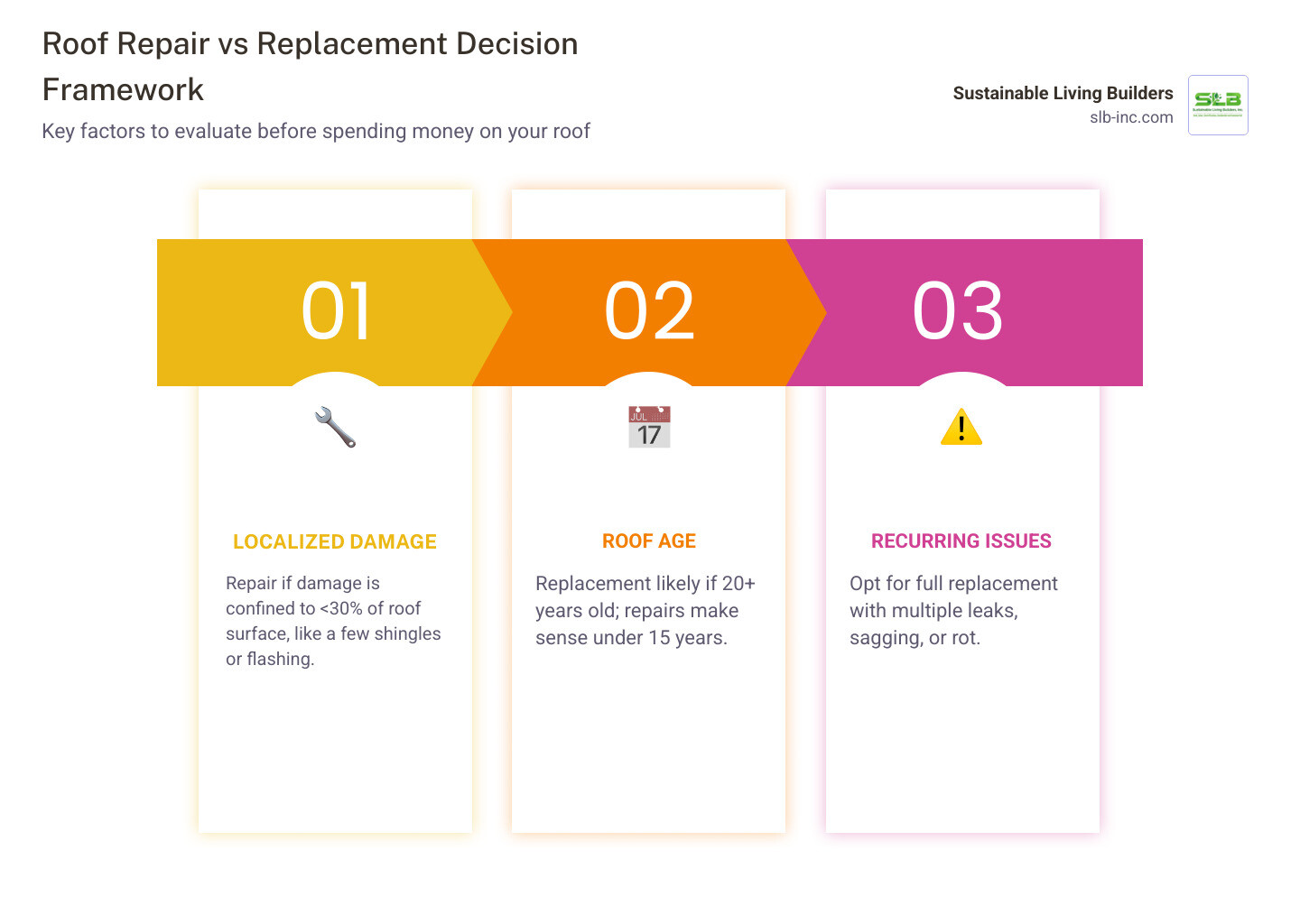
Repair is likely the right choice if:
- Your roof is less than 15 years old
- Damage is localized to one small area (such as flashing around a chimney or a few missing shingles)
- This is the first or second time you’ve needed a repair
- The repair cost is less than 30% of the full replacement cost
Replacement is likely the right choice if:
- Your roof is 20 years or older
- Damage covers more than 30% of the total surface area
- You have recurring leaks, sagging sections, or visible decking rot
- You’ve had multiple repairs in recent years with new problems still appearing
- The repair estimate exceeds 50% of what a full replacement would cost
The challenge is that many of the most important warning signs — rotted decking, failing underlayment, hidden moisture damage — aren’t visible from the ground. A roof can look functional from the street while quietly deteriorating from the inside out.
This guide walks through exactly how roofing professionals evaluate a roof, what physical signs matter most, how age factors into the math, and when a full replacement becomes the smarter long-term investment for your home and your budget.
The Core Differences: Roof Repair vs. Full Replacement

When we talk about a roof repair, we are essentially talking about a “symptomatic fix.” It is a targeted intervention designed to address a specific, localized problem. Think of it like a surgeon removing a splinter rather than performing a full limb replacement. If a heavy windstorm in Marin County blows off a few shingles, but the rest of the roof is in pristine condition, a repair is the logical path forward.
A full roof replacement, on the other hand, is a “system reset.” This process involves stripping the entire structure down to the wooden decking. We aren’t just putting on new shingles; we are replacing the underlayment (the moisture barrier), installing new flashing (the metal bits that keep water out of joints), and ensuring the ventilation system is functioning correctly.
Many homeowners ask if they can simply layer new shingles over the old ones — a process known as reroofing. While building codes in some parts of Sonoma County allow for two layers of shingles, we generally advise against it. Layering adds significant weight to your home’s structure, can trap heat that accelerates shingle degradation, and often voids manufacturer warranties. It also hides the condition of the roof deck, which is where the most dangerous rot usually lives. For a deeper look at specific issues, check out 4 Common Residential Roofing Problems And How To Fix Them.
Understanding the Scope of Work
A repair might involve replacing a few square feet of shingles or resealing the flashing around a vent. It’s quick, often completed in a single day, and keeps your current system going.
A replacement is a major construction project. Because we strip everything away, we can inspect the roof decking (the wooden boards that make up the roof’s foundation). If we find soft spots or rot caused by years of minor leaks, we replace those boards to ensure the new roof has a solid base. Without this “reset,” even the most expensive shingles will fail prematurely. If you’re seeing signs of widespread wear, you may want to review these Signs Your Roof Needs A Replacement.
Comparing Repair and Replacement Scenarios
| Factor | Roof Repair | Full Roof Replacement |
|---|---|---|
| Primary Goal | Stop a localized leak or fix minor damage. | Restore structural integrity and long-term protection. |
| Average Timeline | 1–4 hours. | 2–5 days. |
| Impact on Lifespan | Extends current roof life by 1–5 years. | Resets the clock (25–50 years of life). |
| Aesthetics | Shingles may not perfectly match due to UV fading. | Uniform look; significantly boosts curb appeal. |
| Best For | Newer roofs (<15 years) with "event-based" damage. | Older roofs (>20 years) with systemic wear. |
Physical Warning Signs: When a Replacement is Unavoidable
Sometimes, the roof makes the decision for you. As we move into May 2026, many homes in the Napa and Santa Rosa areas are seeing the cumulative effects of several years of intense UV exposure and heavy winter rains.
One of the most telling signs is “roof sand” or granule loss. Asphalt shingles rely on a layer of crushed stone granules to protect the underlying asphalt from UV rays. If you see piles of these granules at the base of your downspouts or in your gutters, your shingles are essentially losing their sunscreen. Once the asphalt is exposed, it becomes brittle and cracks, leading to leaks.
Other critical indicators include:
- Curling or Buckling: When shingles curl at the edges or buckle in the middle, they are no longer lying flat enough to shed water properly.
- Missing Shingles: A few missing shingles can be replaced, but if shingles are flying off every time a light breeze hits, the adhesive strips have failed across the entire system.
- Daylight in the Attic: If you can see pinpricks of light coming through the roof boards while standing in your attic, water is definitely getting in too.
- The “Spongy” Walk: If we walk on a roof and it feels soft or bouncy, it usually means the underlying decking has been compromised by moisture.
For homeowners coming out of a particularly rough season, our The Essential Post Winter Roof Damage Checklist provides a step-by-step guide to spotting these issues.
Identifying Structural Compromise
Structural damage is the “deal-breaker” for repairs. If the roofline is sagging or dipping, it’s no longer just a shingle problem; it’s a structural emergency. This often points to rotted rafters or trusses caused by long-term, neglected leaks. In these cases, a repair is like putting a band-aid on a broken bone. You must address the core issue to prevent a potential roof collapse during the next heavy rain in Sebastopol. You can find more details on these red flags here: Signs Your Roof Needs A Replacement.
Using the 30% Rule: How to Decide Between Roof Repair and Replacement
In the roofing industry, we often use the 30% Rule. It’s a simple mathematical threshold: if more than 30% of your roof’s surface area is damaged or showing significant wear, a full replacement is almost always more cost-effective than patching.
Why? Because if 30% of the shingles have reached their failure point, the other 70% aren’t far behind. Sinking money into a large-scale repair on a failing system is often “throwing good money after bad.” You’ll likely find yourself paying for another repair in a different spot just a few months later — a frustrating cycle we call “roofing whack-a-mole.”
How to Decide Between Roof Repair and Replacement Based on System Age
Age is the baseline for every roofing decision. As of May 2026, we have to look at the materials used and how they’ve weathered our specific Northern California climate.
Standard 3-tab asphalt shingles typically have a lifespan of 15 to 20 years. Modern architectural shingles (which are thicker and more durable) usually last 25 to 30 years. If your roof is approaching the 80% mark of its expected lifespan, any major repair should be viewed as a temporary measure at best. For more on how age impacts your home’s systems, especially if you’re considering upgrades, see Roof Age And Solar Compatibility When To Say Goodbye To Your Shingles.
The 20-Year Benchmark for Asphalt Systems
Once an asphalt roof hits the 20-year mark in places like Napa or Sonoma, it has endured decades of “thermal shock” — the expanding and contracting that happens as temperatures swing from hot afternoons to cool nights. This makes the shingles brittle. If we try to repair a 20-year-old roof, the surrounding shingles often crack when we lift them to install new ones. At this age, the system has simply lost its flexibility. Regular maintenance can help, but it can’t stop the clock. See our Tips To Maintain Your Roof And Extend Its Life for ways to maximize that lifespan before you hit the limit.
Considering Future Plans: How to Decide Between Roof Repair and Replacement
Your personal timeline is just as important as the roof’s timeline.
- Selling Soon: If you plan to sell your home in the next year, a localized repair might be enough to pass a home inspection. However, keep in mind that a new roof typically recoups 60-70% of its value in the final sale price and can be a major selling point.
- Solar Readiness: Thinking about going solar? You should never install solar panels on a roof that has less than 10-15 years of life left. The cost of removing and reinstalling panels just to fix the roof underneath is prohibitive.
- Long-Term Residency: If this is your “forever home,” a replacement provides peace of mind and long-term savings on maintenance that a series of patches never will.
Professional Inspections: How to Decide Between Roof Repair and Replacement
When our lead inspector, Sunny, arrives at a home in Marin or Sonoma County, they aren’t just looking for missing shingles. A professional inspection is a deep dive into the health of the entire home envelope. We often use drones to get a high-resolution view of hard-to-reach areas and infrared technology to spot moisture trapped behind walls or under shingles.
A proper inspection should always include an attic visit. The attic is the “storyteller” of the roof. We look for water stains on the rafters, mold growth, and signs of poor ventilation. To prepare for your own assessment, read What To Expect During A Roof Inspection A Homeowners Checklist.
Evaluating the Attic and Ventilation
Poor ventilation is the silent killer of roofs. If your attic isn’t breathing — meaning hot air can’t escape through ridge vents and cool air can’t enter through soffit vents — your shingles are essentially being “cooked” from both sides. This leads to premature curling and shingle failure. During an inspection, we ensure your ventilation isn’t blocked by insulation, which is a common mistake. For more on keeping your system healthy, check out our Top Roof Maintenance Tips.
Navigating Insurance and Qualifying Events
If your roof was damaged by a specific “event” — like a fallen oak limb in Santa Rosa or a freak hailstorm — your homeowners insurance may cover a significant portion of the replacement.
It’s important to know if you have a Replacement Cost Value (RCV) or Actual Cash Value (ACV) policy. RCV policies cover the cost of a new roof today, while ACV policies only pay out the depreciated value based on the roof’s age. We often act as homeowner advocates, meeting with insurance adjusters to ensure every bit of damage is documented and covered.
Maximizing Your Investment: Energy Efficiency and Sustainability
At Sustainable Living Builders, we don’t just look at a roof as a lid for your house; we see it as a critical component of your home’s energy efficiency. When you choose a full replacement, you have the opportunity to upgrade to “cool roofs” or reflective shingles that bounce sunlight away from your home, significantly lowering your AC bills during those scorching Napa summers.
Long-Term Value and ROI
A new roof is an investment in your home’s equity. Beyond the immediate protection from the elements, a modern, energy-efficient roof reduces your carbon footprint and increases your property value. It’s one of the few home improvements that offers both structural security and a high return on investment. For more on the intersection of roofing and modern home tech, see Roof Age And Solar Compatibility When To Say Goodbye To Your Shingles.
Frequently Asked Questions
Does a leak mean I need a new roof? Not necessarily. Many leaks are caused by localized issues like failing flashing around a chimney or a cracked vent boot. If the rest of the shingles are healthy and the roof is under 15 years old, a targeted repair is often sufficient.
Can I layer new shingles over old ones? While technically possible in some areas, we strongly advise against it. It hides rot, adds weight, and shortens the lifespan of the new shingles. A full tear-off is always the better long-term choice.
How does local weather affect my roof? In Northern California, our biggest enemies are intense UV rays and the “wet-dry” cycle. The sun bakes the oils out of the asphalt, making shingles brittle, while heavy winter rains test every tiny crack in the system.
Conclusion
Deciding how to decide between roof repair and replacement doesn’t have to be a guessing game. By looking at the age of your system, the extent of the damage, and your long-term goals for your home, the right choice usually becomes clear.
At Sustainable Living Builders, we specialize in providing holistic, sustainable solutions that protect your home while reducing your energy footprint. Whether you need a precision repair to get through the season or a full, energy-efficient “system reset,” our team is here to guide you with expert advice and smart technology.
If you’re still unsure which path is right for your home, don’t wait for the next storm to find out. Contact our experts for a professional assessment and let us help you protect your investment for decades to come.