Is a Tesla Solar Roof or Traditional Solar Panels the Right Choice for Your Home?
When weighing a tesla solar roof vs traditional solar panels comparison, the short answer is this: traditional solar panels cost less upfront and generate more energy per square foot, while the Tesla Solar Roof offers a seamless, integrated look and makes the most sense when your roof already needs replacing.
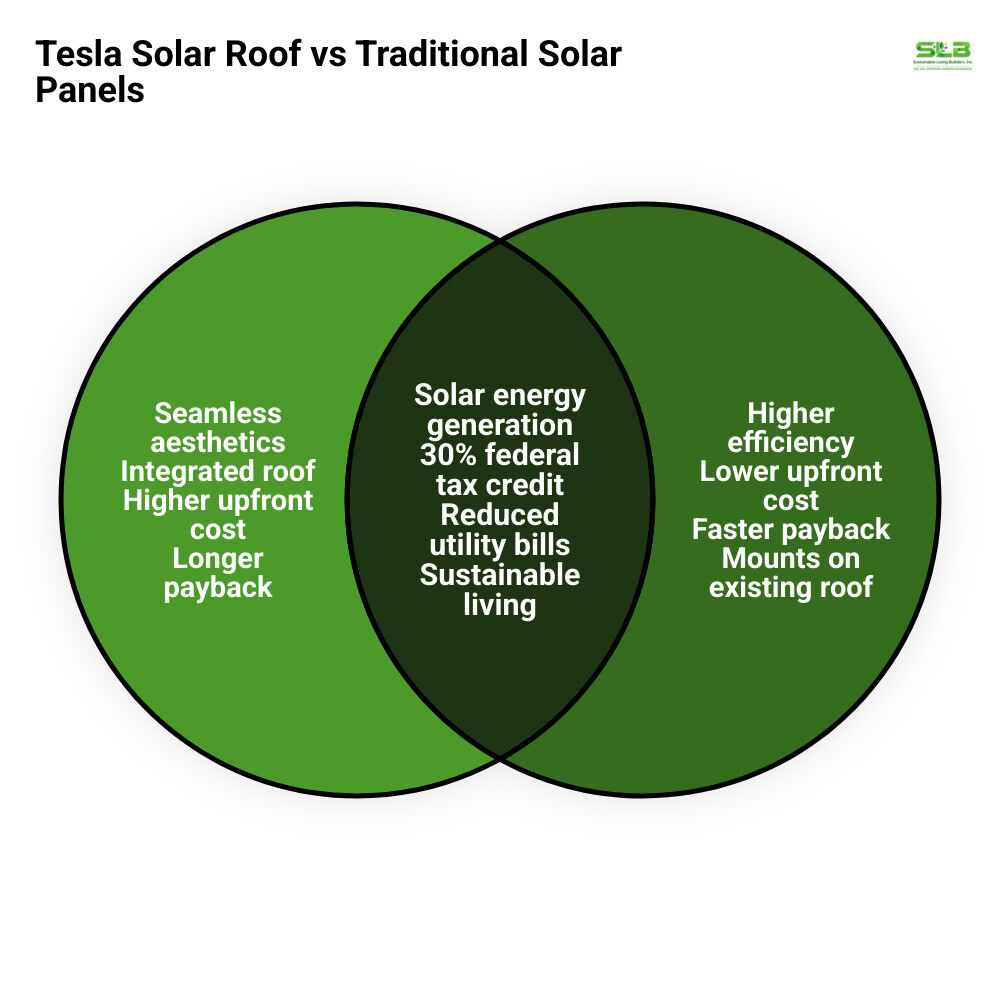
Here is a quick side-by-side summary to help you decide:
| Factor | Tesla Solar Roof | Traditional Solar Panels |
|---|---|---|
| Upfront Cost | Significantly higher | Lower |
| Energy Efficiency | ~17–20% | ~19–23% |
| Payback Period | 15–20 years | 6–10 years |
| Aesthetics | Seamless, tile-like | Visible panel arrays |
| Roof Replacement Needed | Yes — replaces entire roof | No — mounts on existing roof |
| HOA Friendliness | High | Moderate |
| 30% Federal Tax Credit | Yes — full system qualifies | Yes — solar components qualify |
| Best For | Roof replacement + solar combined | Maximum savings, newer roofs |
Going solar is one of the most impactful upgrades a homeowner can make — both for monthly energy bills and long-term environmental footprint. But choosing how to go solar is where things get complicated. The Tesla Solar Roof promises a sleek, fully integrated system that replaces your roof entirely. Traditional solar panels, on the other hand, mount on top of your existing roof and have been the proven standard for decades.
Both paths lead to cleaner energy and lower utility bills. The right choice depends on your roof’s current condition, your budget, your neighborhood’s aesthetic expectations, and how quickly you want to see a return on your investment. This guide breaks it all down clearly so you can make a confident, informed decision.
Understanding the Core Technologies: Solar Tiles vs. Mounted Panels
To make an informed choice, we first need to look under the hood—or rather, on top of the rafters. While both systems harness sunlight to power your home, they do so using fundamentally different engineering philosophies.

Traditional solar panels are standalone photovoltaic (PV) modules. They are mounted on top of your existing roof using a metal racking system. The racks are bolted into your roof’s rafters, and the panels sit a few inches above your shingles. This design is highly optimized for one thing: raw power generation. Because they are raised, they benefit from natural airflow underneath, which keeps the solar cells cool and running efficiently.
On the flip side, we have building-integrated photovoltaics (BIPV), which is the category the Tesla Solar Roof belongs to. Instead of mounting panels on top of a finished roof, BIPV systems are the roof. Each glass tile on a Tesla Solar Roof serves a dual purpose: it protects your home from the elements just like standard asphalt or slate shingles, and it contains solar cells to generate clean electricity.
This integration means there are no bulky metal racks, no visible conduits running down your siding, and no drilling through your existing shingles. To learn more about how these two structural designs stack up against each other, check out our detailed guide on Solar Shingles vs Solar Panels.
A Detailed Tesla Solar Roof vs Traditional Solar Panels Comparison
For homeowners in Sonoma, Marin, and Napa counties, choosing between these two options often comes down to balancing long-term financial returns with architectural beauty. Let’s look at how they compare across key categories.
When we look at a tesla solar roof vs traditional solar panels comparison, the first major differentiator is how they handle energy density and roof coverage. Traditional panels are large, uniform rectangles. We position them on the sections of your roof that receive the most direct sunlight, such as south- and west-facing slopes. The rest of your roof remains untouched.
With a Tesla Solar Roof, we replace your entire roof with a mix of active solar tiles and inactive glass tiles that look completely identical from the street. This allows us to maximize your solar coverage while maintaining a uniform, premium look across every slope and valley. To dive deeper into which system fits your specific home layout, read our analysis on Tesla Solar Roof vs Traditional Solar Panels: What’s the Right Choice for Me?.
Efficiency and Energy Output: A Tesla Solar Roof vs Traditional Solar Panels Comparison
When it comes to pure performance, traditional solar panels hold a clear advantage. High-efficiency traditional panels boast solar module efficiency ratings between 19% and 23%. In contrast, Tesla’s solar shingles generally operate in the 17% to 20% range.
This performance gap is largely due to temperature management. Solar cells are like computers; they perform worse when they get too hot. Because traditional panels are mounted on racks a few inches above your roof, air flows freely underneath them, keeping them cool even during hot summer days in Santa Rosa and Sebastopol.
Tesla’s solar tiles are flush-mounted directly onto your roof deck. Without that rear airflow, the tiles run hotter, which slightly decreases their daily energy output per square meter. A traditional system will generate more kilowatt-hours (kWh) of electricity per square foot of solar coverage than an integrated tile system. If you have limited roof space and want to squeeze out every drop of power, traditional panels are the clear winner. Discover how to optimize your home’s energy production in our article on Powering Your Future with Tesla’s Solar Solutions.
Aesthetics and Curb Appeal: Tesla Solar Roof vs Traditional Solar Panels Comparison
While traditional panels win the efficiency battle, the Tesla Solar Roof completely dominates when it comes to visual appeal.
Traditional solar panels are highly visible. Even with modern “all-black” panels and low-profile mounting hardware, they still look like an addition to your home rather than a natural part of it. For modern architectural styles, this can look fine, but for historic homes in Sonoma County or luxury estates in Napa Valley, bulky panels can detract from the home’s original design.
The Tesla Solar Roof is virtually invisible as a solar system. From the curb, it simply looks like a high-end, modern textured glass tile roof. The solar cells are hidden behind tempered glass that mimics the texture of premium slate or asphalt shingles. This seamless integration dramatically boosts your home’s curb appeal and can significantly increase its resale value. If preserving your home’s architectural character is a top priority, the aesthetic advantages of an integrated system are hard to beat. Explore more visual benefits in our guide on 5 Reasons Why a Tesla Solar Roof is a Great Roofing.
Durability, Lifespan, and Weather Resilience
Living in Northern California means our roofs must withstand a wide range of weather conditions—from intense summer heat to heavy winter rainstorms and high wind events.
Traditional solar panels are incredibly durable, typically lasting 25 to 30 years. However, because they are mounted on top of your roof, they can occasionally trap leaves, debris, or moisture underneath them, which requires periodic cleaning to prevent roof rot.
The Tesla Solar Roof is engineered to be exceptionally tough. The tiles are made of tempered glass, which is physically stronger than standard roof tiles. They carry a Class 4 hail rating (the highest possible) and are certified to withstand winds up to 130 mph. Because it is a complete, unified roofing system, there are no gaps for debris to accumulate. Plus, with a comprehensive 25-year warranty covering both the roof’s structural integrity and its power generation, it is built to protect your home for decades. Learn more about protecting your home from extreme weather in our article on Combining Solar and Storm Resilience: The Dual Benefits of Tesla Solar Roofs.
Installation Requirements and Roof Replacement Considerations
The installation process for these two options could not be more different, and this is often the deciding factor for many homeowners.
Installing traditional solar panels is a relatively quick process. A standard residential installation typically takes just one to three days. Because the panels mount onto your existing roof, there is no need to tear off your current shingles—provided your roof is in good condition. If your roof is more than 10 to 15 years old, however, we highly recommend replacing it before putting panels on top. Otherwise, you will have to pay to have the panels removed and reinstalled when your roof eventually needs to be replaced.
A Tesla Solar Roof installation is a massive, full-scale construction project. It requires completely stripping away your old roof down to the wooden deck, installing specialized underlayment, and then meticulously laying down thousands of individual glass tiles. Because of the complexity, the installation timeline typically ranges from two to four weeks.
This level of precision requires highly specialized, certified crews. To ensure your roof is structurally sound and perfectly integrated, you must work with installers who are trained in both advanced roofing techniques and electrical engineering. Read about what makes certified installation so vital in The Tesla Edge and What Certified Installers Bring to Your Project.
Frequently Asked Questions about Solar Roofing Options
Choosing the right solar upgrade brings up plenty of practical questions. Let’s look at some of the most common questions we hear from homeowners in Marin, Sonoma, and Napa counties. For a broader look at how solar integration compares to standard construction, check out Traditional Roofing vs Solar Roofing: What’s the Right Choice for Me?.
Does the 30% federal tax credit apply to both options?
Yes, the 30% Residential Clean Energy Credit (Section 25D) applies to both traditional solar panels and the Tesla Solar Roof through 2032.
However, there is a major structural difference in how the credit is calculated. For traditional solar, the 30% credit only applies to the solar equipment (panels, inverters, wiring, and batteries). It does not cover the cost of replacing your roof if you need to do that beforehand.
For a Tesla Solar Roof, because the active solar tiles and the inactive roofing tiles are part of a single, integrated energy-generating system, the entire project cost can often qualify for the 30% federal tax credit. This makes the integrated roof option incredibly attractive if you are already planning a full roof replacement.
Which option is better if I need a roof replacement anyway?
If your existing roof is nearing the end of its life, the Tesla Solar Roof becomes a much stronger contender.
When you install traditional panels on an old roof, you are essentially locking in a future expense. When the roof eventually fails, you will have to pay a solar contractor to detach the panels, wait for a roofing company to replace the shingles, and then pay the solar contractor again to reinstall the panels.
By choosing an integrated solar roof, you combine these two major home improvement projects into a single installation. You get a premium, ultra-durable roof and a high-performance solar system all at once, backed by a single warranty.
Are solar roofs suitable for HOA communities with strict rules?
Yes, this is one of the biggest selling points of the Tesla Solar Roof. Many Homeowners Associations (HOAs) in Northern California have strict architectural guidelines to maintain neighborhood uniformity. Some HOAs outright ban or severely restrict the placement of traditional, rack-mounted solar panels on front-facing roof slopes.
Because the Tesla Solar Roof looks identical to a high-end slate or dark shingle roof, it easily passes HOA architectural reviews that would reject traditional blue or black panels. It preserves the neighborhood’s aesthetic harmony while still allowing you to transition to clean, self-produced power.
Conclusion
The choice in this tesla solar roof vs traditional solar panels comparison comes down to your home’s current needs and your personal design preferences. If your roof is relatively new and your main goal is to maximize your financial savings with the fastest possible payback period, traditional solar panels are your best bet.
However, if your home is due for a new roof, or if you live in an HOA community with strict aesthetic rules and want to preserve your home’s premium curb appeal, the Tesla Solar Roof is an unmatched investment in your home’s future.
At Sustainable Living Builders, we specialize in providing holistic, eco-friendly home improvements across Santa Rosa, Sebastopol, Sonoma, Marin, and Napa counties. Whether you want to explore traditional solar configurations or a seamless integrated roof, our expert team is here to guide you every step of the way. Ready to see what makes the most sense for your home? Use our interactive Smart Roof Calculator and explore our tailored solar solutions today on our Sustainable Living Builders Solar Services page.