Why Knowing What Solar Incentives Are Available in California Could Change Your Energy Bills
If you’re wondering what solar incentives are available in California, here’s a quick overview of the main programs you can tap into right now:
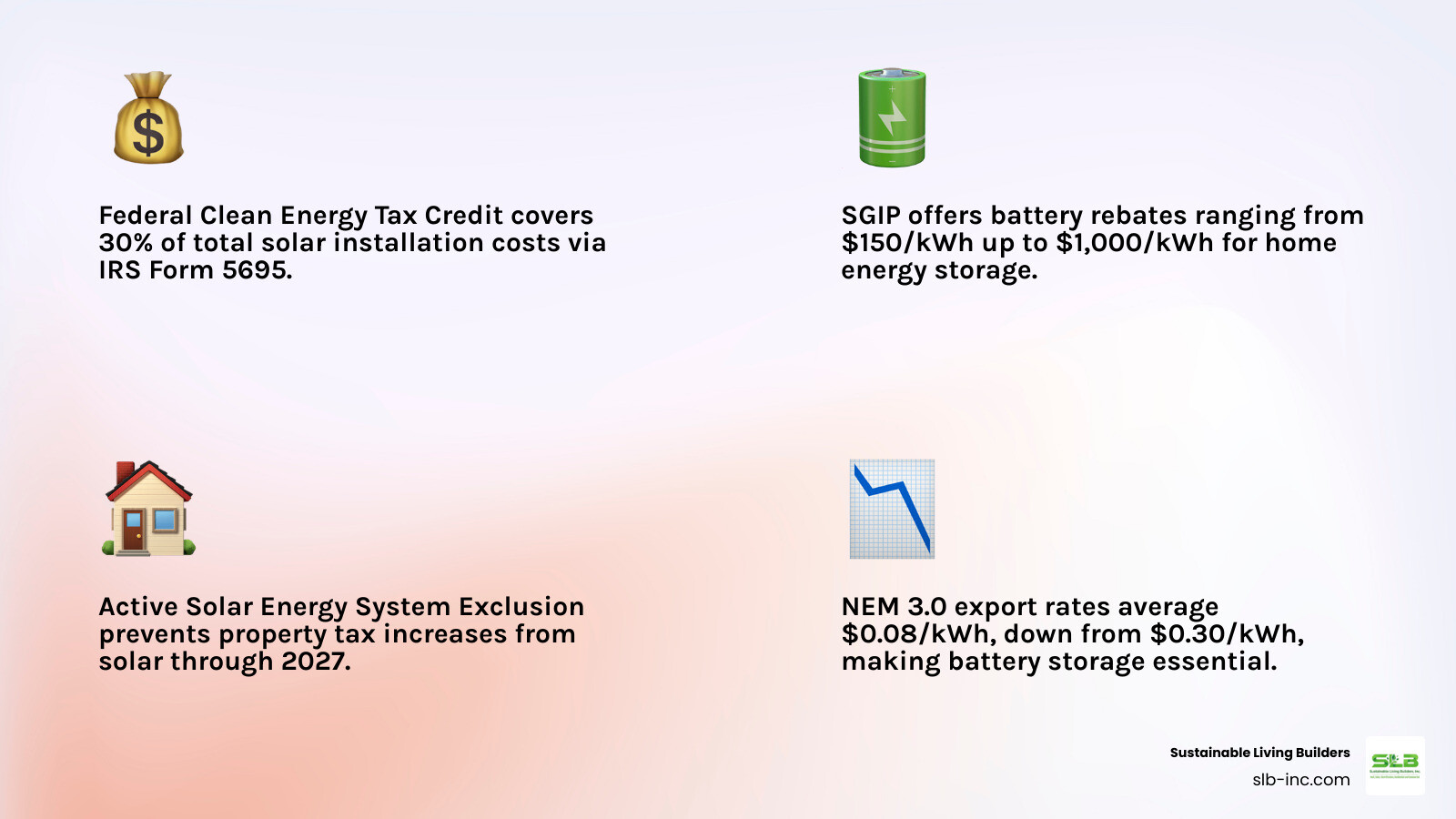
- Federal Clean Energy Tax Credit – 30% of your total solar installation cost, claimed via IRS Form 5695
- Self-Generation Incentive Program (SGIP) – Rebates from $150/kWh up to $1,000/kWh for home battery storage
- DAC-SASH – $3 per watt for qualifying low-income customers in disadvantaged communities
- Active Solar Energy System Exclusion – Prevents your property taxes from rising due to solar (in effect through January 1, 2027)
- Solar Billing Plan (NEM 3.0) – Net billing program replacing traditional net metering for PG&E, SCE, and SDG&E customers
- Solar for All – Community solar and storage access for low-income households and disadvantaged communities
- PACE Financing – Property-assessed financing available in California to spread solar costs over time
California ranks number one in the nation for solar adoption — and it’s not hard to see why. Between federal tax credits, state rebate programs, and utility-specific billing plans, homeowners here have access to a powerful stack of incentives that can meaningfully reduce the cost of going solar.
That said, the landscape has shifted. Since April 2023, California replaced traditional net metering with a new net billing structure known as NEM 3.0. Export rates dropped sharply — from around $0.30 per kilowatt-hour down to roughly $0.08 per kilowatt-hour on average. That single change has reshaped how homeowners need to think about solar, making battery storage a much smarter part of any new system.
The good news? Programs like SGIP make adding a battery more affordable than most people expect. And for households in lower-income or disadvantaged communities, programs like DAC-SASH and Solar for All can dramatically reduce — or even eliminate — upfront costs.
In this guide, we’ll walk through every major incentive available to California homeowners in 2026, explain who qualifies, and show you how these programs work together to lower your energy bills and your environmental footprint.
What Solar Incentives Are Available in California for Homeowners?
When you decide to transition your home to clean, renewable energy, you are not just buying solar panels; you are investing in a cleaner future for our communities in Santa Rosa, Sebastopol, and throughout Sonoma, Marin, and Napa counties. To make this transition easier, a robust stack of state and federal incentives is designed to lower your initial investment and accelerate your long-term savings.
Understanding how these incentives interact is the secret to maximizing your return. By combining federal tax programs with California’s unique local offerings, you can significantly lower the net cost of upgrading your home. To learn how these federal programs fit into a broader residential energy plan, check out our California Homeowners Guide to Inflation Reduction Act Savings and explore how to coordinate these opportunities by reading about State and Federal Incentives for Your Electric Home Upgrade.

Understanding the Federal Clean Energy Tax Credit
The absolute cornerstone of solar savings in 2026 is the federal Residential Clean Energy Credit, historically known as the Investment Tax Credit (ITC). This program allows you to claim a federal tax credit equal to 30% of your total solar installation expenses.
Here is what makes the federal tax credit so powerful:
- No Cap on Savings: Whether you install a modest system or a large-scale array to power your entire home and electric vehicles, the credit remains a flat 30% of the total cost.
- Broad Eligibility: The credit covers the solar modules, mounting equipment, inverters, system wiring, professional installation labor, permitting fees, and even sales tax.
- Battery Storage Included: If you pair your solar panels with a battery storage system, the battery qualifies for the same 30% tax credit. Even if you install a standalone battery without solar panels, it still qualifies.
- Rollover Provision: If your tax liability in the year of installation is lower than your total credit value, you do not lose the remaining balance. You can roll the unused credit forward to offset your taxes in future years.
To claim this credit, you or your tax professional will need to complete IRS Form 5695 when filing your annual federal tax return. For a deeper dive into how this federal program operates and how to claim it, take a look at our guide on how Uncle Sam Wants You to Go Solar for Less.
State-Level Programs: DAC-SASH and Property Tax Exclusions
In addition to federal support, California offers targeted programs to ensure clean energy is accessible to everyone while protecting homeowners from unexpected tax increases.
The DAC-SASH Program
For homeowners living in designated disadvantaged communities, the Disadvantaged Communities – Single-Family Solar Homes (DAC-SASH) program is an exceptional resource. This program provides a substantial incentive of $3 per watt for solar systems up to 5 kW.
Administered under the oversight of the California Public Utilities Commission (CPUC), DAC-SASH is designed to help low-income homeowners in PG&E, SCE, and SDG&E territories access the benefits of solar power. To qualify, you must:
- Own and occupy your single-family home.
- Receive your electricity from one of the major investor-owned utilities (such as PG&E in our North Bay service areas).
- Household income must fall within specified limits (for example, meeting the household income limits defined by the program).
- Live in one of the top 25% most disadvantaged communities statewide as identified by CalEnviroScreen.
This program can dramatically reduce the financial barrier to going solar, often resulting in free or highly subsidized systems for qualifying families.
Active Solar Energy System Exclusion
A common concern for homeowners upgrading their properties is that home improvements usually trigger a reassessment of property taxes. Fortunately, California’s Active Solar Energy System Exclusion protects you from this.
Under this state rule, the value added to your home by installing a solar energy system is excluded from property tax assessments. This means that while your solar panels increase the actual market value of your property, your local assessor cannot raise your property taxes based on that added value. This crucial exclusion is currently active through January 1, 2027, making 2026 an ideal window to complete your installation and lock in these tax-free home equity gains.
Navigating NEM 3.0 and Battery Storage Incentives
If you have researched solar in California recently, you have likely heard of NEM 3.0. Officially known as the Net Billing Tariff, this policy went into effect in April 2023 and fundamentally changed the financial equation for new solar installations.
Under the previous system (NEM 2.0), when your solar panels produced excess electricity during the sunny middle of the day, you could export that power back to the utility grid in exchange for credits nearly equal to retail electricity rates.
Under NEM 3.0, those export rates were reduced by roughly 75% to 80%. Instead of receiving retail rates, homeowners now receive a much lower rate—averaging about $0.08 per kWh—for the power they send back to the grid.
This policy change shifted the goal of home solar from export maximization to self-consumption. The strategy is simple: instead of selling your cheap solar energy to PG&E during the day and buying expensive power back at night, you want to keep every kilowatt-hour you generate.
To do this, a battery storage system is no longer just an optional add-on; it is an essential component to maximize your return on investment. By storing your excess daytime solar generation in a home battery, you can power your home during the evening when utility rates peak, bypassing the low export rates entirely. For a comprehensive look at your storage options, read our guide on The Best Ways to Save on California Energy Storage.
| Feature | NEM 2.0 (Pre-April 2023) | NEM 3.0 / Net Billing (Current) |
|---|---|---|
| Export Credit Rate | Retail rate (~$0.30 – $0.40/kWh) | Avoided cost rate (averaging ~$0.08/kWh) |
| Battery Requirement | Optional (mainly for backup power) | Essential (to maximize financial return) |
| Main Economic Strategy | Export excess power to the grid | Store excess power for home self-consumption |
| Utility Rate Structure | Time-of-Use (TOU) rates | Highly dynamic, peak-focused TOU rates |
How SGIP Rebates Support Your Battery Setup
Because battery storage is so critical under the current net billing rules, California offers the Self-Generation Incentive Program (SGIP) to help offset the cost of adding energy storage to your home. SGIP provides upfront rebates for installing battery systems, with the rebate amount determined by your income level, location, and medical needs.
The program is structured into three primary tiers:
- Standard Residential Storage Tier: This is the baseline program open to all residential utility customers. It provides a rebate of $150 per kilowatt-hour (kWh). For a standard home battery (like a 13.5 kWh capacity unit), this translates to an automatic rebate of approximately $2,025, which significantly lowers your out-of-pocket setup costs.
- Equity Tier: Designed for lower-income households, this tier provides an increased rebate of $850 per kWh. This covers a very large portion of the battery equipment costs for qualifying families.
- Equity Resiliency Tier: This is the most generous tier, offering a rebate of up to $1,000 per kWh. To qualify, you must live in a high fire-threat district (very common in parts of Sonoma, Marin, and Napa counties) or have experienced multiple Public Safety Power Shutoffs (PSPS), and meet low-income criteria or rely on life-support equipment. In many cases, this tier can cover nearly the entire cost of the battery installation.
Combining these SGIP rebates with the 30% federal tax credit makes adding storage incredibly practical. Learn more about aligning these incentives in our article on How to Make the IRS Pay for Your Home Battery.
Maximizing Savings Under the Solar Billing Plan
To thrive under the Solar Billing Plan, you need a system designed for smart energy management. In our local North Bay communities served by PG&E, this means utilizing your battery to avoid purchasing electricity during high-cost peak hours, which typically run from 4:00 PM to 9:00 PM.
Additionally, our team at Sustainable Living Builders can help you explore localized programs. For instance, if you live in Sonoma County, you can benefit from Sonoma Clean Power programs that coordinate with PG&E to offer additional efficiency incentives. To see how these local and regional resources can be stacked for maximum impact, take a look at how to Save Big with Sonoma and PG&E Energy Programs.
Additional Programs and Financing Options
Beyond direct rebates and tax credits, California has established several innovative regulatory frameworks and financing structures to help you transition to clean energy without straining your cash flow.
- PACE Financing (Property Assessed Clean Energy): PACE allows you to finance your solar and energy-efficiency upgrades through a voluntary assessment on your property tax bill. Instead of making monthly payments to a traditional bank, you repay the balance over time (up to 20 or 30 years) as part of your property taxes. Because the loan is attached to the property rather than your personal credit, it can be an excellent option for homeowners who want to keep their personal debt-to-income ratios clear.
- Net Energy Metering Aggregation (NEMA): If you own a property with multiple meters—such as an agricultural property, a home with an accessory dwelling unit (ADU), or adjacent parcels in Sonoma or Marin—PG&E’s NEMA program allows you to utilize a single solar array to offset the electricity load of multiple meters on the same or contiguous properties. This is a game-changer for local landowners looking to streamline their utility accounts.
- Solar for All: Under the federal Inflation Reduction Act, California received nearly $250 million in Solar for All grant funding. This program coordinates state agencies (including the CPUC and the California Energy Commission) to deploy community solar and storage projects. This funding expands clean energy access to low-income multifamily housing, tribal lands, and disadvantaged neighborhoods, ensuring that the benefits of the clean energy transition are shared equitably.
If you are planning to replace an aging roof at the same time you install solar, combining these projects can yield massive efficiency and financial advantages. You can learn more about coordinating these upgrades by reading our guide on how to Maximize Your California Solar and Roofing Savings Today.
Frequently Asked Questions
Navigating clean energy programs can feel like learning a new language. Here are clear answers to the most common questions we hear from homeowners in Santa Rosa, Sebastopol, and the surrounding North Bay counties.
What solar incentives are available in California for low-income households?
Low-income households in California have access to some of the most supportive solar programs in the country. The DAC-SASH program provides an upfront incentive of $3 per watt (up to 5 kW) for qualifying single-family homeowners in disadvantaged communities.
Additionally, the SGIP Equity and Equity Resiliency tiers provide battery rebates ranging from $850/kWh to $1,000/kWh, which can cover almost the entire cost of a home battery. Finally, the newly deployed Solar for All initiative and the Solar on Multifamily Affordable Housing (SOMAH) program provide targeted community solar and storage opportunities for renters and low-income multifamily residents.
What solar incentives are available in California for battery storage?
Battery storage is highly incentivized in California to support grid reliability. The primary incentive is the Self-Generation Incentive Program (SGIP), which offers a standard residential rebate of $150/kWh (averaging around $2,025 for a standard home battery) and up to $1,000/kWh for qualifying equity resiliency customers.
Furthermore, your battery installation qualifies for the 30% federal clean energy tax credit, whether installed alongside solar or as a standalone system. Lastly, programs like the Demand Side Grid Support (DSGS) program pay homeowners annual incentives (often around $350 per year) for allowing their batteries to support the grid during extreme peak demand events.
How do I claim the federal solar tax credit in California?
To claim the 30% federal tax credit, you must own your solar system (either purchased with cash or financed through a solar loan; leased systems do not qualify for the residential credit, as the leasing company claims it).
When you file your federal income taxes for the year the system was fully installed and operational, you will complete IRS Form 5695 (Residential Energy Credits). You will calculate your 30% credit based on your total eligible expenses and enter this amount on your Form 1040 to reduce your overall federal tax liability. If your credit is larger than your tax liability, the remaining balance rolls over to the following tax year.
Conclusion
Determining what solar incentives are available in California is the first step toward taking control of your monthly utility bills. While the transition to NEM 3.0 has changed the rules of the game, pairing high-efficiency solar panels with smart battery storage remains an incredibly effective way to build long-term energy independence. By stacking the 30% federal tax credit, local SGIP battery rebates, and property tax exclusions, you can construct a highly efficient, self-sustaining energy system that protects your home from rising utility rates.
At Sustainable Living Builders, we specialize in providing holistic, eco-friendly home improvements tailored specifically to the unique climate and utility rules of Santa Rosa, Sebastopol, and Sonoma, Marin, and Napa counties. We don’t believe in one-size-fits-all solutions. Our team is here to help you navigate these complex state and federal programs to design a system that maximizes your savings.
Ready to see how the numbers look for your home? Use our interactive Smart Roof Calculator to analyze your property’s potential, and Start Your Solar Journey Today with a team of local experts who put sustainability and smart planning first.