Is a Tesla Solar Roof Worth the Investment? Here’s What Homeowners Need to Know First
Is a Tesla Solar Roof worth the investment? For most homeowners, the honest answer is: it depends — but the financial case is harder to make than Tesla’s marketing suggests. Here’s a quick breakdown before we go deeper:
Quick Answer:
| Situation | Worth It? |
|---|---|
| You need a full roof replacement AND want solar | Possibly yes |
| You’re building a new home | Good candidate |
| Your existing roof is in great shape | Likely no |
| You prioritize aesthetics over pure ROI | Maybe |
| You want the fastest payback on solar | No — standard panels win |
Your neighbor with a sleek, tile-like roof generating its own electricity isn’t just showing off — they made a major financial decision that could take decades to pay back, or might never fully pay off at all. That’s the tension at the heart of this guide.
A Tesla Solar Roof is one of the most visually stunning ways to add solar energy to a home. But stunning doesn’t always mean smart financially. With prices significantly higher than traditional solar-plus-roof combinations, and energy output that tends to run lower than equivalent rooftop panel systems, the numbers deserve a very close look before you sign anything.
In this guide, we break down the real costs, real savings, real performance data, and real owner experiences — so you can make a clear-eyed decision about whether this product fits your home, your goals, and your wallet.
What a Solar Roof Is and How It Works
A solar roof is a roofing system that also generates electricity. Instead of mounting solar panels on top of shingles, the roof itself becomes the solar system. With a Tesla Solar Roof, some tiles are active and generate power, while others are inactive and match the same appearance to create a uniform finished roof.
The system typically includes:
- Glass roofing tiles
- Active solar tiles that produce electricity
- Inactive tiles for non-producing sections
- Electrical wiring beneath the roof surface
- An inverter that converts solar power for household use
- Optional battery storage for backup and load shifting
In plain English: your roof keeps weather out and makes energy at the same time. It is a roof first, and a solar system second.

What makes a solar roof different from standard rooftop solar
The biggest difference is integration. Standard solar uses panels mounted above an existing roof. A solar roof is the roof. That gives it a cleaner, more architectural appearance and can be appealing for homeowners who do not want visible racks and modules.
This integrated approach also changes the project scope. You are not just adding generation equipment; you are replacing the roofing material across the home. That is why products like integrated solar roofing appeal most to homeowners already planning a major roof project.
The tradeoff is that integrated solar roofing usually sacrifices some pure energy efficiency for appearance. Research shows these systems often generate less electricity than a similarly sized traditional rooftop solar array. That does not make them bad. It just means beauty and performance are being balanced, not maximized in the same way.
How electricity flows from roof to home and battery
The electricity path is fairly simple:
- Active roof tiles collect sunlight and produce DC power.
- An inverter converts that DC power into usable AC electricity.
- Your home uses that electricity first.
- Extra production may charge a battery or flow to the grid, depending on system design and utility rules.
- During outages, a battery can keep selected home loads running if the system is configured for backup.
If you pair the roof with storage, the value proposition changes. Batteries can increase self-consumption, improve outage resilience, and help some Sonoma, Marin, Napa, Sebastopol, and Santa Rosa homeowners use more of their solar power during high-rate periods. You can learn more about whole-home solar energy systems if you are thinking beyond the roof alone.
Is a Tesla Solar Roof Worth the Investment for Financial ROI?
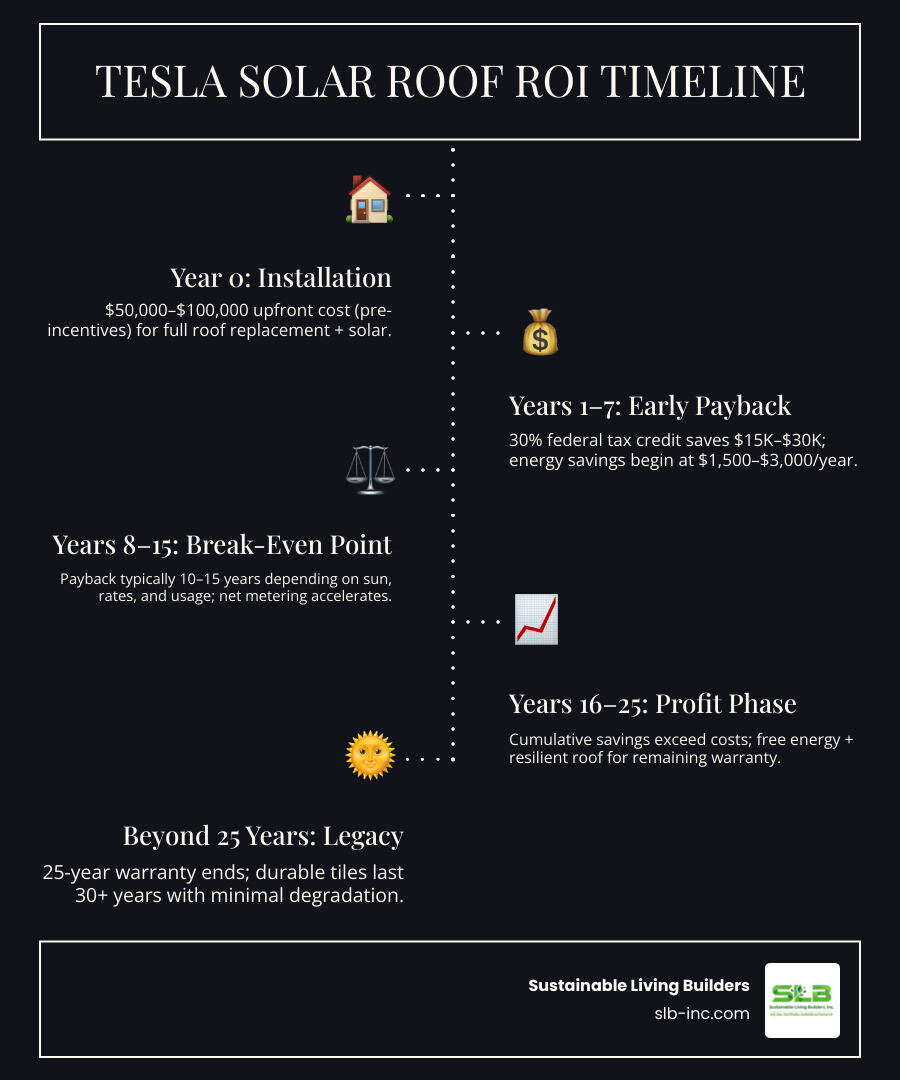
If we focus strictly on financial return, the answer is often “only in specific situations.” Research consistently points to longer payback periods and lower lifetime savings compared with conventional solar on a standard replacement roof.
Why? Mainly because the product combines premium roofing, integrated solar technology, specialized installation, and often battery-ready design. It is not a budget play. It is closer to a design-forward energy upgrade.
A quick reality check from the research:
- Solar roof systems tend to have much longer payback periods than standard rooftop solar
- They often produce less annual energy than comparable traditional panel systems
- Lifetime utility savings may offset only part of the total investment
- Standard solar usually wins on simple dollars-and-cents ROI
That does not mean a solar roof is automatically a poor decision. It means the return is not just financial. For some households, aesthetics, durability, and all-in-one roof replacement matter enough to justify the premium.
The biggest factors that determine payback
Several variables matter more than the brand name on the brochure:
- Roof size and usable area
- Roof orientation and pitch
- Shade from trees, chimneys, and nearby structures
- Local utility rates
- Net metering or export compensation rules
- Your daytime versus nighttime energy use
- Whether battery storage is included
- Financing structure
- How long you plan to stay in the home
In our North Bay service area, utility rates can be high enough to make solar appealing in general. But high rates alone do not magically make every solar roof a home run. A complicated roof with many small facets, poor sun exposure, or limited active tile placement can drag down production and extend payback.
Roof age is huge too. If your roof is already near the end of its life, combining roof replacement with solar can be more rational. If your current roof is in excellent shape, tearing it off early usually hurts the economics.
When is a Tesla Solar Roof worth the investment for homeowners?
In our view, it makes the most sense when several “yes” answers line up at once:
- You already need a new roof
- You want solar at the same time
- You care a lot about curb appeal
- You expect to stay in the home long term
- Your roof has strong solar exposure
- Your household uses enough electricity to benefit from on-site generation
- You value resilience and may want battery backup
It can also make sense in new construction. Starting from scratch avoids the awkwardness of removing a functioning roof just to install solar tiles. That is one reason forums and owner discussions often point to new builds as the cleanest fit.
For design-conscious homeowners in Santa Rosa, Sebastopol, Sonoma County, Marin County, and Napa County, a solar roof can also deliver something hard to capture in a spreadsheet: a premium, unified look. If your home architecture matters deeply to you, that may be part of the return.
When it usually does not make financial sense
A solar roof usually does not pencil out well when:
- Your existing roof is still in good condition
- Your electric bills are relatively low
- The roof has meaningful shading
- You may move within a few years
- Your roof geometry limits solar-producing tile area
- Your main goal is the fastest payback possible
This is the part many homeowners do not love hearing, but it is better to hear it now than after installation day: if pure ROI is your only goal, a solar roof is rarely the strongest financial answer.
Performance, Durability, and Warranty Expectations
Performance is where expectations need to be realistic. Tesla solar shingles are widely cited at roughly 72 watts per active tile, with tile dimensions around 15 inches by 45 inches. Reported efficiency for the solar portion tends to fall below the efficiency of top-tier standard panels. Research commonly places solar roof efficiency in a broad range around 8% to 14%, while many conventional panels land closer to the low 20% range.
That gap helps explain why annual production from a solar roof may be lower than a conventional panel array sized for similar roof area.
How much energy a solar roof can produce in real life
Real-world output depends on active tile count, roof design, weather, orientation, and shading. Research in your brief suggests annual production can run roughly 14% to 18% lower than comparable traditional panels.
Why the difference?
- Solar cells are integrated into roofing tiles rather than optimized standalone modules
- Architectural constraints may limit ideal placement
- Not every roof section gets active tiles
- The hidden-cell design favors aesthetics over raw conversion efficiency
This does not mean the roof underperforms its design if installed correctly. It means homeowners should not assume it will match the output of a conventional system with the same roof footprint.
Seasonality matters too. Summer usually brings the highest production, while winter output drops because of shorter days and cloud cover. In steeper-roof homes, snow may shed naturally within a few days, which can help winter recovery in colder conditions. That is less of a day-to-day issue in most of our local California service area, but storm performance still matters.
What homeowners should know about durability and coverage
One of the strongest arguments for a solar roof is durability. The product is built as roofing material, not just generation equipment mounted above roofing material. Tesla solar glass tiles are generally marketed around robust weather resistance, including:
- Tempered glass construction
- High wind resistance
- Hail resistance
- Class A fire performance
- Long-term weather exposure durability
For homeowners exploring Tesla Glass Tile, the appeal is that you are getting a premium roof surface as well as a solar system.
Warranty coverage is another major factor. Research points to a 25-year warranty structure, including long-term power output expectations with gradual annual degradation after the early years. In practice, that is in line with what homeowners expect from established solar equipment warranties, though the details of product, power, weatherization, and workmanship coverage should be reviewed carefully in writing.
Is a Tesla Solar Roof worth the investment if reliability is your top concern?
If reliability is your top priority, the answer may be stronger than if ROI alone is your priority.
Why? Because the product can solve two needs at once:
- Replace the roof
- Generate power for decades
That can be compelling if your current roof is aging and you want a single integrated upgrade rather than separate roofing and solar projects. Add battery backup, and you also gain outage resilience. For homeowners in wildfire-aware and storm-aware parts of the North Bay, resilience is not a theoretical perk anymore.
The flip side is service expectations. A highly specialized integrated roof system can be more complex to troubleshoot than a straightforward rack-mounted solar array. Reliability of the product and simplicity of support are not always the same thing.
Real-World Ownership Experience: What Homeowners Like and Regret
Owner feedback tends to follow a clear pattern: people love the look, enjoy app-based monitoring, and appreciate the premium feel. Regrets usually center on timelines, communication, and the difference between expected and actual production.
Common praise from solar roof owners
The most common positives include:
- A sleek, low-profile appearance
- Better curb appeal than visible rooftop equipment
- A more unified design across the whole home
- Strong “wow” factor from neighbors and buyers
- The feeling of investing in both resilience and sustainability
For many owners, aesthetics are not a side benefit. They are the main reason to choose this route. That is especially true on custom homes or high-visibility properties where standard panels might disrupt the design.
You can explore more on how this kind of system enhances the whole home through Tesla Solar Roof Amplifies.
Common complaints and caution flags
The most frequent concerns discussed in forums and homeowner threads include:
- Long lead times
- Complex project coordination
- Changes between initial estimates and final scope
- Lower-than-hoped-for production
- Frustration with online calculators that did not reflect site realities
- Delays tied to permits, inspections, or roof complexity
In short: the prettier the system, the less forgiving homeowners tend to be when the process is messy.
That is why we always recommend a full site-specific assessment instead of relying on a quick online calculator. Trees, vents, hips, valleys, and utility policy details can all materially affect results.
Questions to ask before signing a contract
Before moving forward, ask these questions:
- How much of my roof will use active versus inactive tiles?
- What is the projected annual production in kWh?
- How was shading evaluated?
- What assumptions were used about utility rates and export credits?
- Does my roof layout limit production?
- What happens if future production falls short of projections?
- What warranty covers the roof itself versus the solar components?
- Is battery storage recommended for my usage pattern?
- How long is the expected installation timeline?
- What maintenance should I expect over time?
A little homework up front can save a lot of forehead-wrinkling later.
Solar Roof vs. Other Home Solar Paths
When homeowners ask us whether a solar roof is worth it, the real question is usually, “Worth it compared to what?” That is the right question.
For many homes, the choice is not solar roof or nothing. It is:
- Integrated solar roof
- Roof replacement plus rooftop solar
- Standard roof now and solar later
- Solar plus battery
- Roof-only improvement if solar exposure is poor
For a broader look at the category, see Solar Shingles vs Solar Panels.
| Option | Best for | Main strength | Main tradeoff |
|---|---|---|---|
| Integrated solar roof | Full-roof upgrade with design focus | Best appearance | Longer payback |
| Roof replacement plus standard solar | Practical homeowners | Better energy value | Panels remain visible |
| Standard solar on good existing roof | Fastest ROI seekers | Strongest financial return | Does not solve roof age |
| Solar plus battery | Resilience-focused homes | Backup and self-use | More system complexity |
Solar roof vs. roof replacement plus standard solar
From a financial standpoint, roof replacement plus standard solar usually has the edge. Research in your brief indicates solar roof systems can cost dramatically more while generating less electricity than conventional solar-plus-roof combinations.
From an architectural standpoint, the solar roof often wins. It avoids the “equipment on top of roof” look and creates a cleaner, more unified finish.
So the decision often comes down to priorities:
- If you want the best pure solar economics, integrated solar roofing is hard to justify
- If you want a premium roof that also produces power, it becomes more compelling
For more context on roof-first thinking, visit Traditional Roofing vs Solar Roofing: What’s the Right Choice for Me?.
How pairing with battery storage changes the value
Battery storage changes the value in two ways:
- It can improve resilience during outages.
- It can help you use more of your own solar energy instead of exporting it.
That matters in places where utility rate structures make self-consumption more valuable than grid export. For some homeowners, a battery is less about payback and more about peace of mind. If you have refrigeration needs, medical equipment, internet dependence, or simply dislike sitting in the dark wondering what century it is, storage can be worthwhile.
That said, batteries add complexity and can lengthen overall payback. They are often easier to justify on resilience grounds than on savings alone. If you want a simpler overview of solar pathways, our solar panels page is a good place to start.
Is a Tesla Solar Roof worth the investment compared with simpler options?
Compared with simpler options, it is worth it only if you personally value the things simpler options do not deliver as well:
- A full-roof aesthetic upgrade
- Integrated design
- Premium curb appeal
- One coordinated roof-plus-solar project
- Potentially stronger emotional satisfaction with the finished result
Compared on raw ROI alone, simpler paths usually win. Compared on architecture and whole-home design, the solar roof can absolutely win for the right homeowner.
For a more direct side-by-side discussion, see Tesla Solar Roof vs Traditional Solar Panels: What is the Right Choice for Me?.
Frequently Asked Questions About Tesla Solar Roof ROI
Does the federal tax credit improve the return enough?
The federal solar tax credit can improve the math significantly for eligible homeowners because it lowers net project cost. It may apply to qualifying solar roofing and battery storage when installation meets current requirements. However, a tax credit improves the return; it does not automatically turn a long-payback luxury product into a fast-payback one.
Homeowners should also confirm:
- Current-year eligibility rules
- Whether they have enough tax liability to benefit
- Whether battery components qualify
- What local utility rules mean for total savings
In other words, incentives help, but they do not erase the importance of roof fit, production, and long-term ownership.
Will a solar roof increase home value?
Potentially, yes. Solar can support resale value, and an attractive integrated roof may appeal to buyers who care about energy efficiency and design. Research on solar in general suggests homes with energy improvements can command stronger buyer interest, especially where electricity costs are high.
Still, resale value is not guaranteed to match what you spent. The increase is usually strongest when the home, neighborhood, and buyer profile all support premium sustainable upgrades.
How do I know if my roof and location are a good fit?
A good fit usually looks like this:
- Plenty of direct sun
- Minimal shading
- A roof that already needs replacement or a new-build project
- Sufficient annual electricity usage
- A plan to stay in the home for many years
- Interest in aesthetics and resilience, not just fast payback
Homeowners in Santa Rosa, Sebastopol, Sonoma County, Marin County, and Napa County should also consider local weather patterns, utility policies, and roof complexity. A professional assessment beats guessing every time.
Conclusion: Who Should Move Forward With a Solar Roof?
So, is a Tesla Solar Roof worth the investment?
For most homeowners, not if the only goal is the strongest financial return. Traditional solar usually reaches payback sooner and delivers better lifetime savings. But that is not the end of the story.
A solar roof can make sense if:
- You already need a roof replacement
- You are building a new home
- You plan to stay put for the long haul
- You care deeply about appearance
- You want a roof that contributes to resilience and energy independence
In other words, this is usually a best-fit product for homeowners who want a premium, integrated home upgrade and understand that beauty has a budget.
If that sounds like you, we recommend starting with a site-specific evaluation rather than a generic online estimate. At Sustainable Living Builders, we help homeowners think through roofing, solar, and smart energy systems as one connected decision, not three separate headaches in a trench coat.
For next steps, explore Combining Solar and Storm Resilience: The Dual Benefits of Tesla Solar Roofs, learn about our Tesla Solar Roof Installation Service in Santa Rosa, CA, or visit our main Tesla Solar Roof page to see whether your home may be a good match.