Is Solar Still Worth It in California in 2026?
Is solar still worth it in California? For most homeowners, the answer is yes — but the strategy has shifted in ways that matter a lot for your wallet.
California has some of the highest electricity rates in the country, with major utilities charging well above the national average. That gap alone keeps solar financially attractive. But policy changes — especially the rollout of NEM 3.0 (the Net Billing Tariff) — have changed how you get the most value from a rooftop system.
Here is a quick snapshot to help you decide:
Solar is likely worth it in California if you:
- Pay more than $150 per month on electricity
- Own your home and plan to stay at least 5 years
- Have a roof with good sun exposure and limited shading
- Can pair your system with battery storage to maximize self-consumption
Solar may be harder to justify if you:
- Have a monthly electric bill under $100
- Plan to move within the next 2 to 3 years
- Have a roof that needs replacement soon
- Cannot use a tax credit and are not eligible for alternative financing
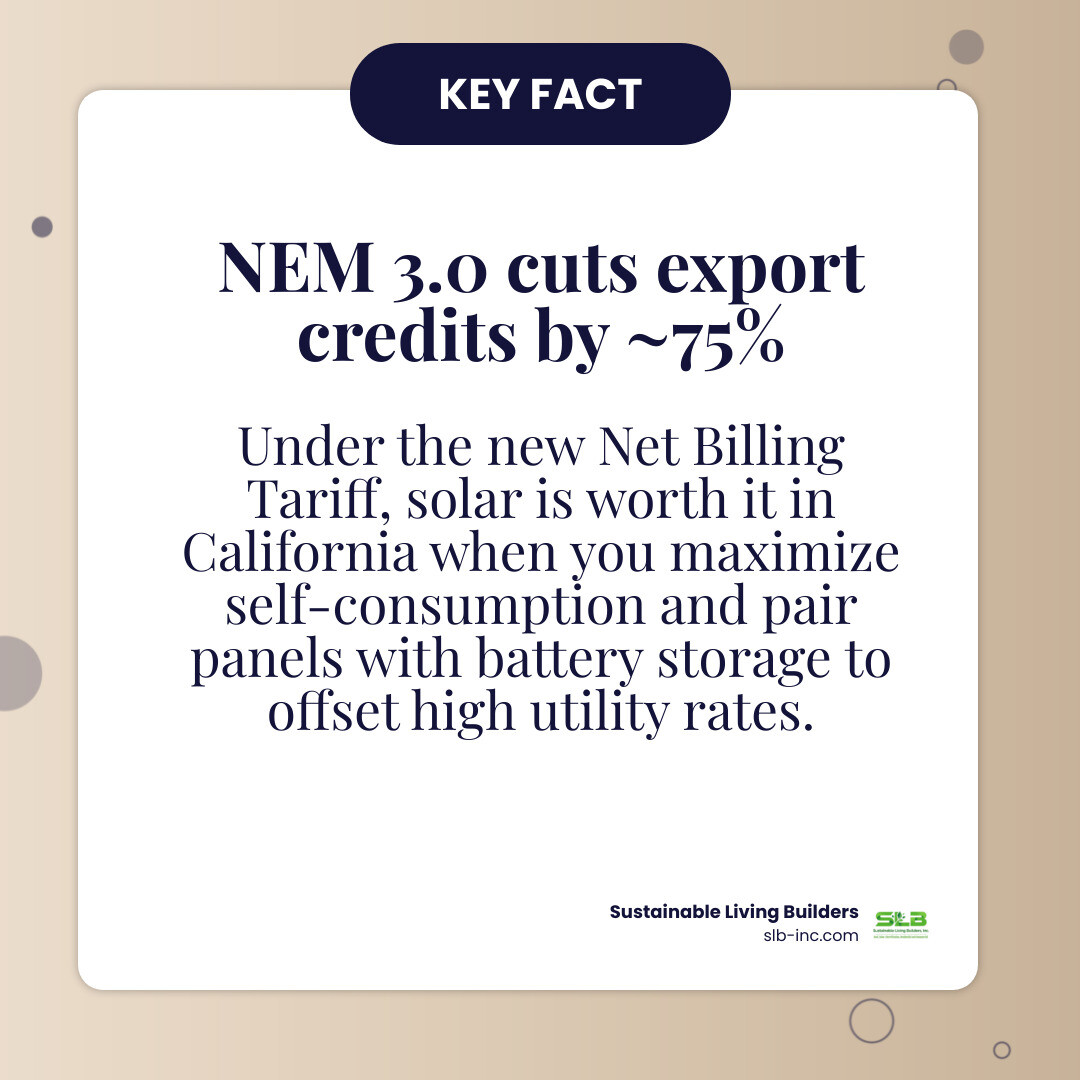
The core issue is this: under the old net metering rules, homeowners could send excess solar power to the grid and receive close to full retail credit for it. Under NEM 3.0, that export credit dropped by roughly 75%. Today, the financial case for solar depends far more on how much power you use directly from your panels — and how well you store the rest.
California still gets around 278 sunny days per year, and residential electricity rates continue to climb across PG&E, SCE, and SDG&E territories. The fundamentals remain strong. What has changed is how you need to design and use your system to make the numbers work.
Is Solar Still Worth It in California Under NEM 3.0?

For years, California was the undisputed leader in residential solar. Under the previous net metering framework (NEM 2.0), the grid essentially functioned as a free, infinite battery. When your panels produced excess electricity during the sunny middle of the day, you sent it to the grid and received full retail credit. At night, you pulled that power back at no extra cost.
However, the transition to NEM 3.0—officially known as the Net Billing Tariff—fundamentally altered this dynamic. Under this system, the relationship between solar homeowners and the utility grid has transformed. To understand if the transition is still beneficial for your home, we must look at how we generate, store, and consume energy. For a deeper look at the foundational economics of going solar, you can read our guide on Are Solar Panels Worth It?
The bottom line is that is solar still worth it in california under NEM 3.0 depends entirely on your design strategy. The “install-and-export” model of the past is no longer viable. Today, the most successful solar installations focus on self-consumption: keeping the clean energy you produce on-site and using it to power your own home.
How the Net Billing Tariff Affects Your Return on Investment
The primary change introduced by NEM 3.0 is a drastic reduction in export rates. Instead of receiving credit equal to the retail rate of electricity, homeowners who export power back to the grid now receive a much lower rate—often representing a drop of about 75%. While you might pay a high retail rate to buy power from the utility, they will only credit you a fraction of that amount for the power you send back.
This change directly impacts the payback period for traditional solar-only systems. Because exporting power is no longer financially rewarding, a system that relies on sending excess energy back to the utility grid will take significantly longer to recover its initial investment.
However, this does not mean solar is a losing proposition. It simply means we must change our approach. By focusing on self-consumption, we minimize the amount of power we export and maximize the amount of free solar energy we use within the home. To explore the various state-level programs and rate structures that can help offset these changes, see How Solar Incentives in California Can Help You to Save.
Why Battery Storage Determines If Solar Is Still Worth It in California
If the grid no longer offers a favorable exchange rate for your excess electricity, the solution is to stop relying on the grid for storage. This is where modern battery technology becomes essential.
By pairing your solar panels with a home battery storage system, you can store the abundant energy your panels produce during the day. Instead of exporting that power to the utility for a minimal credit, your battery saves it. When the sun goes down and utilities transition to their most expensive peak time-of-use (TOU) rates—typically between 4:00 PM and 9:00 PM—your home can automatically switch to battery power.
This strategy allows you to bypass the most expensive hours of the day, dramatically reducing your utility bills and accelerating your return on investment. Furthermore, in areas like Santa Rosa, Sebastopol, and throughout Sonoma, Marin, and Napa counties, a battery provides vital energy independence and backup power during Public Safety Power Shutoffs (PSPS) and seasonal grid outages. To learn more about how storage integrates with your daily routine, read A Practical Guide to Home Battery Storage: Worth It in California?.
Maximizing Your Long-Term Energy Savings
While the regulatory landscape has evolved, the underlying driver of solar savings remains stronger than ever: escalating utility rates. In Northern California, PG&E rates have risen consistently over the past decade, with average annual increases outpacing historical norms. As long as utility rates continue to climb, the value of every kilowatt-hour you generate yourself increases.
By taking control of your power generation and storage, you lock in a predictable, clean energy source. Over the lifetime of your system—which typically spans 25 to 30 years—these avoided utility costs add up to substantial lifetime savings. To see how you can coordinate a solar installation with other home improvements to maximize efficiency, check out our guide on how to Maximize Your California Solar and Roofing Savings Today.
Deciding Between Solar-Only and Solar-Plus-Battery Systems
For homeowners in our North Bay service areas—including Marin, Napa, and Sonoma counties—the choice between a solar-only system and a solar-plus-battery system often comes down to your primary goals.
A solar-only system can still provide value if your household consumes a large portion of its energy during the day (for example, if you work from home, run pool pumps, or charge an electric vehicle during peak sunlight hours). However, because you cannot store excess daytime power, you remain highly reliant on the grid during the evening. You also remain vulnerable to local grid outages.
A solar-plus-battery system, on the other hand, offers comprehensive self-generation and outage protection. It allows you to run your home seamlessly through a blackout and protects you from high evening utility rates. For a complete comparison of these two approaches, read Everything You Need to Know About Choosing Solar-Only vs. Solar-Plus-Battery.
Evaluating If Solar Is Still Worth It in California for Your Home
Every property is unique, and several physical factors will determine how effectively a solar system performs on your roof:
- Roof Orientation: South- and west-facing roofs receive the most consistent sunlight throughout the day. North-facing roofs are generally less productive and may require more panels to achieve the same energy output.
- Shading: Tall trees, chimneys, or neighboring buildings that cast shadows on your panels during peak hours will reduce overall system efficiency.
- Energy Consumption: Homes with moderate to high energy usage (especially those utilizing air conditioning, heat pumps, or electric vehicle chargers) typically see a faster return on investment because they are offsetting a larger volume of expensive utility power.
To help visualize how system design impacts performance under the current Net Billing Tariff, consider the following comparison:
| Performance Metric | Solar-Only System | Solar-Plus-Battery System |
|---|---|---|
| Grid Reliance | Moderate-High (reliant at night & during outages) | Low (highly self-sufficient) |
| Average Self-Consumption % | Approximately 50% | Approximately 80% or higher |
| Outage Resilience | None (shuts down during blackouts for safety) | Full backup power for essential appliances |
| Time-of-Use Optimization | Low (cannot shift daytime power to evening peak) | High (discharges stored power during peak hours) |
| Long-Term Savings Potential | Moderate | Maximum |
Frequently Asked Questions About California Solar
How long is the typical payback period for solar in California today?
The payback timeline depends heavily on your system configuration and your local utility. For a solar-plus-battery system designed for maximum self-consumption, the typical payback period ranges from 7 to 11 years. While the addition of a battery extends the initial payback period compared to older NEM 2.0 solar-only systems, it unlocks significantly higher lifetime savings by protecting you from ongoing utility rate increases. Once your system pays for itself, the energy generated for the remainder of the system’s 25-to-30-year lifespan is virtually free.
Do solar panels increase home resale value in California?
Yes. Homebuyers in California highly value energy independence and lower monthly operating costs. Studies have shown that homes with customer-owned solar installations sell for a premium—often averaging a 4% to 6% increase in home value—compared to homes without solar. This added home equity means that even if you decide to move before your system fully pays for itself through utility bills, you can recover a significant portion of your investment when you sell.
How do the federal tax credit rules in 2026 affect solar buyers?
In 2026, the Residential Clean Energy Credit remains a powerful incentive for homeowners. Under current rules, homeowners who purchase their systems outright (via cash or a solar loan) can claim a 30% federal tax credit on the total cost of their solar and battery installation.
For those who choose third-party ownership models, such as solar leases or Power Purchase Agreements (PPAs), the tax credit is claimed by the commercial entity owning the system. In many cases, these third-party providers pass a portion of those savings along to the homeowner in the form of lower monthly payments, though direct ownership typically yields the highest long-term return on investment.
Conclusion
Navigating the modern solar landscape in California requires a thoughtful, tailored approach. While the rules of the road have changed under NEM 3.0, the combination of rising utility rates and abundant local sunshine means that solar energy remains an exceptionally strong investment for North Bay homeowners. By focusing on smart system design, efficient roofing integration, and modern battery storage, you can secure reliable power and long-term financial savings.
At Sustainable Living Builders, we specialize in providing holistic, sustainable home improvements tailored to our local communities in Santa Rosa, Sebastopol, and throughout Sonoma, Marin, and Napa counties. Our expert team is here to help you evaluate your home’s unique potential using our Smart Roof Calculator, ensuring you get a system designed for maximum self-consumption and resilience.
Are you ready to take control of your energy future? Schedule a consultation with Sustainable Living Builders today to design a system that works for your home, your roof, and your budget.