What Are Battery Storage Incentives and Tax Credits in 2026?
Battery storage incentives and tax credits have gone through major changes in 2026, and knowing where things stand can save you thousands of dollars on your home energy upgrade.
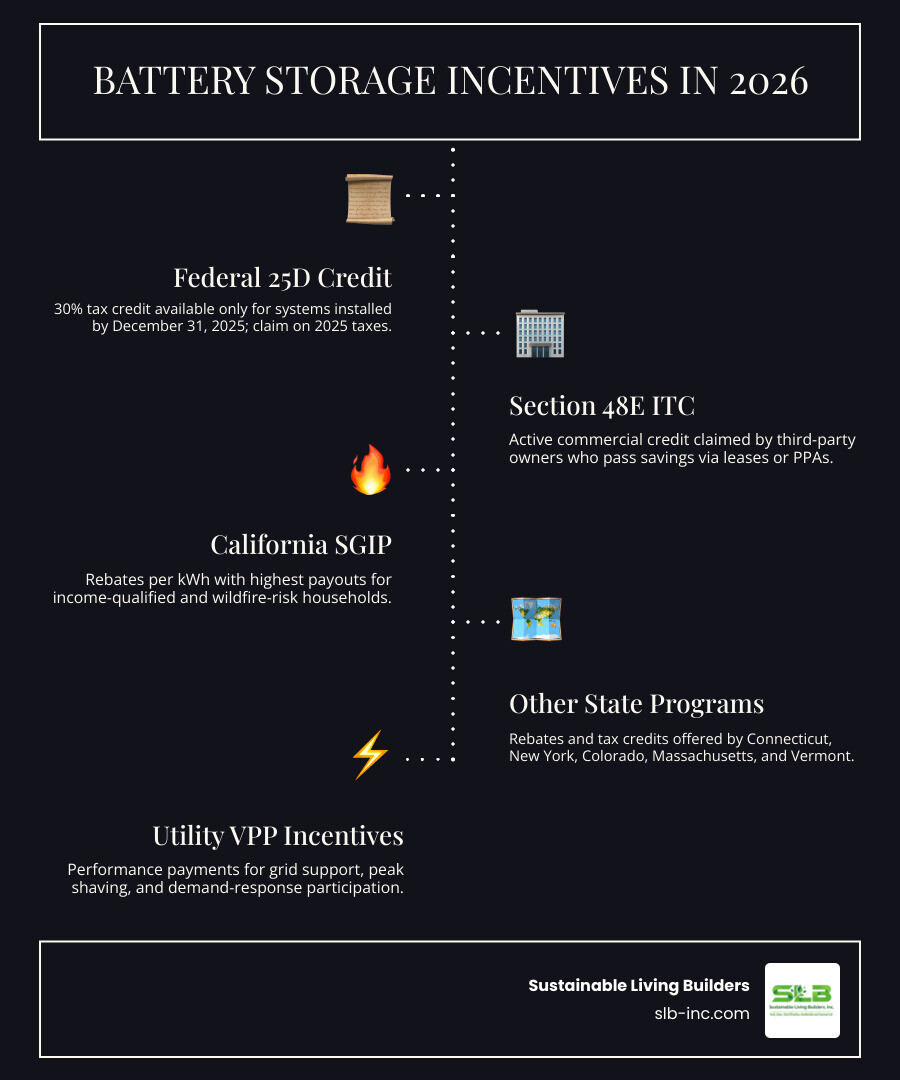
Here is a quick snapshot of what is available right now:
- Federal 25D Credit (expired): A 30% tax credit for homeowners who purchased and installed a qualifying battery system by December 31, 2025. If you did, you can still claim it when you file your 2025 taxes.
- Section 48E Commercial ITC (active): A federal investment tax credit for battery systems under third-party ownership (leases or PPAs). The company that owns your battery claims the credit and passes the savings to you through lower monthly payments.
- California SGIP: The Self-Generation Incentive Program offers rebates per kilowatt-hour of storage capacity, with the highest amounts going to income-qualified households and those in high wildfire-risk areas.
- Other state programs: Connecticut, New York, Colorado, Massachusetts, and Vermont all offer their own rebates or tax credits for battery storage installations.
- Utility programs: Many utilities offer virtual power plant participation payments and demand-response incentives that improve the financial case for adding a battery.
The landscape shifted significantly after the One Big Beautiful Bill Act (OBBBA) ended the residential 25D credit for new purchases. But pathways to savings still exist — especially if you live in California or use a lease or PPA arrangement.
The global battery storage market is growing fast. Worldwide installations grew 54% in just the first half of 2025, and the U.S. residential storage market hit its highest-ever first quarter that same year. Homeowners are clearly paying attention — and the financial tools to support them, while changing, are far from gone.
Battery storage incentives and tax credits word guide:
Navigating Federal Battery Storage Incentives and Tax Credits Post-OBBBA
The legislative landscape for green energy took a sharp turn recently. With the passage of the One Big Beautiful Bill Act (OBBBA), the direct-to-consumer federal tax credit pathway under Section 25D has officially closed for new residential battery purchases made after December 31, 2025. This means that if you buy a home battery system outright in 2026, you can no longer claim the 30% federal tax credit on your personal tax return.
However, this does not mean federal support has vanished. The OBBBA preserved the Section 48E Investment Tax Credit (ITC) for commercial entities. Because third-party solar developers, leasing companies, and Power Purchase Agreement (PPA) providers are classified as commercial entities, they can still claim this credit. They then pass these substantial federal savings directly to you in the form of lower monthly payments, making third-party ownership the premier pathway for residential installations in 2026.
Understanding these structural shifts is the key to unlocking federal support. If you want to dive deeper into the mechanics of how these federal programs function, check out our guide on How to Make the IRS Pay for Your Home Battery.
Claiming the Expired 25D Credit for 2025 Installations
If you purchased and installed your battery system on or before December 31, 2025, you are grandfathered into the Section 25D program. You can claim this 30% tax credit when filing your federal tax return during the 2026 tax season.
To successfully claim this credit, you must meet several strict IRS criteria:
- IRS Form 5695: This is the form you must file alongside your standard Form 1040. You will calculate your credit on this form and carry the balance over to Schedule 3.
- Minimum Capacity: The battery storage system must have a manufacturer-certified capacity of at least 3 kilowatt-hours (kWh).
- Property Requirements: The system must be installed at a home you use as a residence in the United States. Both primary residences and second homes qualify, but properties used strictly as rentals do not.
- Uncapped Credit: There is no maximum dollar limit on the 30% credit, and it can cover equipment, electrical wiring, and on-site labor costs. However, keep in mind that the credit is non-refundable; it can reduce your tax liability to zero, and any remaining balance can be carried forward to future tax years.
For a comprehensive breakdown of how these residential credits are calculated and structured, read our detailed article All About the Federal Solar Tax Credit for Homeowners.
The Third-Party Ownership Pathway for Battery Storage Incentives and Tax Credits
Because the direct Section 25D credit is no longer active for new home purchases in 2026, third-party ownership (TPO) models like solar leases and PPAs have become highly popular. Under a lease or PPA, a solar developer or financier owns the physical battery system installed at your home.
Because the developer is a business, they are eligible to claim the active Section 48E commercial investment tax credit. This commercial credit remains robust, providing a baseline credit of 30% (assuming prevailing wage and apprenticeship standards are met) and potentially up to 70% when combined with various federal bonus adders.
Leasing companies use these massive tax savings to offset their capital costs, allowing them to offer you highly competitive monthly rates. This setup allows you to enjoy backup power and time-of-use savings without needing to navigate complex personal tax forms. To see how these lease and PPA models fit into the broader federal landscape, refer to our California Homeowners Guide to Inflation Reduction Act Savings.
Integrating Solar and Battery Storage Systems
Pairing a battery with a solar array maximizes your energy independence, but it also introduces unique permitting and physical installation requirements. In California counties like Sonoma, Marin, and Napa, adding a battery to your solar system typically requires separate electrical and building permits, updated electrical one-line diagrams, and strict compliance with local fire codes.
Most local jurisdictions enforce National Fire Protection Association (NFPA) 855 standards. These standards dictate where batteries can be safely installed (such as garages or exterior walls), require specific spacing between multiple battery units, and may mandate heat detectors or protective bollards to prevent vehicle impacts.
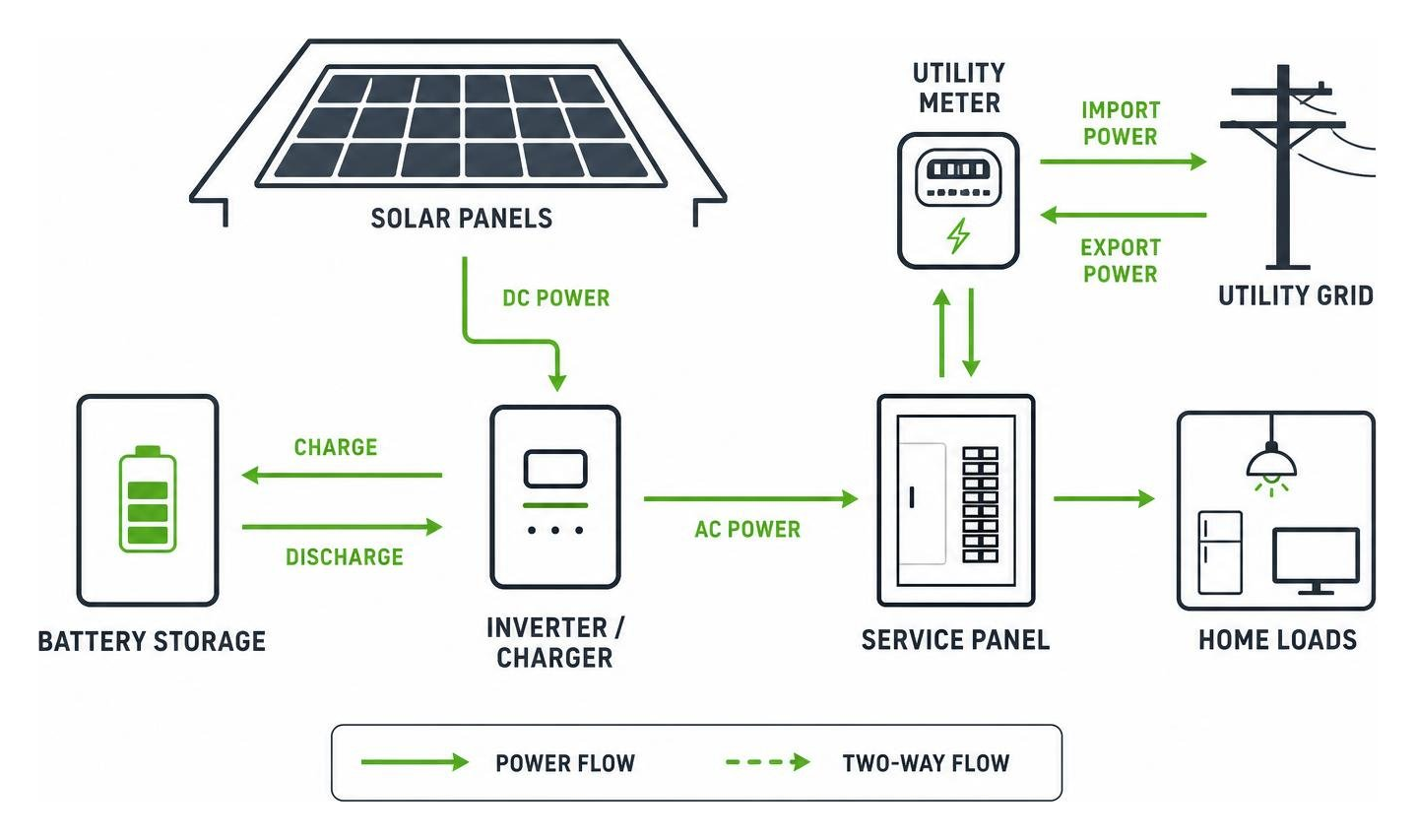
When planning your system, it helps to understand how a standalone battery compares to an integrated solar-plus-storage system:
| Feature | Standalone Battery Storage | Integrated Solar-Plus-Storage |
|---|---|---|
| Primary Energy Source | Grid power (charges during off-peak hours) | On-site solar generation (charges via clean solar energy) |
| Grid Outage Resilience | Limited to stored capacity; cannot recharge during extended outages | Indefinite backup; solar panels recharge the battery daily |
| Section 48E TPO Eligibility | Fully eligible | Fully eligible |
| Local Permitting Complexity | Moderate (requires electrical permit and NFPA 855 compliance) | High (requires combined structural, electrical, and fire permits) |
| Optimal Use Case | Emergency backup and basic time-of-use rate optimization | Complete energy independence, maximum bill savings, and long-term outage backup |
To explore whether a paired system is the right choice for your home, take a look at our resource on Everything You Need to Know About Choosing Solar Only vs Solar Plus Battery.
Understanding Eligibility and Supply Chain Compliance

Federal tax credits under Section 48E are highly lucrative, but they come with strict compliance requirements. The federal government has introduced stringent rules regarding where battery components are sourced and manufactured. If a battery system does not meet these guidelines, the owner cannot claim the credit.
The most critical of these rules are the Foreign Entity of Concern (FEOC) restrictions. These regulations aim to shift battery supply chains away from countries like China, Russia, Iran, and North Korea. For projects starting construction in 2026, at least 55% of the total manufactured component costs must come from non-FEOC sources. This threshold increases annually, rising to 60% in 2027 and reaching 75% by 2030.
Navigating these requirements demands careful coordination with manufacturers. To learn more about how federal policies balance with state-level programs, read our guide on State and Federal Incentives for Your Electric Home Upgrade.
Sourcing Requirements and the 10-Year Recapture Risk
The FEOC rules carry a serious enforcement mechanism: a 10-year credit recapture provision. If a commercial project claims the Section 48E credit and is later found to have made payments to a Prohibited Foreign Entity for battery components at any point during the first 10 years of operation, the federal government can claw back the tax credit.
Because of this 10-year recapture risk, leasing companies and solar developers must meticulously audit their supply chains. They must secure certified supply chain documentations from battery manufacturers to verify that no materials violate FEOC thresholds. For homeowners entering a lease or PPA, this means it is vital to work with reputable providers who install compliant, high-quality hardware. To understand your equipment options and how they impact your system’s compliance, read our guide Picking Your Power: A Guide to Home Battery Options.
Commercial ITC (48E) Rules for Battery Storage Incentives and Tax Credits
For commercial battery storage projects—and by extension, the third-party owned residential systems that utilize commercial tax pathways—the base Section 48E credit rate is 6%. To increase this rate to the full 30%, projects must satisfy strict federal labor standards:
- Prevailing Wage Requirements: All mechanics and laborers employed in the construction, alteration, or repair of the project must be paid wages at rates not less than those prevailing in the local locality as determined by the Department of Labor.
- Apprenticeship Requirements: A set percentage of the total labor hours must be performed by qualified apprentices from registered apprenticeship programs.
- Minimum Capacity: Commercial-scale systems must have a nameplate capacity of at least 5 kWh to qualify under the Section 48E energy storage definitions (though residential TPO systems can utilize the 3 kWh threshold).
By meeting these labor standards and combining them with domestic content or energy community bonus adders, developers can maximize their tax benefits. You can read more about how federal guidelines incentivize clean energy deployment in our article Uncle Sam Wants You to Go Solar for Less.
California State Incentives and Utility Programs
While federal rules have become more complex, California continues to offer some of the most supportive state-level incentives in the nation. This is largely driven by the California Public Utilities Commission (CPUC) and its transition toward encouraging battery installations to support grid reliability.
The cornerstone of California’s state-level support is the Self-Generation Incentive Program (SGIP). SGIP provides direct financial rebates to customers who install qualifying energy storage systems. Because California’s electric grid faces stress from wildfires and extreme weather, SGIP is designed to prioritize communities that need backup power the most. For a complete overview of regional energy storage programs, see The Best Ways to Save on California Energy Storage.
Self-Generation Incentive Program (SGIP) Categories
SGIP is divided into several tiers, targeting different household demographics and geographic locations across Sonoma, Marin, and Napa counties:
- General Residential Storage: Offers a standard rebate per kilowatt-hour for residential customers looking to add backup power.
- Equity Category: Provides a higher rebate of $850/kWh (covering approximately 85% of typical installation costs) for low-income households and multifamily housing in designated communities.
- Equity Resiliency Category: This is the most generous tier, offering a rebate of $1,000/kWh, which can cover up to 100% of the cost of a battery system. To qualify, you must live in a high wildfire-threat district, have experienced multiple Public Safety Power Shutoff (PSPS) events, or rely on critical medical equipment that requires continuous electricity.
Because funds are limited and rebate steps decline as more capacity is installed, applying early is essential. To find out how local utility programs can help you save in your specific area, check out our article Save Big with Sonoma and PGE Energy Programs.
Virtual Power Plants and Performance-Based Incentives
In addition to upfront rebates, California homeowners can access performance-based incentives by enrolling their batteries in Virtual Power Plant (VPP) programs. A VPP is a network of decentralized home batteries working together to support the electric grid.
During times of peak demand, the utility company can pull clean, stored energy from your battery to prevent blackouts. In return, you receive direct financial compensation, often in the form of bill credits or annual performance payments. This allows you to generate ongoing revenue from your battery while retaining enough emergency reserve to protect your home during an outage. To learn how VPPs fit into a home energy strategy, read A Practical Guide to Home Battery Storage Worth It in California.
Smart Panels and Electrical Upgrades
Installing a battery system often requires updating your home’s main electrical panel to handle the new bi-directional power flows. Integrating a smart panel, such as a Span panel, can streamline this process.
Smart panels allow you to digitally manage your home’s electrical loads during an outage. Instead of hardwiring a few select backup circuits, a smart panel lets you choose which appliances to power in real-time from an app. This dynamic load management can extend your battery’s backup duration, helping you get the most out of your system.
For more details on smart panel integration, explore How to Integrate Solar Batteries and Span Panels for a Smarter Home and learn about the physical advantages in Smart Panel Benefits for Homeowners.
Frequently Asked Questions About Battery Storage Incentives
Can I still get a federal tax credit for a home battery in 2026?
Direct federal tax credits under Section 25D are no longer available for new residential battery purchases made in 2026. However, you can still access federal tax benefits by choosing a third-party ownership model, such as a solar lease or PPA. Under this arrangement, the leasing company claims the active Section 48E commercial credit and passes the savings to you through lower monthly payments. To explore your options, read more about Home Energy Incentives.
What is the minimum battery size required to qualify for incentives?
For residential systems claimed under the grandfathered Section 25D program, the battery must have a minimum capacity of 3 kWh. Commercial installations and third-party owned systems utilizing the Section 48E commercial credit typically require a minimum capacity of 5 kWh, though residential TPO arrangements can often utilize the 3 kWh standard. You can learn more about choosing the right capacity for your home in Picking Your Power: A Guide to Home Battery Options.
How do California’s SGIP rebates work with federal tax credits?
If you qualify for both an SGIP rebate and a federal tax credit, you must subtract the utility rebate amount from your total project costs before calculating your federal tax credit basis. For example, if your system costs are reduced by an SGIP rebate, the federal credit percentage is applied to the remaining net cost, not the original gross price. To see how these savings work together, see Maximize Your California Solar and Roofing Savings Today.
Conclusion
Navigating battery storage incentives and tax credits in 2026 requires understanding the transition from direct consumer tax credits to third-party ownership pathways and local state-level rebates. While the federal landscape has shifted under the OBBBA, programs like California’s SGIP and performance-based VPP incentives continue to make home batteries a highly practical investment for grid resilience and energy savings.
At Sustainable Living Builders, we specialize in helping homeowners across Santa Rosa, Sebastopol, Sonoma County, Marin County, and Napa County design and implement custom, sustainable energy solutions. Our team, guided by our energy expert Sunny, is here to help you navigate local permitting, utility programs, and smart home integrations to maximize your long-term savings.
To learn more about how home batteries can benefit your household, read The Ultimate Guide to Home Battery Storage Benefits. When you are ready to take the next step toward energy independence, Get started with Sustainable Living Builders today.