Why Understanding Battery Storage Cost vs Value Long Term Is Key to Your Energy Freedom
Many homeowners face the frustrating problem of rising utility rates and sudden blackouts. If you want to keep your lights on and lower your bills, understanding the battery storage cost vs value long term is the first step toward true energy independence. When you invest in home energy upgrades, you protect your family from grid failures while taking control of your monthly utility expenses. Our team at Sustainable Living Builders specializes in helping you navigate these smart home upgrades in Oakland, CA, ensuring your system is sized perfectly for your home’s needs.
To get the most out of your clean energy setup, read our complete guide to home energy systems or book your home energy assessment with us today.
Evaluating the battery storage cost vs value long term does not have to be complicated. Here is a quick summary of how a home battery system delivers real value over time:
- Time-of-Use Arbitrage: Store cheap solar power during the day and use it during expensive evening peak hours to lower your bills.
- Smart Self-Consumption: Keep your extra solar power at home instead of sending it back to the grid for low credits.
- Emergency Backup Power: Keep critical appliances like your refrigerator, lights, and medical equipment running during a blackout.
- Increased Home Value: Modern buyers seek out homes with built-in energy resilience and lower operating costs.
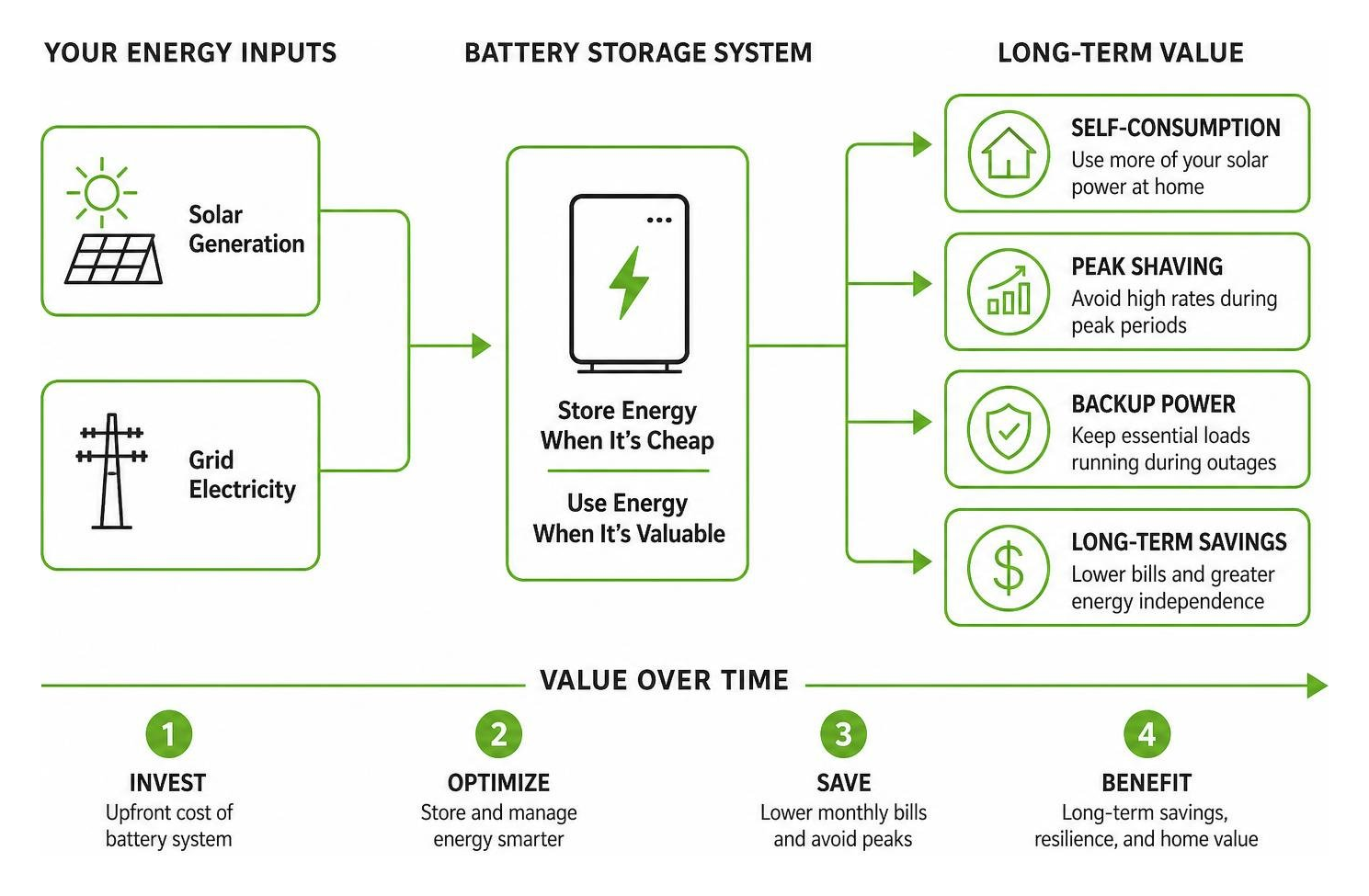
Evaluating Battery Storage Cost vs Value Long Term
When you begin looking into home energy upgrades, it is easy to focus only on the initial investment. However, looking at the long-term value paints a much more accurate picture of how smart batteries pay for themselves. Our home energy expert, Sunny, always reminds families in Santa Rosa, Sebastopol, and across Sonoma County that a home battery is not just an appliance; it is an active financial asset for your household.
The long-term value of your system depends on its investment lifespan, capacity retention, and how effectively it reduces your reliance on the electrical grid. Modern residential batteries are designed to perform thousands of charge and discharge cycles while maintaining their ability to hold a charge. By storing your own clean energy, you establish a predictable shield against unpredictable utility rate hikes.
To explore how these systems transform your household economics, check out The Ultimate Guide to Home Battery Storage Benefits to see the full picture of what modern energy storage can do.
Key Factors Driving Battery Storage Cost vs Value Long Term
To truly understand how the financial return of a battery system works, we must break down what goes into the total investment. The total value is shaped by several key components:
- Hardware Components: This includes the physical battery cells, the integrated battery inverter, and smart management software. Different chemistries offer different lifespans and performance profiles.
- Installation Labor: Installing a battery requires specialized electrical work. This involves mounting the heavy battery enclosures, wiring the system into your home’s main electrical panel, and often setting up a critical loads subpanel so your essential appliances remain powered during outages.
- Permitting and Grid Interconnection Fees: Local building departments and utilities in Marin County and Napa County require specific permits, structural reviews, and safety inspections before your system can go live.
Investing in high-quality hardware and professional installation ensures your system operates safely and efficiently for decades. To learn more about the different physical battery options available for your home, read Picking Your Power: A Guide to Home Battery Options.
How Utility Rates Shape Battery Storage Cost vs Value Long Term
Your local utility provider’s rate structure is the single biggest driver of your battery’s financial return. In California, particularly under the Net Billing Tariff (commonly known as NEM 3.0), the rules of solar energy have changed.
Under older net metering rules, homeowners could send excess solar energy back to the grid and receive a nearly one-to-one credit on their bills. Today, under NEM 3.0, the export credits for sending solar power back to the grid have been reduced by roughly 75% to 80%. This means exporting your power is no longer financially rewarding.
Instead of sending that power away for pennies, a home battery allows you to store your excess daytime solar generation and use it yourself. This is where Time-of-Use (TOU) rate structures come in. Utilities charge significantly higher rates during peak evening hours—typically between 4:00 PM and 9:00 PM. By discharging your battery during these peak hours, you avoid buying expensive electricity from the grid. This process, known as peak shaving or load shifting, dramatically increases your monthly savings.
To see how these local regulations affect your investment, take a look at A Practical Guide to Home Battery Storage: Worth It in California? for an in-depth analysis of our local energy market.
Financial Return: Solar-Only vs. Solar-Plus-Storage
Choosing between a solar-only system and a solar-plus-storage system is one of the most important decisions you will make. While solar panels alone generate clean power during the day, they cannot store that energy for later use. Without a battery, any solar electricity you do not use immediately is exported to the grid for minimal credit, and your home remains completely vulnerable to grid blackouts.
Adding a battery turns your solar setup into a fully dispatchable, self-sufficient energy system. It allows you to maximize your self-consumption, meaning you use almost every kilowatt-hour your panels produce.
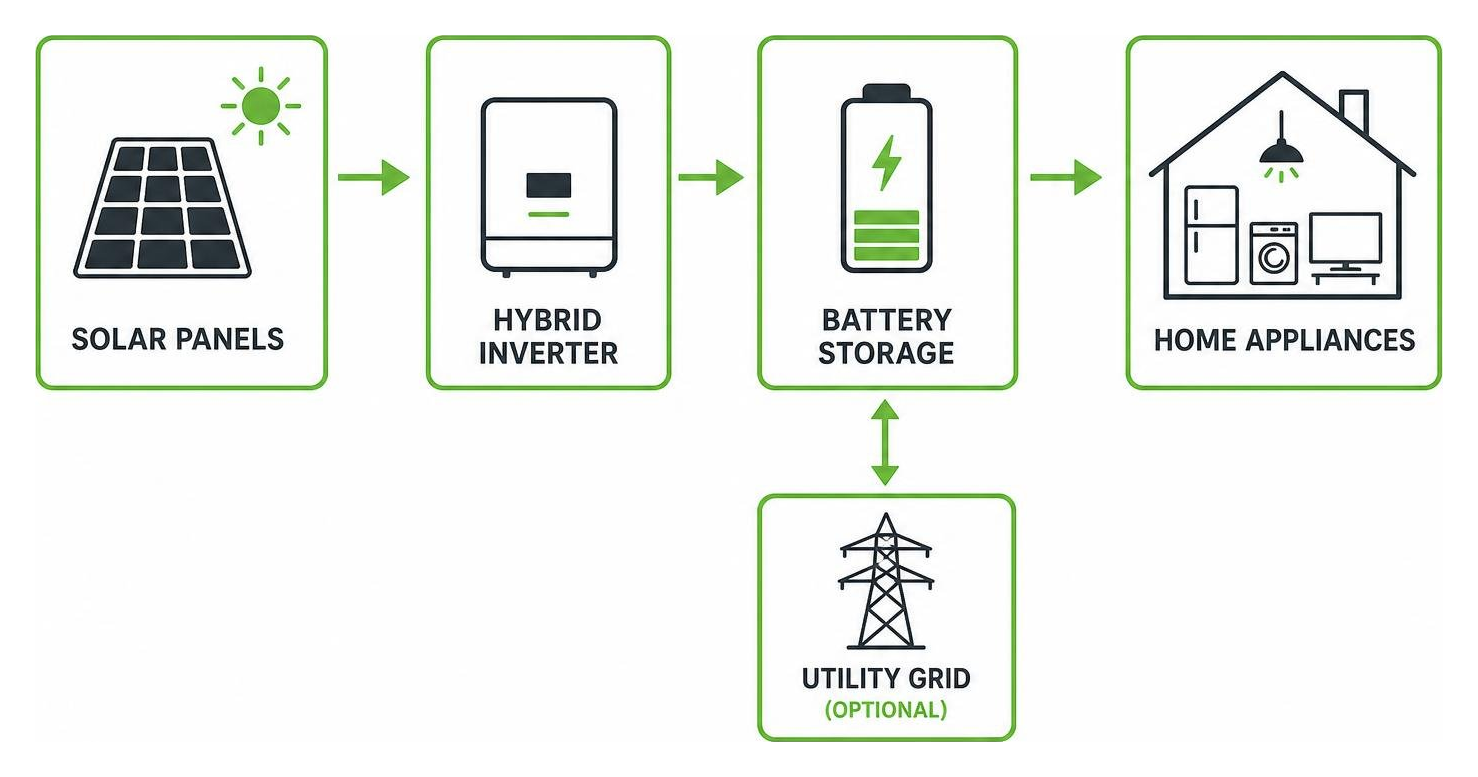
To help you compare the two paths, we have outlined the long-term value differences between solar-only and solar-plus-storage configurations:
| Feature / Benefit | Solar-Only System | Solar-Plus-Storage System |
|---|---|---|
| Daytime Grid Independence | High (while the sun is shining) | Complete |
| Nighttime Grid Independence | None (reliant on utility power) | High (powered by stored energy) |
| NEM 3.0 Export Optimization | Poor (most excess energy is wasted) | Excellent (stored for home use) |
| Outage & Blackout Protection | None (system shuts down for safety) | Full backup for critical loads |
| Time-of-Use Bill Management | Limited to daytime hours | Maximum (covers evening peak rates) |
| Long-Term Financial Return | Moderate under current utility rules | High (optimized for maximum savings) |
By pairing your panels with a smart storage system, you ensure that your home runs on clean, self-generated power day and night. For a deeper dive into how these systems work hand-in-hand, explore Everything You Need to Know About How Battery Storage Works with Solar Panels and read our comparison guide, Everything You Need to Know About Choosing Solar Only vs Solar Plus Battery.
Maximizing Long-Term Value Through Incentives and Grid Services
While the long-term savings of a battery system are substantial, you can accelerate your return on investment by taking advantage of available financial incentives and grid programs.
First, the federal government offers the Residential Clean Energy Credit (often referred to as the Section 25D tax credit). This incentive allows you to deduct 30% of the total installation cost of your battery storage system from your federal taxes. This credit applies to both standalone battery installations and combined solar-and-storage projects, provided the battery has a capacity of 3 kilowatt-hours or greater. To understand how to apply this credit to your upcoming project, read our guide on How to Make the IRS Pay for Your Home Battery.
In addition to federal tax credits, California homeowners can access state-specific programs like the Self-Generation Incentive Program (SGIP). SGIP provides financial rebates for installing energy storage, with higher rebate levels available for homes in high-fire-threat districts or those with low-income residents.
Furthermore, you can enroll your battery in Virtual Power Plant (VPP) programs. When the electrical grid is under extreme stress, the utility can request brief, automated discharges from enrolled home batteries to help stabilize the grid. In exchange, you receive direct financial compensation, turning your battery into a source of recurring revenue.
To learn how to stack these incentives for maximum savings in Sonoma, Marin, or Napa County, read The Best Ways to Save on California Energy Storage.
Non-Financial Benefits: Resilience and Peace of Mind
While the financial metrics of the battery storage cost vs value long term are incredibly compelling, some of the greatest benefits of home storage cannot be measured on a utility bill. For many families living in Northern California, the peace of mind that comes with energy resilience is priceless.
With our region facing regular winter storms, seasonal high winds, and Public Safety Power Shutoffs (PSPS) designed to prevent wildfires, grid reliability is a constant concern. A prolonged blackout is more than an inconvenience—it can lead to spoiled food, lost work hours for home-based businesses, and safety risks for those relying on temperature-sensitive medical equipment.
A smart home battery acts as a silent, instantaneous backup generator. The moment the grid goes down, your system switches over in milliseconds, keeping your critical loads running without a single flicker of your lights. Unlike traditional gas generators, batteries operate silently, require no refueling, and emit zero greenhouse gases, allowing you to reduce your carbon footprint while protecting your home.
To see how real-world families stay safe and comfortable during grid failures, read Lights Out? Not for You with These Battery Benefits.
Frequently Asked Questions About Battery Storage Value
How long do home batteries typically last?
Most modern home energy storage systems utilize Lithium Iron Phosphate (LFP) chemistry, which is highly regarded for its safety, thermal stability, and long lifespan. Under normal operating conditions, these batteries typically last between 10 and 15 years. Manufacturers generally provide robust warranties guaranteeing that the battery will retain a specific percentage of its original capacity (usually 70% to 80%) after 10 years of daily cycling.
Does battery storage make sense without net metering?
Yes, battery storage makes even more sense in areas without net metering or under reduced-rate structures like California’s NEM 3.0. When utility export credits are low, sending your excess solar power back to the grid is inefficient. Storing that energy in a home battery allows you to use it yourself during peak hours, maximizing your self-consumption and protecting you from expensive utility rates.
Can I add a battery to an existing solar system later?
Absolutely. Adding a battery to an existing solar array is a common upgrade known as a retrofit. This is typically done using an “AC-coupled” configuration, where the battery has its own specialized inverter that integrates seamlessly with your existing solar inverter. Our team can evaluate your current solar setup to design the most efficient battery integration path for your home.
Conclusion
When evaluating the battery storage cost vs value long term, the evidence points toward a smart, resilient investment. While the initial setup requires careful planning and professional installation, the combination of daily utility bill savings, valuable tax incentives, and reliable backup power makes energy storage a highly rewarding upgrade for your home.
At Sustainable Living Builders, we believe in taking a holistic approach to home energy. From energy-efficient roofing to custom solar-and-storage systems, we help homeowners in Santa Rosa, Sebastopol, and throughout Sonoma, Marin, and Napa Counties build comfortable, sustainable, and self-sufficient homes.
Ready to protect your home from blackouts and take control of your energy bills? Secure your energy future with Sustainable Living Builders and schedule your personalized home energy assessment today.