Why Understanding How Energy Storage Reduces Your Reliance on the Grid Matters in 2026
How energy storage reduces your reliance on the grid comes down to one simple idea: capture the energy you generate or buy when it’s cheap, store it, and use it on your own terms — not the utility’s.
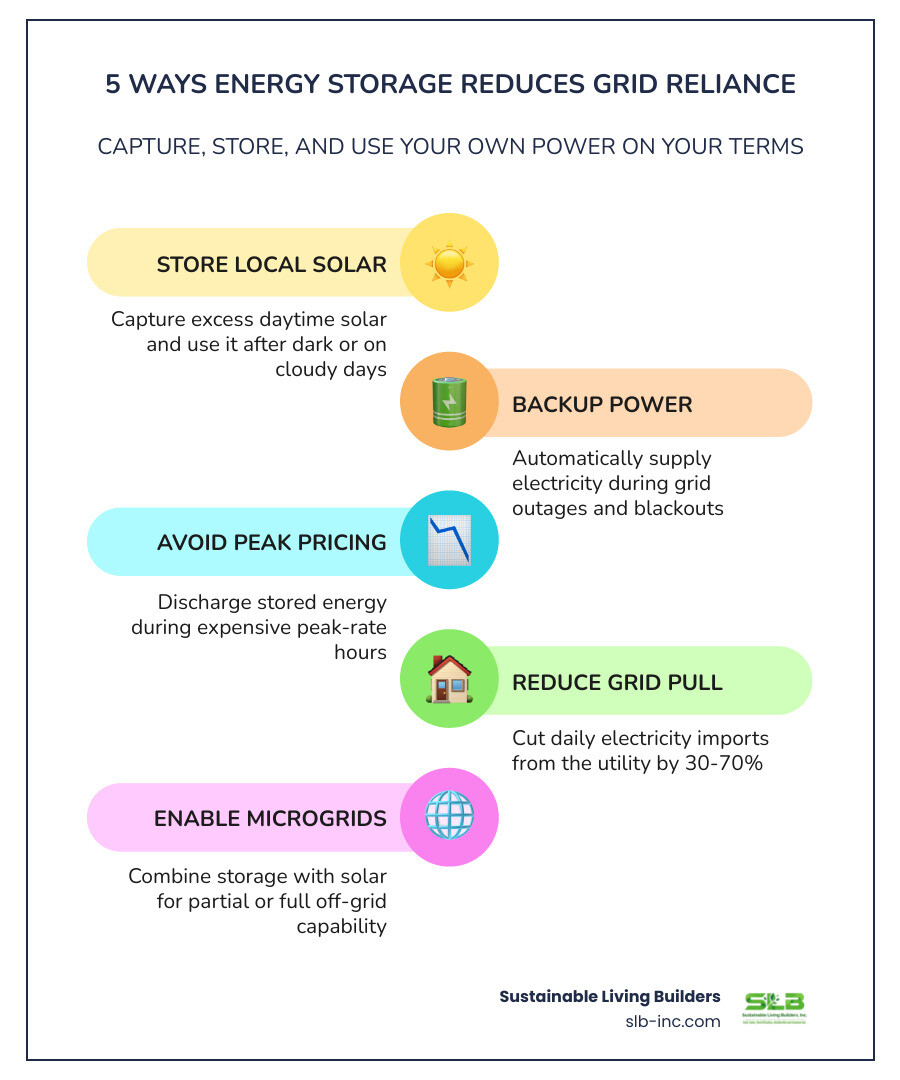
Here’s a quick summary of the ways energy storage cuts your dependence on the grid:
- Stores local solar generation so you can use it after dark or during cloudy days
- Provides backup power automatically when the grid goes down
- Avoids peak pricing by discharging stored energy during the most expensive hours
- Reduces how much electricity you pull from the grid day to day
- Pairs with solar panels to maximize clean energy use around the clock
- Enables partial or full off-grid capability for homes with the right setup
If you’ve opened your electricity bill lately and winced, you’re not alone. U.S. utility rates are climbing, extreme weather events are knocking out power more often, and the old grid — built decades ago — is straining to keep up. At the same time, more homeowners are asking a simple question: why am I still so dependent on the utility company?
The answer, increasingly, is that you don’t have to be. Battery energy storage systems (BESS) have matured rapidly. A Stanford study found that about 60% of U.S. households could reduce their electricity costs by an average of 15% with a solar-plus-storage setup — and 63% could meet roughly half their electricity needs during a blackout. The technology is real, proven, and accessible.
This guide walks you through exactly how it works, what the benefits are, and what to consider before making the switch.
Key terms for how energy storage reduces your reliance on the grid:
- battery backup benefits during power outages
- home battery storage benefits explained
- how battery storage works with solar panels
The Basics: How Energy Storage Reduces Your Reliance on the Grid
To understand how energy storage reduces your reliance on the grid, it helps to look at the traditional relationship between your home and the utility. Historically, electricity has been a “just-in-time” commodity. Power is generated at a distant plant, travels along transmission lines, and is consumed the exact millisecond it reaches your home.
When you add solar panels, you generate your own clean power. But without a battery, you are still bound to the grid’s schedule. If your panels produce excess energy at noon, that power is sent back to the grid. When the sun goes down, you have to buy that electricity back—often at a premium.
By introducing a battery energy storage system (BESS), you break this cycle. You gain control over when you use your power, when you store it, and when you draw from the main lines.
| Feature / Benefit | Grid-Tied Solar Without Storage | Solar-Plus-Storage System |
|---|---|---|
| Source of Nighttime Power | 100% Grid-Dependent | Stored Solar Energy / Battery |
| Power During Grid Outages | System Shuts Down (No Power) | Automatic Backup Power (Continuous) |
| Protection Against Peak Rates | None (Subject to Time-of-Use rates) | High (Discharges battery during peak hours) |
| Grid Independence Level | Low | High |
| Excess Solar Utilization | Exported to grid (often for low credits) | Saved locally for your own consumption |
Understanding the Mechanics: Arbitrage, Peak Shaving, and Load Shifting
To maximize your self-reliance, modern battery systems use three primary strategies:
- Load Shifting: This is the process of moving your electricity consumption from one time period to another. Instead of running heavy appliances when grid demand is high, you power your home using clean, stored energy.
- Energy Arbitrage: This involves charging your battery when electricity is cheap (either from your solar panels during the day or from the grid during late-night hours) and discharging it to power your home when grid electricity is expensive.
- Peak Shaving: For properties with demand-based charges, peak shaving prevents your energy use from spiking. The battery steps in during those high-draw moments—like when your air conditioner kicks on—to keep your grid draw flat and low.

Local Generation and Backup Power: How Energy Storage Reduces Your Reliance on the Grid
When you generate power locally, your home becomes its own mini power station. But local generation is only half the battle. Because the sun doesn’t shine 24/7, you need a way to bridge the gap between generation and consumption.
During a standard grid outage, traditional grid-tied solar systems automatically shut down. This is a safety feature designed to prevent your panels from sending electricity back into the lines where utility technicians might be working. Unfortunately, it means that even on a beautiful, sunny afternoon, a grid-tied solar home without a battery will be completely dark during a blackout.
With a battery backup, your system can safely disconnect from the utility lines—a process known as “islanding”—and continue running. The battery keeps your lights, refrigerator, and Wi-Fi operational, recharging itself the next day when the sun rises.
If you are looking for a complete breakdown of how these systems protect your household, read through The Ultimate Guide to Home Battery Storage Benefits to understand how modern storage keeps your home running smoothly.
For residents living in areas prone to seasonal power disruptions, PSPS (Public Safety Power Shutoff) events, or winter storms, having localized power is no longer a luxury. It is a fundamental safety measure. To see how this works in practice, explore our guide on how to Never Be Powerless with Home Energy Storage in Fulton to learn how neighbors in Sonoma County are securing their energy independence.
Time-of-Use Management: How Energy Storage Reduces Your Reliance on the Grid
In California, our relationship with the utility company is largely defined by Time-of-Use (TOU) rate plans. Under TOU structures, the cost of electricity changes based on the time of day, the season, and the overall demand on the grid.
Typically, the most expensive hours occur in the late afternoon and early evening (often between 4:00 PM and 9:00 PM). This is exactly when families return home, turn on appliances, run cooling systems, and plug in electric vehicles. It is also when solar production naturally declines as the sun goes down.
Without storage, you are forced to buy expensive power during these peak hours. With a battery, you can program your system to handle this automatically:
- Daytime: Your solar panels power your home and charge your battery.
- Peak Hours (4:00 PM – 9:00 PM): Your system stops drawing from the grid entirely. Instead, your battery discharges to run your home, shielding you from the highest rates of the day.
- Off-Peak Hours (Late Night): If your battery needs a top-off and you don’t have enough solar, it can pull cheap power from the grid overnight.
By utilizing this cycle, you minimize your interaction with the utility when they want to charge you the most. For a deep dive into navigating California’s unique regulatory and rate environment, see A Practical Guide to Home Battery Storage Worth It in California. To explore strategic ways to maximize your return on investment, check out our resource on The Best Ways to Save on California Energy Storage.
Maximizing Clean Energy and Grid Resiliency
Beyond individual bill savings, reducing your reliance on the grid has a profound, positive ripple effect on the environment and our local communities. When millions of homes rely less on centralized transmission lines, the entire energy infrastructure becomes more resilient.

Pairing Solar Panels with Battery Storage
If you install solar panels without a battery, you are still heavily reliant on the grid to act as your “buffer.” During the peak of the day, your panels may produce far more electricity than your home can consume. This excess energy is exported to the grid.
However, under modern net billing frameworks in California, the compensation you receive for exporting excess solar power back to the utility is significantly lower than it used to be. This makes exporting power financially inefficient.
When you pair solar with storage, you keep your clean energy in-house. Rather than giving away your valuable solar generation for pennies on the dollar, you store it in your battery. This ensures that every kilowatt-hour of clean energy your roof generates is used to power your own lifestyle.
To help weigh your options, read Everything You Need to Know About Choosing Solar Only vs Solar Plus Battery. If you want to understand the technical details of how these systems communicate and work together, check out Everything You Need to Know About How Battery Storage Works with Solar Panels.
Minimizing Power Outages with Microgrids
When a home combines local generation (solar) with energy storage and smart controls, it can function as a “microgrid.” A microgrid is a localized energy system that can operate completely independently of the traditional centralized grid.
During a wider blackout—whether caused by high winds, wildfires, or grid overload—your home’s microgrid keeps your critical systems online. This is especially vital for families in areas like Santa Rosa, Sebastopol, and across Sonoma, Marin, and Napa counties, where seasonal weather patterns and utility safety shutoffs can leave neighborhoods without power for days.
A home microgrid ensures that:
- Medical equipment remains powered.
- Food in refrigerators and freezers does not spoil.
- Well pumps continue to supply water.
- Home security and communication lines stay open.
To learn more about how a localized energy setup keeps your home safe and comfortable during regional emergencies, explore our article Lights Out Not for You with These Battery Benefits.
Smart Energy Management Systems (EMS)
The brain behind any modern battery energy storage system is the Energy Management System (EMS). An EMS is smart software that monitors your household’s real-time energy production, consumption, battery state-of-charge, and utility rates.
Instead of requiring you to manually switch your power sources, the EMS does the thinking for you. It automatically decides when to save power, when to discharge, and how to optimize your electrical loads.
When paired with a smart electrical panel, you can take this control a step further. You can dynamically choose which circuits in your home are “critical” (like your fridge, lights, and Wi-Fi) and which can be turned off during an outage to stretch your battery life from days to weeks.
To see how smart hardware can revolutionize your home’s efficiency, read our step-by-step guide on How to Integrate Solar Batteries and Span Panels for a Smarter Home.
The Broader Impact: Local Economies and Second-Life Batteries
The transition to decentralized energy storage is doing more than just lowering individual utility bills—it is reshaping our local economies and driving the circular economy forward.
Job Creation and Community Tax Revenue
The rapid growth of the battery storage industry has become a powerful economic engine. Across the country, the battery storage sector supports more than 75,000 clean energy jobs. These are local, high-paying positions for installers, technicians, engineers, and project managers right here in our North Bay communities.
Furthermore, utility-scale and distributed energy storage projects contribute significantly to local public funding, delivering more than $580 million in annual tax revenue and land lease payments to communities nationwide. This revenue helps fund local schools, emergency services, and infrastructure improvements.
For homeowners, the federal government also offers substantial financial encouragement. The Residential Clean Energy Credit allows you to claim a 30% federal tax credit on the total cost of your battery storage installation. To learn how to take advantage of these federal incentives, check out our guide on How to Make the IRS Pay for Your Home Battery.
Second-Life EV Batteries and the Circular Economy
As electric vehicles (EVs) become more common, a natural question arises: what happens to their batteries when they are no longer fit for the road?
While an EV battery might lose 20% to 30% of its original capacity after years of driving—making it less ideal for vehicle range—it still holds incredible value. This is where the concept of “second-life” batteries comes in.
These retired EV batteries can be refurbished, tested, and packaged into stationary battery energy storage systems (BESS) for homes and businesses. This circular approach provides massive benefits:
- Reduces E-Waste: Keeps valuable battery components out of landfills.
- Minimizes New Mining: Reduces the demand for raw materials like lithium, cobalt, and nickel.
- Lowers Manufacturing Footprint: Repurposing existing batteries requires far less energy than manufacturing new ones from scratch.
By supporting stationary storage, we help build a sustainable, circular life cycle for clean energy technology. To learn more about the different battery chemistries, lifespans, and options available for your home, take a look at our guide Picking Your Power: A Guide to Home Battery Options.
Frequently Asked Questions About Grid Independence
Can I use a home battery backup system without solar panels?
Yes! You do not need solar panels to benefit from a home battery. A standalone battery can connect directly to your home’s electrical panel and charge straight from the utility grid.
This setup is highly effective for homeowners who:
- Live in areas with high Time-of-Use rate differences (you can charge the battery at night when rates are low, and discharge it during the day when rates spike).
- Want reliable emergency backup power during short-term blackouts but cannot install solar panels due to shade or HOA restrictions.
However, keep in mind that a standalone battery is a finite resource during an outage. Once the battery is empty, it cannot recharge until the grid comes back online. When paired with solar, your battery can recharge every single day from the sun, giving you indefinite backup capability.
How does a battery energy storage system help the local community?
When you install a home battery, you aren’t just helping yourself—you are being a good neighbor.
During hot summer afternoons, the electrical grid experiences extreme stress. To meet this massive demand, utility companies are often forced to turn on “peaker plants.” These plants are typically older, less efficient, and highly polluting fossil-fuel generators that are expensive to run and disproportionately impact air quality in nearby communities.
By using your battery to power your home during peak hours, you reduce the overall strain on the grid. If thousands of homes do this simultaneously, it eliminates the need to run dirty peaker plants, reduces the risk of rolling blackouts, and helps stabilize electricity costs for everyone in the community.
What is the difference between distributed and centralized storage?
- Centralized Storage: These are massive, utility-scale storage facilities (often using large battery arrays or pumped hydroelectric plants) located far away from where the energy is actually consumed. While highly efficient, the power must still travel across miles of transmission lines to reach your home, leaving it vulnerable to transmission losses and line damage.
- Distributed Storage: This refers to smaller battery systems installed directly at the “grid edge”—such as in residential garages, commercial buildings, and local schools. Distributed storage keeps the power exactly where it is needed, reducing transmission congestion and providing hyper-local resilience when regional lines fail.
Conclusion
Taking control of your home’s energy future is one of the most rewarding steps you can take toward a sustainable lifestyle. By understanding how energy storage reduces your reliance on the grid, you can make informed decisions that protect your family from rising utility rates, secure your home against unpredictable power outages, and contribute to a cleaner, more resilient local community.
At Sustainable Living Builders, we specialize in helping homeowners across Santa Rosa, Sebastopol, and throughout Sonoma, Marin, and Napa counties transition to clean, self-reliant energy. We provide holistic, sustainable solutions—from energy-efficient roofing to advanced solar and smart home battery systems—tailored specifically to your home’s unique needs.
Ready to take the first step toward true energy independence? Visit our Sustainable Living Builders Energy Storage page to learn more, or connect with us today to find the perfect battery setup for your home!