Why Understanding How Battery Storage Works with Solar Panels Can Change How You Power Your Home
How battery storage works with solar panels is simpler than most people expect: your solar panels generate electricity during the day, your home uses what it needs, and any extra energy gets stored in a battery instead of going back to the grid. Then, when the sun goes down or the grid goes out, that stored energy powers your home automatically.
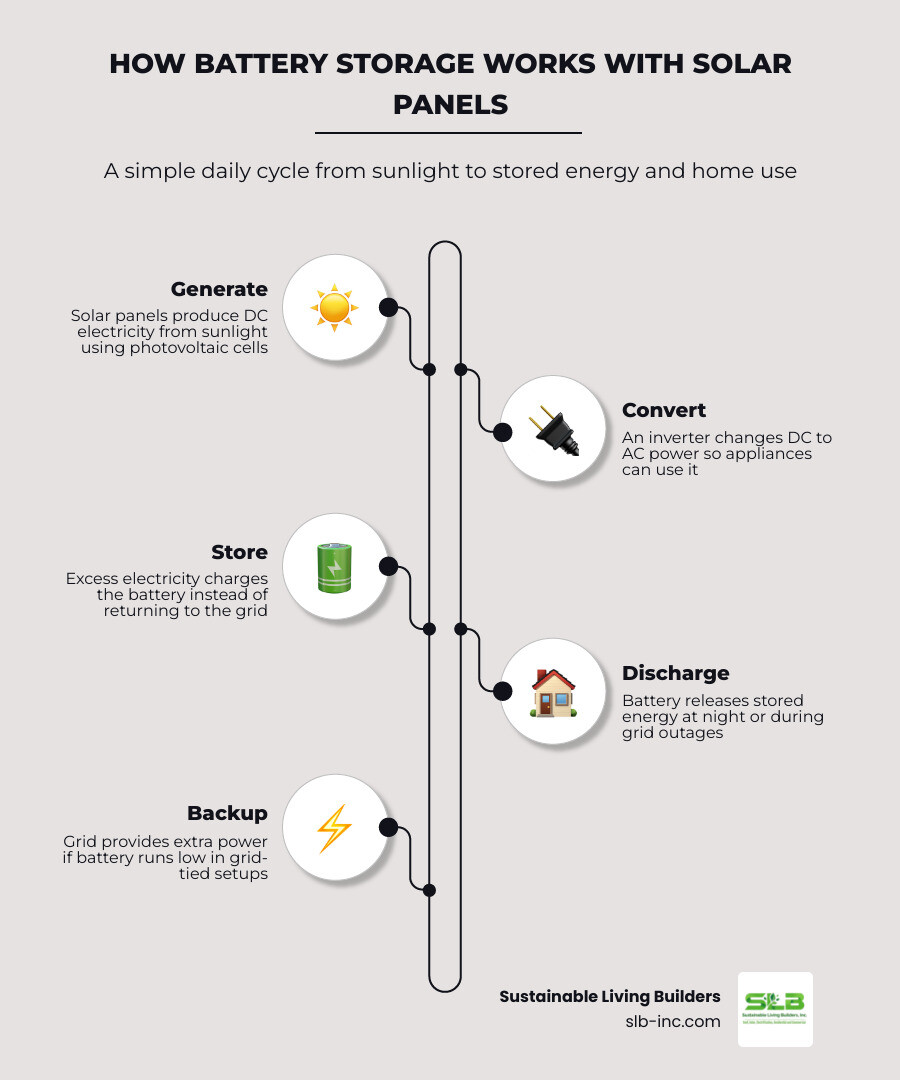
Here’s a quick overview of the process:
- Solar panels generate DC electricity from sunlight using photovoltaic cells
- An inverter converts DC to AC so your home appliances can use it
- Excess electricity charges the battery rather than being sent to the grid
- At night or during an outage, the battery discharges to power your home
- The grid acts as a backup if the battery runs low (in grid-tied systems)
For millions of homeowners, this setup means lower energy bills, protection from grid outages, and a genuine path toward energy independence.
The case for solar-plus-storage is growing fast. In 2023, 13% of residential solar installations included a battery — triple the share from 2018 — and that number is expected to keep climbing. It’s not hard to see why. Electricity demand has surged over the decades, yet much of the grid infrastructure powering our homes has barely changed. Storms knock out power. Utility rates spike at the worst times. And solar panels alone, without a battery, actually shut down completely during a grid outage to protect utility workers — meaning a sunny day offers you zero protection when the lights go out.
A solar battery changes that equation entirely. Whether your goal is cutting your monthly bill, protecting your family during blackouts, or reducing your carbon footprint, understanding how this technology works is the first step to making a smart decision for your home.
Easy how battery storage works with solar panels word list:
- battery backup benefits during power outages
- battery storage tax credits and incentives
- home battery storage benefits explained
What Is a Solar Battery and How Does It Store Energy?
To truly grasp how these systems elevate your home’s energy setup, it helps to understand what a solar battery actually does under the hood. At its core, a solar battery is an energy storage device that captures the surplus electricity generated by your rooftop solar panels. Instead of immediately exporting that extra power back to the local utility grid, the battery holds onto it so you can use it whenever production drops—like on a rainy afternoon, after sunset, or during a sudden utility blackout.
Inside a modern solar battery, electricity is stored as chemical energy. When your solar panels produce more power than your household is currently consuming, the electrical current flows into the battery, triggering a chemical reaction that stores the energy. When your home needs power later, that chemical reaction reverses, releasing the stored energy back as electrical current to run your lights, refrigerator, and HVAC system.
To evaluate how well a battery performs this job, we look at several key metrics:
- Charge Cycles: A cycle represents one full charge and one full discharge of the battery. Over time, the materials inside the battery slowly degrade, meaning the battery can hold slightly less energy than it did when it was brand new. High-quality batteries are built to withstand thousands of these cycles before their capacity drops significantly.
- Depth of Discharge (DoD): This is the percentage of the battery’s total capacity that can be safely used without damaging the internal components or shortening its lifespan. For instance, if a battery has a 90% DoD, you can safely use 90% of its stored energy before it needs to be recharged. Modern lithium-ion batteries feature exceptionally high depths of discharge compared to older technologies.
Choosing the right technology for your home is essential to ensuring long-term reliability. For a deeper dive into the specific battery products on the market, you can read Picking Your Power: A Guide to Home Battery Options to find the perfect fit for your household’s unique needs.
Comparing Battery Chemistries
Not all batteries are created equal. The chemistry used inside the battery cells determines everything from how long the battery will last to how safe it is to operate in your home. Today, several distinct chemistries compete for residential energy storage, though one has emerged as the clear industry leader.
- Lithium Iron Phosphate (LiFePO4): A specialized subtype of lithium-ion technology, LiFePO4 (often called LFP) has become the gold standard for home energy storage. These batteries are incredibly stable, highly resistant to thermal runaway (overheating), and offer an exceptional cycle life—often lasting between 3,000 and 6,000 cycles while maintaining high efficiency.
- Lead-Acid: This is the older, traditional battery technology that has powered cars and off-grid cabins for decades. While lead-acid batteries are reliable and have a lower upfront purchase cost, they are heavy, require regular maintenance, have a very low depth of discharge (usually around 50%), and must be replaced every few years.
- Solid-State: An emerging technology that replaces the liquid electrolyte inside the battery with a solid material. Solid-state batteries promise to be lighter, thinner, and even more energy-dense than current lithium options, though they are still largely in the developmental and early-adoption phases.
- Sodium-Ion: Another up-and-coming alternative that uses abundant, inexpensive sodium instead of lithium. While promising for stationary grid storage in the future, sodium-ion technology is not yet widely available or optimized for residential home installations.
| Feature | Lithium Iron Phosphate (LiFePO4) | Traditional Lead-Acid |
|---|---|---|
| Average Lifespan | 10 to 15 years | 3 to 5 years |
| Depth of Discharge (DoD) | 80% to 95% | ~50% |
| Cycle Life | 3,000 to 6,000 cycles | 500 to 1,200 cycles |
| Efficiency | 90% to 98% | 70% to 85% |
| Maintenance | None required | Regular watering/ventilation checks |
| Safety | Extremely high thermal stability | Risk of off-gassing, requires ventilation |
How Battery Storage Works with Solar Panels Step-by-Step
Understanding the physical components of your solar-plus-storage system makes it much easier to see how everything connects. It all starts on your roof and flows down into your electrical panel.
First, your rooftop Solar Panels use photovoltaic cells to absorb sunlight and convert it directly into Direct Current (DC) electricity. However, because our home appliances and the utility grid run on Alternating Current (AC) electricity, this power must be converted before it can be used.
Here are the primary components that make this conversion and storage process possible:
- Solar Photovoltaic (PV) Panels: Capture sunlight and generate raw DC electricity.
- The Inverter: Converts DC electricity into usable AC electricity for your household appliances.
- The Solar Battery: Stores excess DC or converted AC power for later use.
- The Battery Management System (BMS): An internal computer that monitors the battery’s health, temperature, and state of charge, preventing overcharging or unsafe operating conditions.
- The Smart Gateway / Energy Management System (EMS): The “brain” of the entire installation, which directs the flow of electricity between the panels, the battery, the home’s electrical panel, and the utility grid.

Understanding How Battery Storage Works with Solar Panels Daily Cycle
To see these components in action, let’s look at how a typical solar-plus-storage system operates throughout a standard 24-hour cycle.
- Morning (The Awakening): As the sun rises over Sonoma County, your solar panels begin generating DC electricity. Early in the morning, production is relatively low, so your home uses a mix of solar power and energy imported from the grid or left over in your battery from the night before.
- Midday (The Peak Generation): By noon, the sun is shining directly on your roof, and solar production peaks. Your panels are now producing far more electricity than your home actually needs. Instead of sending this valuable excess power back to the grid, the smart gateway directs it to charge your solar battery.
- Late Afternoon (Battery Fully Charged): Once the battery reaches 100% capacity, any additional excess power generated by your panels is exported to the utility grid. Depending on local rules, this can earn you credits on your electric bill.
- Evening (The Discharge): As the sun goes down, solar production drops to zero. This is when your battery shines. The system automatically switches over to discharge mode, drawing the clean, free energy stored during the day to power your lights, television, and dinner preparations.
- Nighttime (Grid Transition): If your household consumes all the stored energy in the battery overnight, the system seamlessly transitions to drawing power from the utility grid, ensuring you never experience an interruption in service.
This continuous daily cycle maximizes your self-consumption, meaning you use as much of your own clean solar energy as possible rather than relying on expensive utility power. This is especially beneficial for homeowners looking to optimize their systems for Home Solar in Santa Rosa, CA.
Why How Battery Storage Works with Solar Panels Matters During Outages
Many homeowners are surprised to learn that a standard grid-tied solar system will shut down completely during a power outage. This is a built-in safety feature known as anti-islanding protection. When the grid goes down, utility workers must repair the physical lines. If your solar panels were still exporting electricity back onto those lines, it could severely injure or kill the technicians working to restore power.
When you add a battery storage system to your home, you gain a critical piece of hardware: a backup gateway (sometimes called an isolation switch).
When a blackout occurs, the backup gateway detects the loss of utility power in milliseconds. It instantly disconnects your home’s electrical system from the utility grid, creating a self-contained “island” of power. Once safely disconnected, the gateway allows your solar panels and battery to continue operating.
Because backing up an entire home—including heavy loads like central air conditioning or electric vehicle chargers—requires substantial battery capacity, many systems utilize a critical loads subpanel. This dedicated subpanel ensures that during an outage, your battery’s power is directed only to your most essential appliances, such as:
- Your refrigerator and freezer to keep food fresh
- Wi-Fi routers and home modems to keep you connected
- Interior LED lighting and wall outlets for charging phones
- Medical devices and home security systems
By isolating these critical loads, you can keep your home safe and comfortable for days on end, even during extended grid failures. To learn more about how local homeowners protect themselves during severe weather, explore our guide on how to Never Be Powerless with Home Energy Storage in Fulton.
AC-Coupled vs. DC-Coupled Battery Systems
When designing your solar-plus-storage system, one of the most important technical decisions is whether to install an AC-coupled or a DC-coupled system. This choice refers to how the battery is integrated into your solar array and how many times the electrical current must be converted between DC and AC power.
To understand how this installation decision fits into the broader picture of upgrading your property, you can read about the process in Solar Energy Made Simple: Understanding the Installation Process.
DC-Coupled Systems
In a DC-coupled system, the DC electricity generated by your solar panels flows directly into a charge controller, which regulates the voltage and sends that DC power straight into your battery. The electricity only passes through an inverter when it is drawn out of the battery to power your home’s AC appliances.
- How it Works: The solar panels, battery, and home electrical panel are all managed by a single, specialized piece of equipment called a hybrid inverter.
- High Efficiency: Because the electricity does not have to be converted from DC to AC and back to DC to charge the battery, there are very few energy conversion losses (usually around 2% to 3%).
- Best for New Installations: If you are installing solar panels and a battery at the exact same time, a DC-coupled system is almost always the preferred route. It requires fewer components, simplifies the wiring, and provides the highest possible operating efficiency.
AC-Coupled Systems
In an AC-coupled system, the DC electricity from your solar panels goes straight to a standard solar inverter, which converts it to AC electricity to power your home. If there is excess power, it is sent to a separate battery inverter, which converts that AC power back into DC so it can be stored in the battery. When you need to use that stored energy, it must be converted a third time back into AC.
- How it Works: The system uses two separate inverters: a standard solar inverter for the panels and a dedicated battery inverter for the energy storage system.
- Retrofitting Existing Solar: If you already have solar panels installed on your home and want to add battery storage later, AC-coupling is often the easiest and most practical option. It allows us to add the battery to your system without needing to replace your existing solar inverter.
- Grid Charging Flexibility: AC-coupled systems make it incredibly easy to charge your battery directly from the utility grid. This is highly useful for homeowners on time-of-use tariffs, allowing you to charge your battery with cheap off-peak grid power and use it when utility rates spike.
Key Benefits of Adding Battery Storage to Your Solar System
Pairing battery storage with your solar panels unlocks a range of financial and practical benefits that solar panels alone simply cannot provide.
One of the most immediate benefits is energy arbitrage. In many parts of Northern California, utilities charge different rates for electricity depending on the time of day. Under these time-of-use rates, electricity is far more expensive during the late afternoon and early evening hours when grid demand peaks. With a solar battery, you can use peak shaving to avoid these high rates entirely. Your battery stores cheap solar energy during the day and discharges it to power your home during those expensive peak hours, shielding your wallet from high utility costs.
Beyond the direct financial savings, adding a battery significantly reduces your home’s carbon footprint. Because the utility grid often relies on fossil-fuel-burning “peaker plants” to meet high demand during peak hours, using your own stored solar energy during these times prevents dirty energy from being produced. To explore these advantages in greater detail, take a look at The Ultimate Guide to Home Battery Storage Benefits.
Smart Home Integration and Energy Management
Modern solar batteries do not operate in isolation; they are designed to integrate seamlessly with smart home technologies to give you unprecedented control over your energy use.
One of the most exciting advancements in home electrification is the integration of solar batteries with smart electrical panels, such as SPAN panels. Traditional electrical panels use physical breakers that must be manually flipped. A smart electrical panel, however, allows you to monitor and control every single circuit in your home digitally through a smartphone app.
When paired with a solar battery, a smart panel enables advanced load management. If a utility outage occurs, the smart panel can automatically turn off non-essential circuits—like your pool pump or clothes dryer—while keeping your refrigerator, Wi-Fi, and lights running. This smart orchestration prevents your battery from draining too quickly and can easily double or triple your battery’s runtime during an extended blackout.
To see how these technologies work together to create a highly efficient, modern home, read our guide on How to Integrate Solar Batteries and SPAN Panels for a Smarter Home.
Achieving True Energy Independence
For many families in Sonoma, Marin, and Napa Counties, the ultimate goal of installing solar-plus-storage is achieving true energy self-sufficiency. Relying on an aging utility grid that is increasingly prone to public safety power shutoffs and weather-related blackouts can be stressful.
By combining solar panels with battery storage, you create a self-sustaining clean energy ecosystem right on your property. You generate your own power, store your own surplus, and manage your own consumption. This self-reliance becomes even more critical as we continue the transition toward full home electrification—replacing gas furnaces with electric heat pumps, gas water heaters with hybrid heat pump models, and gasoline vehicles with electric cars.
As your home’s electrical demand grows, having a smart, resilient system to manage that load is key. To understand how these pieces fit together, explore The Path to Energy Independence Through Electrification.
Choosing the Right Solar Battery: Sizing, Lifespan, and Incentives
Selecting the right solar battery requires analyzing your household’s daily energy consumption, understanding your backup goals, and matching those needs to the correct battery capacity and power rating.
- Daily Consumption: The average home consumes between 15 and 30 kilowatt-hours (kWh) of electricity per day. If your goal is to run your entire home off-grid, you will need a larger battery capacity (measured in kWh) than if you simply want to back up essential circuits during an outage.
- Battery Capacity vs. Power Rating: It helps to think of capacity as the size of your battery’s “water tank” (how much total energy it can hold, measured in kWh) and the power rating as the size of the “faucet” (how much electricity it can deliver at any single moment, measured in kilowatts or kW). A battery with a high capacity but a low power rating can power a few light loads for a very long time, while a battery with a high power rating can run heavy appliances but will drain much faster.
If you are planning a new solar installation or upgrading your home’s energy system, reading Installing Solar Panels in Your Home will help you understand how to plan your system size and battery capacity from the ground up.
Lifespan and Maintenance
Like all electronic devices, solar batteries experience gradual degradation over time. However, because home batteries are large, stationary assets, they are engineered to last far longer than the battery in your smartphone or laptop.
The typical lifespan of a high-quality home solar battery is about 10 to 12 years, with many modern lithium iron phosphate models easily reaching 15 years of reliable service. Most major manufacturers stand behind their products with robust 10-year warranties that guarantee the battery will retain a specific percentage of its original capacity (usually around 70%) at the end of the warranty period.
To maximize your battery’s lifespan and slow down the natural degradation process, keep these best practices in mind:
- Temperature Control: Keep your battery installed in a shaded, well-ventilated area. Extreme heat or freezing temperatures can accelerate the breakdown of the internal chemicals. Garages or shaded exterior walls are ideal locations in our local climate.
- Avoid Deep Discharges: While modern batteries have built-in management systems to prevent complete draining, try not to leave your battery sitting at 0% charge for extended periods.
- Regular Software Updates: Ensure your battery system remains connected to your home Wi-Fi so it can receive automatic firmware updates from the manufacturer, which optimize charging algorithms and system performance.
Incentives and Tax Credits
To make home energy storage more accessible, there are several excellent financial incentives available to homeowners in our service areas of Santa Rosa, Sebastopol, and throughout Sonoma, Marin, and Napa Counties.
The most significant incentive is the Federal Residential Clean Energy Credit (formerly known as the Investment Tax Credit, or ITC). This federal tax credit allows you to deduct 30% of the total cost of purchasing and installing a solar battery system directly from your federal taxes. Best of all, under current tax laws, this 30% credit applies whether you install the battery alongside new solar panels or add it as a standalone upgrade to an existing solar system.
To make sure you take full advantage of these valuable tax savings, check out our step-by-step guide on How to Make the IRS Pay for Your Home Battery.
Frequently Asked Questions about Solar Batteries
Can I add a battery to my existing solar panels?
Yes, you can absolutely add a battery to an existing solar panel system. Depending on how your current system is configured, we will typically recommend one of two retrofit options:
- AC-Coupling: We add a separate battery inverter and the battery system to your home’s electrical panel. This is the most common and least disruptive retrofit method, as it does not require changing your existing solar panels or solar inverter.
- Hybrid Inverter Upgrade: We replace your existing string inverter with a modern hybrid inverter that can manage both your solar panels and your new battery. This option is highly efficient and simplifies your system design, though it involves replacing a major piece of your original solar hardware.
Do solar panels charge batteries on cloudy days?
Yes, solar panels will still charge your battery on cloudy days, though the charging process will be slower. Solar panels do not require direct, intense sunlight to generate electricity; they can also utilize diffuse sunlight that filters through the clouds. On a typical overcast day, solar panels will produce about 10% to 25% of their maximum rated capacity.
If your battery does not fully charge from solar during a prolonged period of bad weather, smart systems can automatically top themselves up from the utility grid during off-peak hours, ensuring you always have backup power ready.
Can a solar battery power my entire home?
Yes, a solar battery system can power an entire home, but doing so requires careful system design and sizing. To run heavy loads—like central heating, air conditioning, well pumps, or electric vehicle chargers—you will typically need to stack multiple batteries together to increase both your total storage capacity (kWh) and your continuous power output (kW).
For most homeowners, a more practical and cost-effective approach is to use a critical loads panel. This allows a single battery to keep your essential appliances—refrigerator, lights, internet, and outlets—running smoothly for days, while avoiding the added equipment needed for full-home backup.
Conclusion
Integrating battery storage with your solar panels is one of the smartest upgrades you can make for your home. By capturing the clean, free energy generated by the sun and storing it for when you need it most, you protect your household from rising utility rates, secure reliable backup power during unexpected blackouts, and take a massive step toward true energy self-sufficiency.
At Sustainable Living Builders, we specialize in providing holistic, eco-friendly home improvement solutions tailored specifically to the unique climate and utility landscapes of Santa Rosa, Sebastopol, and the surrounding communities of Sonoma, Marin, and Napa Counties. Our team of local experts is here to guide you through every step of the process—from analyzing your daily energy consumption to designing a custom solar-plus-storage system that fits your home perfectly.
Ready to take control of your energy future and secure your home’s power supply? Get started with Sustainable Living Builders today and request your custom home energy assessment!