How Much Can You Save? SPAN Panel Tax Credits Available in 2026
The span panel tax credits available to homeowners in 2026 can significantly reduce the cost of upgrading to a smarter, more efficient electrical system. If you want a quick answer, here is a summary of the main incentives:
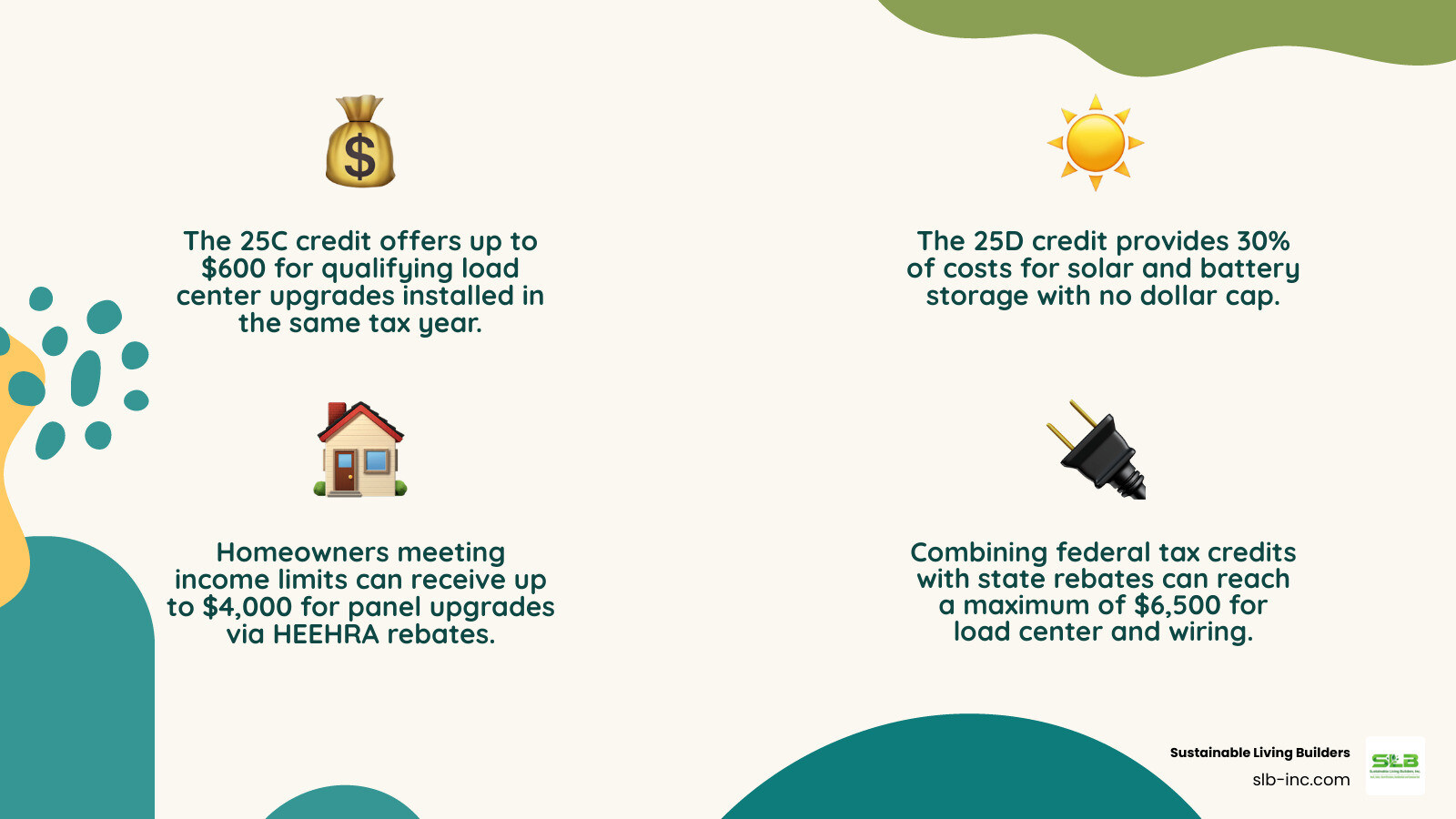
SPAN Panel Tax Credits and Rebates at a Glance
| Incentive | Program | Max Amount |
|---|---|---|
| Federal load center credit | 25C Energy Efficient Home Improvement Credit | $600 |
| Federal solar/storage credit | 25D Residential Clean Energy Credit | 30% of costs (uncapped) |
| Panel upgrade rebate (low/moderate income) | HEEHRA / HEAR Program | $4,000 |
| Electrical wiring rebate (low/moderate income) | HEEHRA / HEAR Program | $2,500 |
| Combined load center + wiring (low/moderate income) | HEEHRA total | $6,500 |
For homeowners focused on cutting energy bills and reducing their carbon footprint, the SPAN Panel has become one of the most incentive-rich home upgrades available today. It qualifies as an upgraded load center under federal law, meaning it can unlock credits under multiple programs depending on how and when it is installed.
The key is knowing which credits apply to your situation — and how to stack them legally to maximize your savings. This guide walks you through exactly that.
Span panel tax credits available terms explained:
- battery storage rebates and incentives in california
- federal solar investment tax credit for homeowners
- inflation reduction act benefits for california homeowners
Understanding the Federal Span Panel Tax Credits Available
When the federal government passed the Inflation Reduction Act, it committed billions of dollars to accelerate home electrification. Because traditional electrical panels were never designed to handle the combined load of modern electric vehicles, heat pumps, solar systems, and home battery storage, the legislation specifically carved out incentives for panelboard upgrades.
This is where the span panel tax credits available under Section 25C of the Internal Revenue Code come into play. The 25C Energy Efficient Home Improvement Credit allows homeowners to claim a tax credit for upgrading their electrical panelboards, sub-panelboards, branch circuits, or feeders.
An advanced system like the Span Panel is much more than a standard metal box with analog breakers. It is an intelligent energy management system that provides real-time monitoring and control over every circuit in your home. Under the 25C framework, this qualifies as a smart load center upgrade, giving homeowners in the North Bay area a direct path to tax savings.
How to Claim the 25C Span Panel Tax Credits Available
The 25C tax credit allows you to claim 30% of the total installation costs for a qualified load center upgrade, up to an annual maximum cap of $600.
Because this is an annual tax credit rather than a lifetime limit, homeowners can strategically plan their upgrades. Under the broader rules of the 25C program, there is an overall annual limit of $3,200 for home efficiency improvements. This is split into different categories, such as:
- Up to $1,200 annually for home envelope improvements (like insulation and windows) plus standard electrical panel upgrades.
- Up to $2,000 annually for qualified heat pumps and heat pump water heaters.
By understanding how these limits interact, you can coordinate your smart panel installation with other energy upgrades to maximize your write-offs. To learn more about how these annual caps work in tandem, check out our guide on State And Federal Incentives For Your Electric Home Upgrade.
Requirements for the 25C Load Center Credit
To successfully claim the 25C credit for a smart panel, the IRS enforces a strict “enabling property” requirement. This means the panel upgrade must be installed in conjunction with, and to enable, another qualified energy efficiency improvement or qualified energy property.
Eligible enabling projects include:
- Electric heat pump space heaters
- Electric heat pump water heaters
- Central air conditioning systems
- Biomass stoves or boilers
Additionally, the electrical upgrade and the energy-efficient equipment it supports must be installed within the same tax year. For example, if you install a new heat pump in your Santa Rosa home, upgrading to a smart panel in the same calendar year allows you to write off 30% of the panel project costs (capped at $600) on top of the heat pump tax credit.
Combining SPAN Panels with Solar, Storage, and State Rebates
While the 25C credit is capped at $600, there is another federal pathway that offers even larger savings without any annual caps: the Section 25D Residential Clean Energy Credit. This program—commonly known as the federal solar Investment Tax Credit (ITC)—offers an uncapped 30% tax credit on qualified clean energy equipment.
If you are planning to install solar panels or a home battery system, pairing them with a smart panel can unlock substantial savings. By integrating these systems, your smart panel can qualify for the full, uncapped 30% tax credit under Section 25D because it acts as an essential microgrid interconnection device that manages the clean energy flow.
To understand how these components communicate with each other, read our guide on How To Integrate Solar Batteries And Span Panels For A Smarter Home.
Maximizing Your Savings with All Span Panel Tax Credits Available
When you install a smart panel as part of a solar or battery storage project, the equipment and its installation are treated as part of the clean energy system. Under the 25D guidelines, battery storage technology (with a capacity of 3 kilowatt-hours or greater) qualifies for the 30% credit even if it is not paired with solar.
Because a smart panel optimizes and extends battery backup life during power outages by up to 40% through automatic load shedding, it is considered integral to the battery storage system. This allows you to apply the uncapped 30% tax credit to the smart panel portion of the project.
For more details on navigating these rules, see our resources on How To Make The Irs Pay For Your Home Battery and Uncle Sam Wants You To Go Solar For Less.
HEEHRA Upfront Discounts for Load Centers and Wiring
In addition to federal tax credits, the High-Efficiency Electric Home Rebate Act (HEEHRA)—administered in California under the Home Electrification and Appliance Rebates (HEAR) program—provides substantial upfront discounts for low- and moderate-income households.
HEEHRA targets the physical infrastructure of your home, offering:
- Up to $4,000 in point-of-sale rebates for electrical panel upgrades.
- Up to $2,500 in point-of-sale rebates for qualifying electrical wiring upgrades.
Because a smart panel upgrade typically requires updated branch wiring to support new smart circuits, eligible households in Sonoma, Marin, or Napa County can potentially stack these two rebates for a combined total of up to $6,500 in upfront savings. You can explore how these programs apply locally in our guide to Maximize Your California Solar And Roofing Savings Today.
State-Level Incentives and Income Limits
HEEHRA rebates are structured around your local Area Median Income (AMI). Here is how the income limits break down for households in locations like Sebastopol, San Rafael, or Napa:
- Low-Income Households (Under 80% of AMI): Eligible for 100% of the project costs, up to the maximum rebate caps ($4,000 for the panel and $2,500 for wiring).
- Moderate-Income Households (80% to 150% of AMI): Eligible for up to 50% of the project costs, up to the same caps.
- Above 150% of AMI: Not eligible for HEEHRA rebates, but still fully eligible for the federal 25C and 25D tax credits.
To find out where your household falls on the local AMI index and how to prepare your applications, consult the California Homeowners Guide To Inflation Reduction Act Savings.
Avoiding Costly Utility Service Upgrades
One of the most valuable hidden savings of installing a smart panel is its ability to perform intelligent load management.
In many older homes across Marin and Sonoma counties, upgrading to modern electric appliances (like an EV charger, a heat pump, and an induction cooktop) would normally require upgrading the physical utility service line from 100 amps to 200 amps. These utility-side service upgrades can be incredibly slow and expensive.
Because a smart panel continuously monitors and dynamically balances your home’s electrical load, it can safely prevent your home from exceeding its physical electrical capacity. This allows you to add high-power appliances without needing a costly utility service upgrade. To see how this system tracks your home’s electrical demand in real time, check out How Can A Span Panel Help Monitor Electricity Usage.
How to File and Claim Your Smart Panel Tax Credits
Claiming your span panel tax credits available requires proper documentation and filing procedures when you submit your annual tax return. You will need to file IRS Form 5695 (Residential Energy Credits) along with your standard Form 1040.
Before you file, ensure you have an itemized invoice from your installer. The invoice must clearly separate the cost of the smart panel hardware and the labor required to install it from other unrelated home improvement work. It must also list the installation date, as the credit can only be claimed for the tax year in which the installation was completed.
IRS Form 5695 Line 25 Instructions
To claim the 25C tax credit for your smart panel upgrade, you must navigate to Part II of IRS Form 5695:
- Line 25a: Confirm that the electrical panel upgrade was installed to enable qualifying energy-efficient property.
- Line 25b: Enter the corresponding code for the qualified equipment that the panel upgrade enabled (for example, entering Code “E” for a qualifying heat pump).
- Line 25c: Enter the total cost of the panel upgrade and installation.
- Line 25d: Enter the Qualified Product Manufacturer ID (QMID) of the enabled equipment (such as the heat pump or water heater), rather than the smart panel itself.
- Line 25e: Calculate 30% of the cost entered on Line 25c, keeping in mind that this specific credit is capped at a maximum of $600.
SPAN QMID Code L1H7 and Manufacturer Certification
The SPAN Panel has a designated Qualified Manufacturer ID (QMID) code of L1H7. SPAN is officially recognized as a Qualified Manufacturer by the IRS, having achieved UL 3141 Power Control Systems certification.
This certification verifies that the panel’s smart energy management software meets the rigorous safety standards required to manage home energy loads dynamically. While you enter the QMID of the enabled appliance on Line 25d, keeping SPAN’s manufacturer certification on file with your tax records is highly recommended in case of an IRS audit.
Frequently Asked Questions About SPAN Panel Incentives
Does the SPAN Panel qualify for the 25C tax credit on its own?
No. To qualify for the 25C Energy Efficient Home Improvement Credit, the smart panel must be installed in the same tax year as a qualifying piece of energy-efficient equipment (such as a heat pump or heat pump water heater) that it directly enables. It does not qualify for the 25C credit as a standalone aesthetic or general home improvement upgrade.
Can I combine HEEHRA rebates with federal tax credits?
Yes, you can stack these incentives, but you must adjust your calculations. If you receive an upfront HEEHRA rebate that reduces the out-of-pocket cost of your panel upgrade, you must subtract the rebate amount from the total project cost before calculating your 30% federal tax credit. You cannot claim a tax credit on costs that were already covered by a government rebate.
What is the maximum incentive amount I can receive?
The maximum incentive depends on your household income and project scope. For a standard 25C tax credit, the limit is $600. If you qualify for HEEHRA, you can receive up to $6,500 in upfront rebates for the panel and wiring. If you install the smart panel alongside a solar-plus-storage system, you can claim an uncapped 30% federal tax credit under Section 25D.
Conclusion
Upgrading to a smart electrical panel is one of the most effective ways to future-proof your home, reduce your energy bills, and transition to a cleaner lifestyle. By taking advantage of the federal span panel tax credits available in 2026, along with regional California rebates, you can make this smart home upgrade highly cost-effective.
At Sustainable Living Builders, we specialize in providing holistic, eco-friendly home energy solutions to homeowners across Santa Rosa, Sebastopol, Sonoma County, Marin County, and Napa County. If you are ready to optimize your home’s energy efficiency with a smart load center, solar, or battery storage, our team is here to guide you through every step of the process.
Claim your home energy incentives today by reaching out to our team of local home electrification experts for a personalized consultation.