What Solar Panels Actually Save on Energy Bills — And Why It Matters in 2026
How much do solar panels save on energy bills? For most U.S. homeowners, the answer is significant: anywhere from $100 to $150 per month on average, adding up to tens of thousands of dollars over the life of the system.
Here’s a quick snapshot of what typical solar savings look like:
| Timeframe | Average U.S. Savings |
|---|---|
| Per month | $100 – $150 |
| Per year | ~$1,500 |
| Over 25 years | $37,000 – $154,000 |
Your actual savings depend on where you live, how much electricity you use, and how your system is set up — but for the vast majority of homeowners, solar delivers real, measurable relief on monthly bills.
And the timing matters. U.S. electricity rates have climbed roughly 32% over the past decade, with no sign of slowing down. Every year you delay going solar is another year you pay those rising rates in full. Solar panels don’t just cut your bill today — they lock in lower energy costs before rates climb even higher.
For homeowners in California and the North Bay region, the case is especially strong. California has some of the highest electricity rates in the country, which means solar systems here generate some of the largest savings anywhere in the U.S. — with some homeowners saving well over $100,000 across a 25-year period.
Whether you’re curious about monthly savings, long-term return, or how storage and incentives change the equation, this guide breaks it all down clearly.
How Much Do Solar Panels Save on Energy Bills on Average?

When we talk about shifting to clean energy, the immediate question we always hear is: “What does this actually do for my wallet?”
On average, a standard residential solar system can reduce a household’s electricity costs significantly, often cutting utility bills by 50% to 100% depending on the system size and the household’s consumption patterns. In high-rate areas like Sonoma County, Santa Rosa, and Marin County, where utility rates are substantially higher than the national average, those percentage cuts translate into massive dollar-for-dollar relief.
By generating your own power right on your roof, you dramatically reduce the amount of electricity you need to buy from the grid. This simple shift is one of the most effective ways to lower your monthly overhead. If you’re wondering how this transition impacts your home beyond the bills, check out our guide on the 4 Benefits of Home Solar: Why You Should Make the Switch.
Calculating Your Monthly Bill Reductions
To understand how much do solar panels save on energy bills for your specific home, we have to look at your baseline energy consumption and local utility rules.
Your monthly savings are determined by a simple equation:
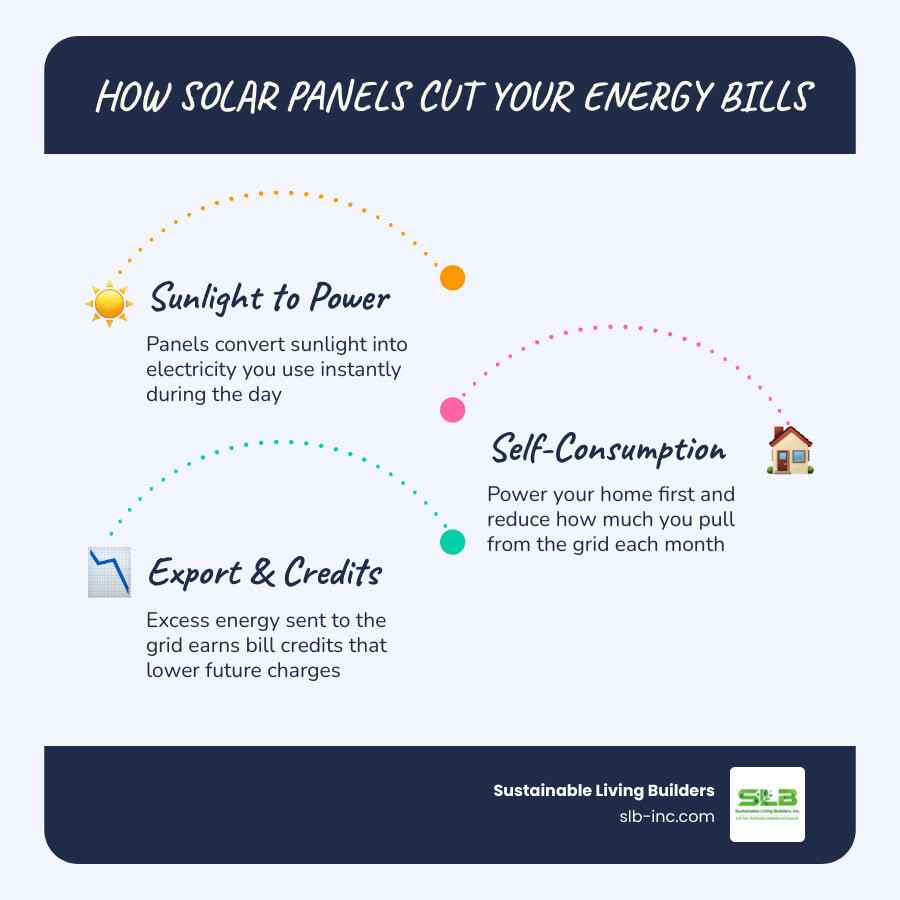
- Your Total Generation: How much electricity your solar array produces during the day.
- Your Direct Self-Consumption: The solar power you use immediately as it is generated (running your refrigerator, AC, or washing machine).
- Net Metering or Net Billing Credits: The value of the excess electricity your system sends back to the local grid.
In our local North Bay service areas, PG&E operates under California’s Net Billing Tariff (NEM 3.0). Under this system, the utility credits you for the excess electricity you export to the grid, though the rates vary depending on the time of day. To maximize these monthly bill reductions, aligning your energy use with peak production hours or utilizing a home battery is key. To explore how local utility structures and regional programs can work in your favor, take a look at how to Save Big with Sonoma and PG&E Energy Programs.
Long-Term 25-Year Savings Potential
While monthly savings are great for your day-to-day budget, the true power of solar lies in its long-term compounding value. Think of solar not as an ongoing expense, but as a low-risk investment that pays consistent dividends.
Over a standard 25-year lifespan—which is the typical warranty period for modern high-quality solar panels—an average California homeowner can save up to $154,000. Why are these lifetime savings so high? It comes down to utility inflation. Historically, national electricity costs have increased by about 2.8% to 3.5% every single year. In California, rate hikes have frequently exceeded these national averages.
When you install a solar system, you are essentially locking in your electricity costs. While your neighbors watch their utility bills climb year after year, your cost of power remains flat. This protection against inflation is why solar outpaces many traditional low-risk investments. For a deeper dive into the return on investment and how these long-term numbers stack up, read our comprehensive analysis: Are Solar Panels Worth It?.
Harnessing Solar Power for Daily Savings
Every morning when the sun rises over the Napa and Sonoma hills, your solar panels quietly go to work. This daytime generation is the foundation of your daily savings.
By utilizing appliances during peak daylight hours—such as running your pool pump, dishwasher, or electric vehicle charger between 10 AM and 3 PM—you practice direct self-consumption. This is the most financially efficient way to use solar energy because you avoid purchasing power from the grid entirely during those hours.
This direct path to grid independence means you rely less on external energy providers and protect your household from unpredictable grid failures and peak pricing structures. To understand the mechanics of this process and how daylight turns into direct household savings, read more about how to Harness the Power of the Sun: What Solar Energy Can Do for Your Home.
Key Factors That Influence Your Solar Energy Savings
Not every roof generates the exact same amount of savings. To get an accurate estimate of how much do solar panels save on energy bills, we look at several physical and environmental variables:
- Roof Orientation and Tilt: In the Northern Hemisphere, south-facing roofs receive the most consistent sunlight throughout the day. West-facing roofs are also highly valuable because they capture the late afternoon sun, which aligns perfectly with peak utility pricing hours.
- Shading and Obstructions: Trees, chimneys, and nearby buildings that cast shadows on your roof can reduce your system’s overall output. Even partial shading on a single panel can impact the efficiency of the entire string if not designed correctly with microinverters.
- System Sizing: Your system should be custom-designed to match your household’s annual electricity usage. Sizing a system to offset 80% to 100% of your consumption typically yields the best financial return.
- Local Sun Hours: Fortunately, our North Bay locations—from Sebastopol to Napa—enjoy abundant sunshine, making our region ideal for high-yield solar production.
Understanding these variables ensures your system is optimized from day one. If you want to know exactly what to expect during the planning phase, we explain it step-by-step in Solar Energy Made Simple: Understanding the Installation Process.
How Location and Local Utility Rates Impact Savings
Your geographic location dictates two things: how much sun your panels get, and how much your utility company charges you for power.
In California, high utility rates mean that every kilowatt-hour (kWh) of solar electricity you generate is worth substantially more than it would be in a state with cheap, coal-heavy power. For instance, while a homeowner in a state with low electricity rates might save a modest amount over 25 years, a homeowner in Santa Rosa or Marin County can save triple or quadruple that amount simply because they are offsetting highly expensive PG&E grid power.
These local dynamics make our region one of the most financially rewarding places in the country to transition to solar. To see how state-level policies and regional factors boost your financial return, check out our California Homeowners Guide to Inflation Reduction Act Savings.
Maximizing Savings by Combining Roof Upgrades and Solar
If your roof is nearing the end of its natural lifespan, installing solar panels on top of it can lead to complications later on. Removing and reinstalling solar panels to replace a roof down the road adds unnecessary labor costs.
That is why we often recommend combining a roof replacement with your solar installation. By doing both projects at the same time, you streamline the permitting, scheduling, and labor. Even better, you can often integrate modern, sleek solar roofing solutions—like GAF Timberline Solar shingles—which serve as both your protective roof water-barrier and your solar generator.
Combining these projects also allows you to maximize your financing efficiency and potentially leverage tax incentives across the combined project scope. Learn how to optimize this process in our guide: How to Save Big by Combining Your Roof Replacement and Solar Install.
The Financial Impact of Adding Battery Storage
In the current solar landscape of 2026, pairing your solar panels with a home battery storage system is no longer just an optional luxury—it is often the key to unlocking maximum savings.
With modern utility billing structures like NEM 3.0 in California, the rates paid for exporting solar energy back to the grid during the middle of the day have been reduced. However, electricity rates during the evening peak hours remain incredibly high.
A home battery acts as your personal energy vault. Instead of exporting your excess daytime solar power to the utility company for a lower credit, you store it in your battery. Then, when the sun goes down and utility rates skyrocket, your home automatically switches to battery power. This process, known as “time-of-use arbitrage,” can significantly increase your self-consumption rate and keep your monthly bills as low as possible.
Beyond the clear financial benefits, battery storage provides priceless peace of mind by offering seamless backup power during local grid outages and wildfire safety shutoffs. If you are wondering about the financial viability of adding storage, you might be surprised to learn how tax incentives apply. Check out our guide on How to Make the IRS Pay for Your Home Battery.
How Batteries and Panels Work Together to Lower Bills
When solar panels and battery storage systems operate in tandem, they create a highly efficient, closed-loop energy ecosystem for your home:
- Morning to Afternoon: Your solar panels power your home’s immediate needs. Any extra energy generated is automatically directed to charge your home battery.
- Late Afternoon to Evening: Once the battery is fully charged, any additional excess energy is exported to the grid for credits. When the sun sets and utility rates peak, your home draws seamlessly from the stored battery power, avoiding expensive peak-hour grid rates.
- Nighttime: Your home continues to run on clean battery power. If the battery runs low, you draw minimal, off-peak power from the grid.
This daily cycle drastically reduces your dependence on the grid and protects your budget from sudden rate hikes. To explore the local programs, rebates, and state-level incentives available for these advanced systems, read about the State and Federal Incentives for Your Electric Home Upgrade.
Incentives, Net Metering, and Financing Options in 2026
Navigating the financial landscape of solar in 2026 requires understanding the tools available to lower your net investment and accelerate your payback period. While financing structures like solar loans, home equity lines of credit (HELOC), and cash purchases each have unique benefits, they are all supported by state and federal programs designed to make clean energy highly accessible.
To see how federal programs can directly lower your transition costs, take a look at our article: Uncle Sam Wants You to Go Solar for Less.
To help visualize how system configuration impacts your long-term financial return, consider the differences in savings structures below:
| Feature | Solar-Only System (Standard Net Billing) | Solar + Battery Storage System |
|---|---|---|
| Primary Savings Source | Direct daytime self-consumption & grid export credits | Time-of-use arbitrage & high evening self-consumption |
| Grid Dependability | High dependency during non-sunlight hours | Low dependency; highly self-sufficient |
| Outage Resilience | System shuts down during blackouts for safety | Seamless backup power to keep essential appliances running |
| Long-Term Savings Yield | Moderate (subject to utility export rate changes) | Maximum (optimizes every kWh generated) |
Understanding Net Metering and Grid Export Credits
Net metering (and its modern evolution, net billing) is the billing mechanism that credits solar energy system owners for the electricity they add to the grid.
During the sunniest parts of the day, your solar panels will often produce more electricity than your home actually consumes. Under net billing rules, this surplus energy is sent back through your smart meter to the local grid, and your utility account receives credits that offset the cost of the electricity you pull from the grid at night.
Even though California’s transition to NEM 3.0 has reduced the export value of daytime solar, these credits still play an important role in balancing your seasonal energy costs—allowing you to bank credits during the high-production summer months to offset higher usage during the winter.
Are Solar Upgrades Still Viable Without the Federal Tax Credit?
A common question homeowners ask in 2026 is whether solar remains a viable investment if they missed out on previous federal tax structures or if local incentive landscapes shift.
The short answer is: absolutely. While federal tax credits have historically provided a major boost, the long-term return on investment for solar is primarily driven by the avoided cost of highly expensive utility power. Because PG&E rates continue to rise, the financial penalty of doing nothing and relying solely on the grid increases every year.
Furthermore, local rebates, state-level incentive programs, and property tax exemptions for solar installations remain highly active in California, ensuring that going solar continues to deliver an annual return on investment that consistently outperforms traditional market investments.
Frequently Asked Questions About Solar Savings
How much do solar panels save on energy bills during winter or cloudy days?
While solar panels perform best under direct, clear sunlight, they still generate electricity on cloudy, overcast, or rainy days by utilizing diffuse light. During the winter months, shorter daylight hours and lower sun angles naturally reduce overall production. However, because solar savings are calculated on an annual basis, the massive surplus of energy and credits you generate during the long, sunny summer months in the North Bay helps offset your winter energy bills.
What is the typical payback period for a residential solar system?
For most homeowners in Sonoma, Marin, and Napa counties, the payback period—the time it takes for your cumulative monthly bill savings to equal your net investment—typically ranges between 6 to 10 years. Because local electricity rates are among the highest in the nation, North Bay homeowners often reach their break-even point much faster than the national average. Once you clear this threshold, every dollar saved is pure financial return for the remaining 20+ year lifespan of your system.
When are solar panels not worth the investment for a homeowner?
Solar might not be a sound financial investment if your roof experiences severe, unresolvable shading from protected trees or surrounding structures that cannot be cleared. Additionally, if your current monthly electricity bills are already exceptionally low (e.g., under $50 to $70 a month), or if you plan on moving out of your home within the next two to three years, you may not stay in the property long enough to fully realize the return on investment. Finally, if your roof is structurally compromised and requires replacement, solar should not be installed until the underlying roof structure is upgraded.
Conclusion
At the end of the day, understanding how much do solar panels save on energy bills reveals a simple truth: solar is one of the few home improvements that actively pays you back. By transitioning to clean energy, you aren’t just doing your part for the environment—you are taking control of your monthly expenses, building long-term home equity, and insulating your household budget from unpredictable utility rate hikes.
If you are ready to stop renting your power from the utility company and start owning your energy future, we are here to help. Our team specializes in designing holistic, sustainable solutions tailored to the unique climate and architectural styles of Santa Rosa, Sebastopol, and the surrounding North Bay counties.
To explore how solar can transform your home’s energy footprint and to get a precise estimate tailored to your roof, visit our Sustainable Living Builders solar solutions page today. Let’s build a brighter, more sustainable future together!