What Homeowners Need to Know About the Federal Solar Tax Credit Right Now
The federal solar tax credit explained for homeowners comes down to one core idea: the U.S. government lets you subtract a percentage of your solar installation costs directly from what you owe in federal income taxes. As of July 2026, this credit has recently changed in a significant way that every homeowner considering solar needs to understand before making any decisions.
Here is a quick breakdown of the key facts:
- What it is: A nonrefundable tax credit equal to 30% of the cost of a qualifying solar energy system
- Who qualifies: Homeowners who own (not lease) a solar system installed on their primary or secondary U.S. residence
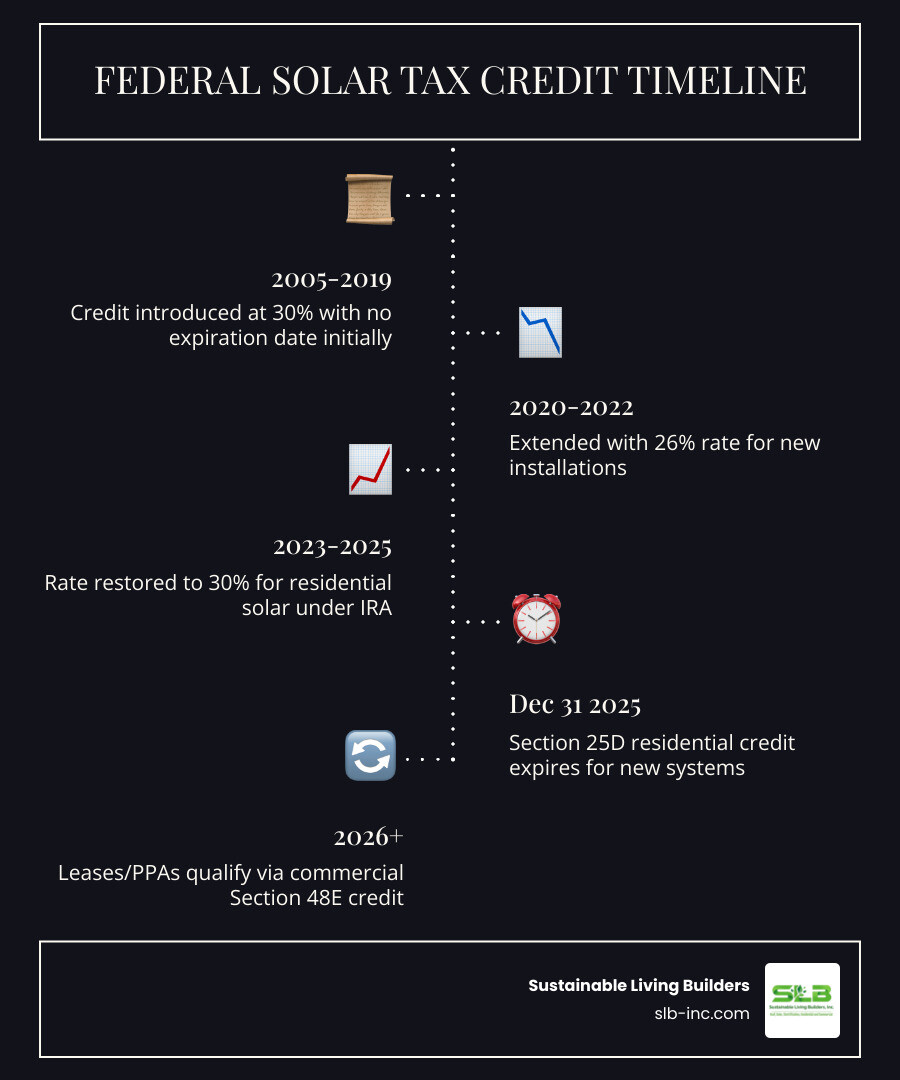
- 2025 deadline: The residential credit (Section 25D) expired on December 31, 2025 for new installations
- If you installed in 2025: You can still claim the 30% credit on your 2025 tax return using IRS Form 5695
- If you’re installing in 2026: Customer-owned systems no longer qualify for the federal residential credit — but solar leases and power purchase agreements (PPAs) offer an indirect path to federal savings through the commercial Section 48E credit
- Carryforward rule: If the credit is larger than your tax bill, the unused amount rolls over to future tax years
- No income limits: There are no income caps or phase-outs for this credit
Even without the federal credit for new 2026 installations, solar still makes strong financial sense. Electricity rates have risen 32% over the past decade, and homeowners typically save tens of thousands of dollars over the life of a solar system. State incentives, utility rebates, and net metering programs remain available in many areas and can meaningfully offset installation costs.
This guide walks you through everything you need to know — how the credit worked, who could claim it, what expenses qualify, how to file if you installed in 2025, and what options remain if you’re going solar today.
What Is the Residential Clean Energy Credit?
To understand how the federal solar tax credit explained for homeowners works, we first have to look at its official name: the Residential Clean Energy Credit. Established under Section 25D of the Internal Revenue Code, this tax incentive was designed to encourage homeowners across the United States to adopt renewable energy technologies like solar photovoltaics (PV), wind turbines, geothermal heat pumps, fuel cells, and battery storage.
Unlike a tax deduction—which simply reduces the amount of your income subject to income tax—a tax credit is a dollar-for-dollar reduction of your actual tax liability. If you owe a specific amount in federal taxes and have a tax credit, your tax bill is reduced directly by the value of that credit.
However, the Residential Clean Energy Credit is nonrefundable. This means that if your tax credit is larger than your total federal tax liability for the year, the IRS will not write you a check for the difference. Instead, the IRS allows you to carry forward the unused portion of your credit to the following tax year. This carryforward rule ensures that even if you don’t have a massive tax bill in a single year, you can still eventually realize the full financial benefit of your investment.
For many years, this incentive has been the single most powerful tool for lowering the net cost of clean energy. If you want to dive deeper into the history of these incentives and how they have shaped home energy, check out our guide on how Uncle Sam Wants You to Go Solar for Less.
The Federal Solar Tax Credit Explained for Homeowners in 2026
The landscape of solar incentives shifted dramatically as we entered 2026. Under the original schedule established by the Inflation Reduction Act (IRA) of 2022, the 30% residential tax credit was supposed to remain active through 2032. However, the passage of the One Big Beautiful Bill Act (OBBBA) repealed that timeline and accelerated the expiration date.
As a result, the Section 25D residential clean energy credit officially expired on December 31, 2025, for customer-owned systems.
This change introduces a strict “Installation Completed” rule. The IRS determines the tax year of your clean energy expenditure based on when the physical installation of the system was completed and placed in service, not when you signed the contract or paid your deposit. If your solar panels were fully installed and operational on or before December 31, 2025, you are fully eligible to claim the 30% credit on your 2025 tax return. However, if your installation was completed on or after January 1, 2026, you cannot claim the residential tax credit as an owner.
This leaves 2026 homeowners with two primary paths forward: purchasing a system without the federal credit while relying on state and local incentives, or choosing a third-party ownership model like a solar lease or Power Purchase Agreement (PPA). Under a third-party model, the commercial developer owns the system and can still claim the Section 48E commercial clean energy credit, passing those federal savings down to you in the form of lower monthly utility rates.
To help you navigate these options, here is a comparison of how customer-owned and third-party owned solar models look under the current 2026 rules:
| Feature | Customer-Owned Solar (Cash/Loan) in 2026 | Third-Party Owned Solar (Lease/PPA) in 2026 |
|---|---|---|
| Federal Tax Credit (Section 25D) | No longer available (expired Dec 31, 2025) | Not directly claimable by the homeowner |
| Commercial Credit (Section 48E) | Not eligible | Claimed by developer; passed down as lower monthly rates |
| System Ownership | Homeowner owns the equipment | Solar developer owns the equipment |
| Maintenance & Repairs | Homeowner’s responsibility | Developer’s responsibility |
| California State Incentives | Fully eligible (SGIP, Net Metering, etc.) | Benefits managed through the lease agreement |
| Long-Term Savings | High (no monthly payments after loan payoff) | Steady and immediate (lower monthly utility bills) |
For a comprehensive look at how these federal policy changes impact local clean energy upgrades, read our California Homeowners Guide to Inflation Reduction Act Savings.
Eligible Equipment and Expenses Under the Credit
If you are filing taxes for a system completed in 2025, or if you are planning an upgrade and want to know exactly what qualified for the historic 30% credit, it is helpful to understand the range of eligible expenses. The federal government did not just cover the cost of the solar panels themselves. The credit applied to the holistic cost of getting the system up and running.
Eligible expenses under the residential credit include:
- Solar PV panels or cells used to generate electricity.
- Contractor labor costs for onsite preparation, assembly, original installation, and piping or wiring to connect the system to the home.
- Balance-of-system equipment, including inverters, mounting hardware, and system monitoring software.
- Permitting fees, inspection costs, and developer fees directly associated with the installation.
- Sales taxes paid on any of the qualified equipment or labor.
To explore how to design the ideal setup for your home and weigh the benefits of adding storage, see our article on Everything You Need to Know About Choosing Solar Only vs Solar Plus Battery.
How the Federal Solar Tax Credit Explained for Homeowners Applies to Battery Storage
One of the most important updates to the tax code in recent years was the treatment of home battery storage. Previously, a battery storage system only qualified for the federal tax credit if it was charged exclusively by onsite solar panels. However, starting in 2023, standalone battery storage systems with a capacity of 3 kilowatt-hours (kWh) or greater became fully eligible for the 30% tax credit, regardless of whether they were paired with solar panels or charged from the grid.
For homeowners who completed battery installations in 2025, this meant they could claim 30% of the equipment and installation costs. This storage incentive has been incredibly valuable for residents in wildfire-prone areas of Northern California, such as Sonoma, Marin, and Napa counties, where public safety power shutoffs and grid reliability are constant concerns.
If you are interested in how battery storage integration works with federal tax rules, check out our guide on How to Make the IRS Pay for Your Home Battery.
Roofing Upgrades and the Federal Solar Tax Credit Explained for Homeowners
A common question we hear from homeowners in Santa Rosa and Sebastopol is whether they can claim the solar tax credit for a new roof. The short answer is: traditional roofing materials do not qualify. The IRS is very clear that structural components—such as standard shingles, metal roofing, tiles, or roof trusses—are not eligible for the solar tax credit, even if they are installed to support a new solar array.
However, there is an exception for solar shingles and solar tiles. Because these materials serve a dual purpose—acting as a durable roof barrier while actively generating clean electricity—they are considered qualified solar property.
For homeowners who need both a new roof and a solar installation, bundling these projects is still a highly efficient strategy. While you cannot claim the federal tax credit on the standard roofing portion, bundling saves you money on labor, permits, and scaffolding, while ensuring your roof warranty matches your solar lifespan.
Learn more about these strategies in our article on 5 Ways Bundling Your Roof and Solar Saves You Serious Cash.
How to Claim the Solar Tax Credit for 2025 Installations
If your solar energy or battery storage system was completed on or before December 31, 2025, you can claim your 30% credit when filing your taxes. To do so, you will need to gather your records and complete the appropriate IRS forms.
Here is the step-by-step process:
- Gather Your Documentation: Collect all purchase agreements, final installation invoices, building permits, and utility connection approvals that prove your system was completed and placed in service in 2025.
- Complete IRS Form 5695: Fill out Part I of IRS Form 5695 (Residential Energy Credits). This is where you will calculate your total qualified solar and battery storage expenses and apply the 30% rate to determine your credit amount.
- Transfer the Credit to Form 1040: Once you have calculated your allowable credit on Form 5695, transfer that figure to Schedule 3 (Nonrefundable Credits) of IRS Form 1040, specifically on Line 5a.
- File Your Return: Submit Form 5695 and Schedule 3 along with your standard Form 1040.
Always consult a certified public accountant or licensed tax professional to ensure you meet all IRS guidelines and maximize your return. For more information on navigating these filings alongside other home electrification credits, see our guide on State and Federal Incentives for Your Electric Home Upgrade.
Combining Federal Incentives with State and Utility Programs
While the expiration of the federal residential tax credit for 2026 customer-owned systems changes the financial math, it does not mean your savings are gone. In California, homeowners can stack multiple local incentives to significantly lower the cost of going solar.
The golden rule of combining incentives is understanding how they impact your “tax basis.” If you receive a cash rebate from your utility company (such as PG&E), the IRS requires you to subtract that rebate from your total system cost before calculating any applicable tax credits. However, state-level tax credits and state government rebates generally do not reduce your federal tax basis, though they can occasionally influence your federal taxable income.
In Sonoma County, Marin County, and Napa County, homeowners can take advantage of several excellent programs:
- Net Energy Metering (NEM 3.0): While the export rates under NEM 3.0 are lower than previous versions, pairing solar with battery storage allows you to store your own power and avoid purchasing expensive peak-hour electricity from PG&E.
- Self-Generation Incentive Program (SGIP): This California program provides substantial rebates for installing home battery storage systems, with higher rebates available for homes in high-threat fire districts or low-income communities.
- Local Utility Incentives: Community choice aggregators like Sonoma Clean Power offer localized programs and rates designed to make home electrification more affordable.
To see how these programs work together to protect your wallet, read about How Solar Incentives in California Can Help You to Save and learn how to Save Big with Sonoma and PGE Energy Programs.
Frequently Asked Questions About Solar Incentives
Navigating tax laws can be complicated. Here are answers to some of the most common questions homeowners ask us about solar incentives in 2026.
Can I still benefit from federal incentives if I lease my solar panels in 2026?
Yes, absolutely! While you cannot directly claim the Section 25D residential credit on your personal tax return for a leased system, the leasing company or PPA provider can claim the commercial Section 48E credit. Because the developer receives this 30% federal incentive, they are able to pass those savings on to you in the form of lower monthly payments and zero upfront installation costs. This remains the most popular way to capture federal solar value in 2026.
What happens if my solar tax credit is larger than my tax bill?
Because the federal solar tax credit is nonrefundable, it cannot reduce your tax liability below zero to give you a cash refund. However, any unused portion of the credit rolls over automatically to the next tax year. You can continue carrying the credit forward to offset your federal taxes in future years for as long as the credit program remains active.
Does the federal solar tax credit apply to second homes?
Yes. The federal credit can be claimed for qualified clean energy equipment installed on any residence located in the United States that you use as a home. This includes your primary residence and any secondary residences (such as a vacation home) that you live in for part of the year. However, you cannot claim the residential credit for rental properties where you act as a landlord and do not personally reside.
Conclusion
Navigating the transition of solar incentives in 2026 might feel overwhelming, but you do not have to figure it out alone. At Sustainable Living Builders, we provide holistic, sustainable solutions that reduce your energy costs and carbon footprint. Whether you want to explore third-party solar leases to capture federal commercial incentives, upgrade your roof, or install a smart home battery system to protect your home from PG&E power outages, we are here to help.
We proudly serve homeowners in Santa Rosa, Sebastopol, Sonoma County, Marin County, and Napa County. Ready to see how much you can save? Use our Smart Roof Calculator and get expert advice tailored to your home by visiting our Sustainable Living Builders Solar Services page today!